

Masterminds and American Honey satirize people and politics.
‘I blame popular culture,” armored-car security guard David Ghantt says to explain his part in a $17 million robbery recounted in the new comedy Masterminds. It’s a good satirical alibi because it lays blame on the process that distracts people from their own feelings, even from their own thoughts. But Masterminds, directed by Jared Hess, needs to go deeper into the tension between the way pop culture betrays its audience by displacing personal needs and then indoctrinating greed and restlessness. Ghantt pleads, “All I wanted was adventure,” but his self-betrayal began when his flirtatious female co-worker Kelly (Kristen Wiig) paid him a compliment and Ghantt looked back at her with wild-eyed excitement.
“You smile like hell,” Ghantt is told, and, indeed, that turd-smacking, please-make-a-fool-of-me grin is the best acting ever from comedian Zach Galifianakis, who has recently become one of the most annoying presences in popular culture. (Aside from routinely portraying buffoons in such noxious franchises as the Hangover movies, he also hosts the Funny or Die podcasts that have become a comic publicity wing for the Obama administration.) Ghantt’s naïveté is a gift to Galifianakis; the role is like the innocent fools Hess innovated in his previous films Napoleon Dynamite, Nacho Libre, and Gentlemen Broncos. Galifianakis doesn’t quite affect the beatific makeover that Jack Black, a similarly rotund and aggressive comic, achieved as the American-born friar working at a Mexican orphanage in Nacho Libre, and that’s probably because the crime plot of Masterminds proves to be an unwieldly trap for Hess’s beneficence.
Another trap is cynicism. Masterminds announces Hess’s collaboration with the wags at Saturday Night Live (Lorne Michaels co-produced the film, and a team of TV Hess clones wrote the script). Blaming pop culture by carelessly spoofing it — such as in Ghantt’s anachronistic addiction to spy flicks — makes for easy targeting in SNL’s typical mode. Ghantt’s movie-love has little basis in the life he’s made for himself, as in his engagement to a strangely self-involved store clerk, Jandice (Kate McKinnon, condescending to her character to a horrible degree).
Most contemporary pop culture is certainly hollow but people have shown themselves capable of making more out of it by investing genuine, unassailable emotion and converting pop junk to practical use. That fact is what made the school election and especially the dance contest in Napoleon Dynamite so elating. (Those “Vote for Pedro” T-shirts worn by Napoleon Dynamite fans nationwide recall a now-lost political goodness.) Masterminds has nothing comparable until the end credits blast “I Fought the Law (and the Law Won)” — an all-American original remade by the Clash at their strongest. The song confesses Ghantt’s ultimate regret as a part of American folklore.
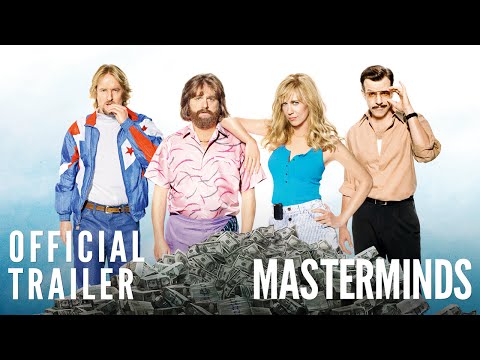
Hess has to work through SNL sarcasm, contrasting cheap ridicule of the Southwestern American characters with his uncommon affection for sometimes off-putting individuality. Kristen Wiig manages heartfelt conflict in brief moments of Kelly’s wrestling with her own selfish duplicity. Leslie Jones’s FBI agent and Ken Marino as a jealous neighbor both get jokes worthy of Hess’s eccentric generosity. But as a redneck con artist who scams Ghannt, Owen Wilson has little to work with besides implying distrust; only his spending spree, scored to the Rare Earth song “Celebrate” — an authentic expression of white working-class joy — capitalizes on Wilson’s visitation from the Wes Anderson universe.) However, Jason Sudeikis conveys Hess’s complexity with the pure lunacy of his gay hitman who senses brotherhood in Ghannt’s dissatisfaction and dumpiness. (“You carry your weight in your chest and your ass.”) It’s uneven, yet a lot funnier than the recent Ghostbusters remake.
The Mormon-raised Hess specializes in American eccentricities and his best movies convey an unexpected spiritual undercurrent — a belief that human foible is part of one’s imperfect struggle toward Christlikeness. His films are not religious allegories but open-hearted visions, testing viewers’ humanity by showing compassion for those who, at the height of American exceptionalism, remain non-celebrities and out of step, like the destitute mentioned in Luke 14:21.
This perspective is far different from most post-indie American movies. Hess’s recent box-office flops may explain why he needed a collaboration with the heartless SNL comics and took on cynical subject matter that seems a mash-up of the Coen Brothers’ Fargo and Michael Bay’s great Pain & Gain. Those films were also loosely fact-based stories of American criminality, but Hess works at wringing out redemptive counterpoint, if not forgiveness, from all examples of treachery. One character, described as having “a keen sense of who doesn’t belong,” defends herself: “Maybe that makes me a snob.” It’s a perfect, odd Hess perception that, ironically, begs for our sympathy. Yet, a snarky retort, “Maybe that makes you a patriot,” is just trite SNL partisanship. Sometimes pop culture does deserve blame.
* * *
American Honey by British filmmaker Andrea Arnold struck me as unbearably phony. She critiques the U.S.A., reducing it to a band of homeless teenagers who travel the Southwest selling fake magazine subscriptions to grotesque suburbanites. From the first scene of biracial, androgynous Star (Sasha Lane) dumpster-diving with her step-siblings, I immediately recalled Mary Ellen Mark’s 1985 Streetwise, another phony attack on American inequality that romanticized reckless adolescents.
Arnold contrives a love story, pairing Star with vagabond Jake (Shia LaBeouf). They complement each other: Her dreads, his thick, braided ponytail; her ragamuffin wardrobe and his self-described “Donald Trump pants” held up by suspenders — supposedly a politically aware meet-cute (to the tune of Rihanna’s “We Found Love”). With its nubile girls and feral boys, American Honey looks like Larry Clark sociological porn — white-trash kids dancing to raunchy hip-hop, drinking, dope-smoking, playing with guns. Each scene is a provocation and an indictment, but the film’s also an offense to the principles of cinéma vérité and social realism.

We are a long way from Robert Frank’s classic 1958 photo-book The Americans with its Jack Kerouac introduction that connected hipster disaffection to social observation. Though different from Jared Hess’s idiosyncratic compassion, The Americans impressed with authentic, verifiable truth. Arnold’s outsider viewpoint is almost a parody of both. Her contrast of wealth and poverty is insulting (the only credible moment: a honky-tonk line dance to “Copperhead Road”).
This is a Borat view of red states — without intentional jokes but drenched in condescension. Star and Jake harass a housewife, who objects, “I have been trying to be Christian but I can see the devil has a hold of you.” Next, they stalk another Christian woman and laugh at her flower-print dress stuck up her posterior. (Jake mocks Star about religion and she launches into a defensive litany of blasphemies.)
Arnold not only has a problem with America and Christianity, but expresses it through specious drama. Her Oliver Twist premise features a female Fagin (Krystal, played by Riley Keough) who mixes phony feminism with dubious politics. Everyone is into exploitation, including Trumpian Jake, who gets used as Krystal’s boy toy. By the time he hooks up with Krystal in her Confederate-flag bikini, American Honey became intolerable.