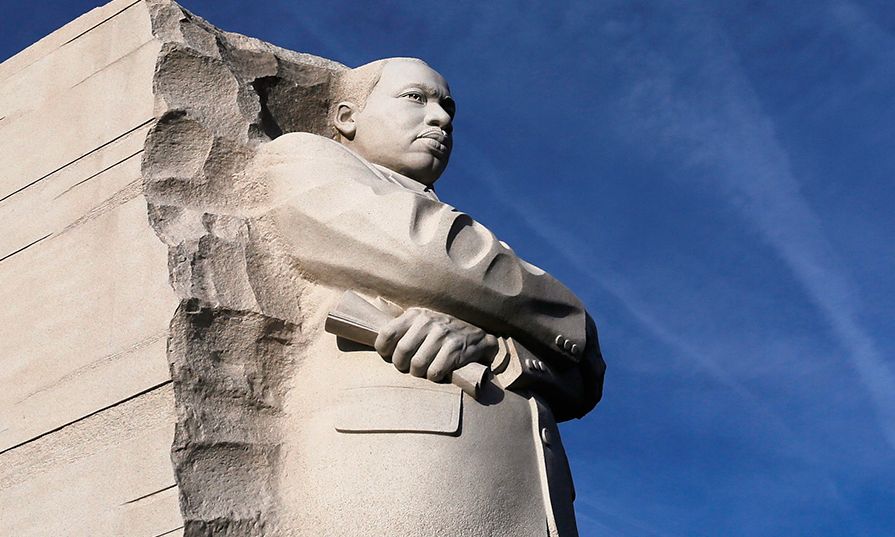
At the conclusion of Barack Obama’s second term, our nation is consumed with poisonous racial discourse. Call it “identity politics,” call it being “woke,” or just call it historical ignorance, it’s the habit of ascribing guilt and moral authority on the basis of race alone. It’s the essence of tribalism. In this world, white Americans are inherently suspect, black Americans are inherently credible, and the pathway to true white “allyship” is by apologizing for sins you did not and do not commit. This is not the world that Martin Luther King Jr. sought to create.
Writing at USA Today, minister and lawyer Oliver Thomas declares that “whites killed MLK” and recites the now-standard indictment of American society. Our nation was achieved “through three centuries of kidnapping, torture, murder, and rape. Broken teeth, broken bones, and broken spirits.” Again and again, as he reflects on American history, he says “whites” did that — that “we,” he and his white readers, are responsible. And what is the proper white response now? How should whites bridge the chasm that “we” created? We could “perform the first and more fundamental act of love. We could listen.”
And if some people denigrate whites as a group, others valorize African Americans. Last Friday, The Nation’s Joan Walsh gained some attention for tweeting this:
Writing in The Nation, she amplified her point and attempted to refute progressives such as David Axelrod who were cautioning Democrats against arguing that Trump was illegitimate:
So I’m going to go with [John] Lewis, [Barbara] Lee, and [Maxine] Waters over David Axelrod on this one. I don’t want to bring race into anything where it doesn’t matter, but I did happen to notice all three leaders are African-American. Maybe that’s a coincidence. Or maybe it means that people who’ve seen the worst of American injustice are trying to warn the rest of us when it’s coming for us again.
This is bizarre. Being black or experiencing racism doesn’t make one better equipped to determine whether specific Trump officials met with Russian intelligence agents in Europe. It doesn’t enable a person to better understand whether Russian propaganda efforts made a decisive difference in Pennsylvania, Michigan, and Wisconsin.
If Martin Luther King Day is to be a time to reflect on the man, his legacy, and the great and broad question of civil rights in America, then it’s time to drop — once and for all — the notion of guilt or innocence, vice or virtue, presumed from the color of one’s skin.
No, “whites” didn’t kill Martin Luther King any more than “whites” commanded the 20th Maine at Gettysburg. “Whites” weren’t responsible for the Dred Scott decision any more than “whites” were responsible for Brown v. Board of Education, or for the Civil Rights Act of 1964. Individual men did those things, and that means that individual men were responsible for their own responses to the challenges of their times.
For white Americans, Martin Luther King Day should be both challenging and inspiring. It is always challenging to be reminded of the evil that men can do, including sometimes the evil of our own ancestors. Yet on examining the broad sweep of history, it’s apparent that white people hardly have a monopoly on evil. Just ask the estimated 20 million Africans kidnapped and captured by other Africans for sale in the slave trade. Just ask the Nigerians who protested its abolition. One of the horrifying facts of slavery is that it was for centuries a cooperative white and black enterprise. One of the exhilarating facts of first abolition and then civil rights was that it was and is a cooperative white and black enterprise.
What we can say is that at a particular time in history, a Christian pastor made a Christian argument that ultimately resonated within American hearts.
It’s a sad reality that race relations are now worse after the two terms of our nation’s first black president. We have white Americans who feel wracked with guilt for actions they don’t take and for racism they don’t possess. Other white Americans are tired of being called racist and privileged when they do their best to be fair to everybody and struggle mightily to put food on their table and keep their own families intact. Sadly, however, the constant cries of racism can blind them to those instances where it truly exists. Then, lurking, are the real racists, like the members of the alt-right who put themselves front and center in the 2016 election and love to inflict pain and misery on their fellow man.
Into this mess steps the moral clarity of King himself. What is so bracing about King’s Letter from a Birmingham Jail is that he gives no man or woman the comfort or condemnation of an identity. He calls out the “white moderate” who urges patience and passivity in the face of persistent injustice. He also warns against the “black nationalist” who has “lost faith in America” and “repudiated Christianity.” His message wasn’t “my people” versus “your people” but instead right versus wrong — justice versus injustice. He makes arguments. He expects action. He longs ultimately not for tribalism but for brotherhood.
On MLK Day, you honor the man himself. You honor his best arguments and his wisest words. You honor the black men and women who stood beside him. But you can also honor the white men and women who played their indispensable roles — men like Joshua Chamberlain at Little Round Top or, a century later, Michael Schwerner at Meridian, Miss. MLK Day is a reminder that the escape from tribalism and white supremacy is a multi-racial enterprise, and its greatest leaders have recognized the enduring power of individual responsibility, not collective guilt.
Had he lived, what would Martin Luther King would have thought of modern identity politics, of the world of “microaggressions” and Black Lives Matter? No one can say. Perhaps he’d be as partisan as John Lewis. Perhaps not. What we can say is that at a particular time in history, a Christian pastor made a Christian argument that ultimately resonated within American hearts.
When it comes to history, there is no “we.” “We” weren’t there. Instead, history teaches us lessons, and history has given us consequences. We seek to learn the lessons and ameliorate the worst consequences. One lesson is that every person of every race bears the burden of moral responsibility. A consequence of our fraught racial history is that we’re often blind to that key lesson. King was not, and that’s why his voice and his arguments indict us still today.



Comments