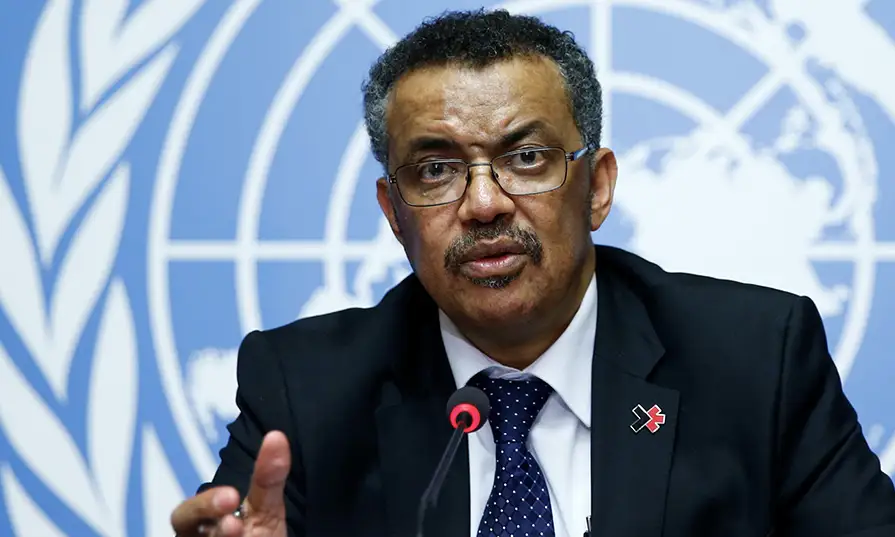
The World Health Organization (WHO), the troubled United Nations health agency, has just elected a controversial new director-general. The choice should disturb taxpayers, members of Congress, and the Trump administration.
We’ll soon hear condemnation of the administration’s plan for steep cuts in funding of international organizations, as proposed by the White House’s budget blueprint. Cuts to WHO will draw dire warnings about global pandemics and cries for America to do more.
Global public health is, indeed, critical to American interests at home and abroad, and the U.S. government is the largest contributor to WHO’s approximately $2 billion budget. However, like other U.N. subsidiaries, WHO is plagued by persistent wasteful spending, utter disregard for transparency, pervasive incompetence, and failure to adhere to even basic democratic standards.
None of these problems are new, but they are worsening, and the latest developments underscore the need for tough love in the form of responsible stewardship of our largesse.
The May 23 election of Ethiopian politician Tedros Adhanom Ghebreyesus to head WHO is the latest evidence that reform won’t come from WHO itself. Dr. Tedros, as he likes to be called (he has a Ph.D. in community health), is a leader of Ethiopia’s brutal minority party, the Tigray People’s Liberation Front, a wing of the ruling Marxist-rooted Ethiopian People’s Revolutionary Democratic Front. He served the violently repressive regime as minister of foreign affairs from 2012 to 2016, after a stint as health minister.
Tedros was reportedly elected with 133 of 185 votes in a third-round secret ballot, handily defeating the eminently qualified British candidate, David Nabbaro, M.D.
Prior to Tedros’s election, the Associated Press published an exposé on WHO’s already infamously lavish spending on first-class airfare and five-star hotels.
The AP obtained documents showing that WHO “routinely has spent about $200 million a year on travel expenses, more than what it doles out to fight some of the biggest problems in public health, including AIDS, tuberculosis and malaria combined.”
This follows similar scandals that prompted a 2015 seminar on accountability, in which WHO finance chief Nick Jeffries said that WHO employees “can sometimes manipulate a little bit their travel.” He admitted that WHO couldn’t be sure that staff travel was booked cost-effectively, or was even warranted.
Ian Smith, executive director of the director general’s office, reportedly said that the agency often did little to prevent abuses. Moreover, the $803 million WHO has paid for travel since 2013 doesn’t include costs often covered by host countries seeking to curry favor, which are off WHO’s books.
Don’t expect improvement from director-general-elect Tedros, who stated in his victory speech to health ministers that his “central priority” will be universal health coverage, presumably at the expense of WHO donors. As to the spending scandal, he said, “Any travel costs, as long as they can be justified because of the program, it’s fine.” He refused to state whether he’d change rules.
In the same meeting, the WHO assembly voted itself a $28 million (3 percent) increase in “assessed” contributions from taxpayers for Tedros’s 2018 and 2019 budgets. Unlike the case with “voluntary contributions” from governments, WHO considers assessed contributions to be “the highest-quality funding” because they are “fully flexible, and can be allocated to any type of work.” Just the way WHO likes it, without strings.
Without a hint of irony, Tedros proclaimed that “this election has been unprecedented in that it brought transparency to the organization, and even greater legitimacy to the director-general.”
Transparency has never been WHO’s strong suit. Consider WHO’s Framework Convention on Tobacco Control (FCTC), which has its own dedicated budget, beyond operational support from WHO. The FCTC develops tobacco policy for about 90 percent of the world’s population.
At the last two FCTC biennial meetings, held in Moscow and New Delhi, the WHO group ejected credentialed media and members of the public before deliberations began. I know, because I was among them. At the 2014 Moscow meeting, Russian security personnel escorted me out on orders of the FCTC secretariat.
At last year’s ostensibly transparent meeting, a credentialed American journalist suffered bruises on his arms and shoulders while being pulled out of his chair and dragged out of the meeting hall by six guards.
In advance of the 2016 meeting, FCTC released an anonymously written e-cigarette report for delegates considering rules that would have effectively banned the safer alternative to smoking. The scientifically flawed report was criticized by leading tobacco-control experts for positioning these harm-reducing products as a “threat rather than an opportunity.”
It’s no wonder FCTC goes to such lengths to ensure secrecy. Its work can’t withstand scrutiny. Donald Trump’s December 26 tweet (“The United Nations has such great potential but right now it is just a club for people to get together, talk and have a good time. So sad!”) was a rare understatement, with respect to the U.N.’s WHO.
With so many lives at stake, it is imperative that the U.S. exercise leadership by using its influence as a leading donor to force real change, before it commits to maintain its current level of funding.
WHO’s malfeasance has gone on for too long, with no accountability to U.S. taxpayers. But it’s the world’s poorest who have the most to lose.


Comments
On “Stop Funding WHO Until It Cleans Up Its Act”