

Borg vs. McEnroe is not a great sports film but rather a beguiling character study.
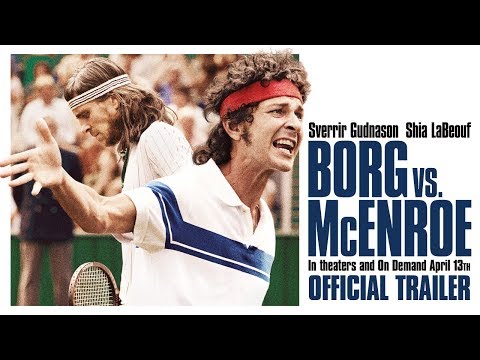
Hot-tempered, prone to throwing rackets and screaming abuse at referees, he was quite a character, that Björn Borg.
Borg vs. McEnroe, a dramatization of the rivalry between the Swedish Wimbledon champ and his upstart challenger John McEnroe in 1980, seeks to enlarge our understanding of both superstar tennis players, each of whom was frustrated by the tabloid-driven reductionist approach to their personalities. Yes, McEnroe was a brat, but he was also something of a math whiz. Borg, meanwhile, as a teen was notable for his inability to control his temper.
The casting is serendipitous, indeed sublime: For the querulous McEnroe, Danish director Janus Metz has hired the even more mischief-prone Shia Labeouf. It’s like putting together a movie on John Dillinger and finding out Clyde Barrow is available to play the role. And yet Labeouf’s actual acting gifts, this film reminds us, are modest. He fails to capture the atavistic appeal of McEnroe’s rampaging-toddler act. (That Johnny from Queens presaged even more norm-shatteringly indecorous behavior on the part of current president Donny from Queens is a point the film does not press. This is just as well given the clunky results when last year’s tennis film Battle of the Sexes urged us to think of Billie Jean King and Bobby Riggs as Hillary Clinton and Donald Trump.)
Labeouf is cast into shadow by Sverrir Gudnason, who plays Borg exceptionally well — poised, superstitious, wracked with torment, and altogether Scandinavian. He’s a rich, blond, blue-eyed 24-year-old idol to the world’s girls who is at the top of his profession, so you can feel his pain. When he approaches the balcony of his high-rise home in Monte Carlo, you half-expect him to dive off it. “They say he’s an iceberg but really he’s a volcano,” says another player. Uneasy lies the head that wears a sweatband: Being number one means there is nowhere to go but down. As his coach (Stellan Skarsgård) predicts, “When he starts losing, it’s over.” Moreover, the grace and craftsmanship and humility he brings to the game — upon winning a championship, his characteristic move is to fall to his knees — seem ill-suited to an incipient era of impatience. Borg is simply too quiet for the loud decades to come, and he will later retire at 26.
McEnroe, by contrast, essentially tells his inner demons, “You cannot be serious.” Watch him swear at a referee for not doing something about the pigeons on the roof whose cooing noises are distracting him: It’s not really about the pigeons, it’s about distracting himself. Lashing out at everything and everyone protects him from having to look inside. This provides substantial entertainment value, and unlike Borg, McEnroe understands athletes are entertainers. When he appears on a Tonight Show–like chat program, his taunts and jibes stir something in the crowd. He appeals to the same collective lizard brain that was drawn to professional-wrestling sagas, then to reality TV, then to the first president who had mastered both of these formats. Being “gentlemanly,” in 1980, is already starting to look dated. Dignity and restraint no longer sell. At a press conference, Borg is asked what it will mean to him to win and he says, “No special feelings.” You can feel the times conspiring to ease him off the stage.
The 1980 Borg–McEnroe marathon — one set was decided by an 18–16 tiebreaker — previously supplied inspiration for a ribald spoof, 7 Days in Hell, a very funny 2015 HBO special, starring Andy Samberg, that via comic hyperbole had more to say about the era than this film does, with its timid peek inside Studio 54 and its inconclusive scene about Borg and his bride being urged to sell access to their wedding to the tabloids. Nor does Borg vs. McEnroe find an exciting approach to the tennis play in the players’ Wimbledon final, which doesn’t start until the second hour of the film. The director disguises the doubles he uses for the actors by cutting to distant overhead shots and jumps around the match highlights in a manner more befitting SportsCenter highlight reel than a suspense movie.
So this isn’t a great tennis film but rather a beguiling character study, a rumination on two Shakespearean types. That each of the principals fit so easily into a classic template lent them resonance beyond their sport. On the one hand there’s a melancholy Scandinavian who is fatally unsure of himself; on the other there’s an impetuous young king in waiting, Prince Hal in short shorts.