We can all easily imagine circumstances in which a manager of a coffee shop or restaurant might properly call the police to ask them to remove loiterers. These are places of business. There’s nothing wrong in principle with calling the cops on non-customers who are taking up space. And there’s nothing wrong with police asking people to leave private property where they aren’t welcome, given that trespassing is a crime. When such people refuse, that’s unfortunate, but what can the police do but arrest them?
On the other hand, calling the police on two men in a Starbucks because they’re black would be very, very wrong, even outrageous. At a glance, what happened at that Philadelphia coffee shop last Thursday looks like racism. But there’s little context. Does the manager also routinely call the police on white people who loiter in the shop? If a white manager called the police on two white guys hanging around a coffee shop, it wouldn’t make the news, much less become a national obsession. Was the manager new on the job and unfamiliar with the generally lax policy at Starbucks when it comes to allowing nonpaying customers to hang out? Did the manager have some reason we don’t know about for disliking the two men?
I’m convinced, as I believe most Americans are, that being black is like a tax or burden that you carry with you at all times. In his book Please Stop Helping Us, my friend Jason L. Riley, a Wall Street Journal columnist, writes eloquently about how he used to routinely get stopped and questioned by police in Buffalo for no apparent reason as he was driving in white neighborhoods. Riley maintains more sangfroid about this state of affairs than I would: Frustration, even anger, with the status quo is easy to understand.
We know racism exists, it inflames our sense of injustice, and so we’re eager to punish it. But it can be frustratingly difficult to prove that a given incident is an example of it. Firing any employee who demonstrates race bias would seem to be a fair punishment and would also serve as a warning to other staffers that racism won’t be tolerated. But at this point we don’t even know whether that Starbucks manager was fired. (“We can confirm that she is no longer at that store” is all the company had to say about the unidentified worker.) On the other hand, if Starbucks has found reason to believe that the employee isn’t prejudiced, firing her would appear to be unwarranted. But how would someone demonstrate that anyway? It’s hard to see into someone’s heart.
[pullquote align=”left”]Would you boycott Richmond because one person there had committed murder, much less because one person there was shown to be a racist?[/pullquote]
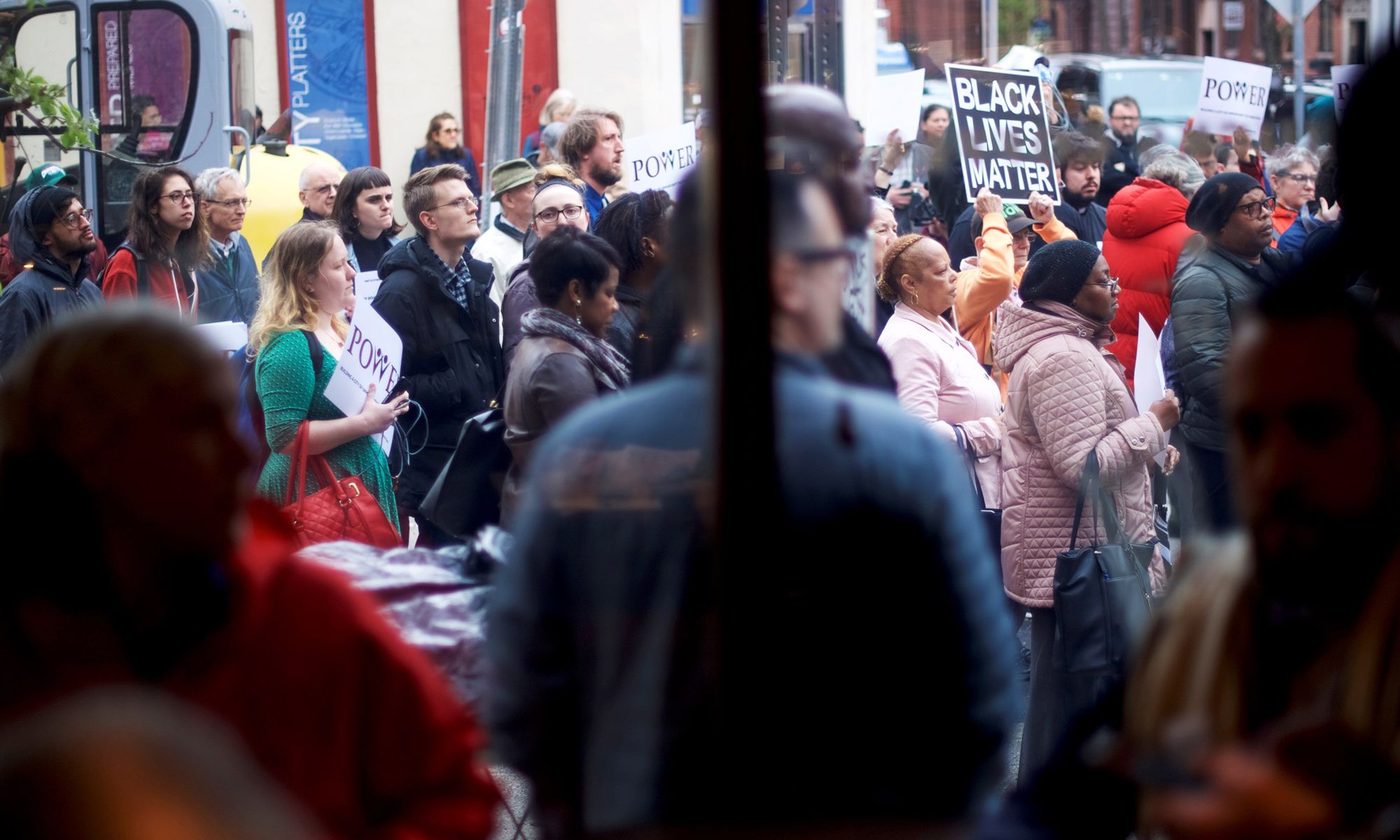
A glance at social media reveals little interest in thinking through such subtleties. The incident is making people unhinged. When the “racism” circuits in our brain get activated, we stop thinking clearly. We go out looking for someone to chastise, and one low-level staffer isn’t enough. We want a larger target suited to the strength of the frenzy. It affects our judgment the way being drunk does. This is your brain. This is your brain on race. At “a protest outside a Starbucks at the typically tranquil corner of 18th and Spruce Streets,” reported the Philadelphia Inquirer, “a woman poured a cup of (non-Starbucks) coffee out onto the sidewalk.”
Only via frazzled, race-drunk thinking can a (possibly) racist act on the part of one out of 238,000 Starbucks employees somehow become the fault of the whole company. Starbucks as a corporation is comparable to a midsize city: larger than Richmond, Va. Would you boycott Richmond because one person there had committed murder, much less because one person there was shown to be a racist? Unless it turns out that Starbucks’s training materials include the admonition, “Call the cops on any black people in your store who don’t buy anything,” I doubt the company as a whole is to blame.
That this particular corporation has been at pains to publicize its concern with race tensions — at one point in 2015 even encouraging employees to write “race together” on customers’ cups while sponsoring a series of anti-racism articles in USA Today — has caused some chortling among conservatives. The lesson there is that no matter how loudly you declare yourself one of the good guys, it’ll be forgotten when the mob assembles. Any money spent buying indulgences in the church of racial enlightenment buys you no insurance against cries of racism.
When that cry goes up, everyone wants in on the action. So, on Monday, a mob of protesters shut down the Philadelphia Starbucks in question for more than three hours. Any nonracists in the mood for a cup of Starbucks java had to go elsewhere. Why punish them? Why harass all the good people at that location for the actions of someone who doesn’t even work there anymore? And if it’s the arrest that’s the most bothersome part of the story, why train your fury mostly on baristas rather than cops?
Local politicians rushed to join the fray: “Starbucks has issued an apology, but that is not enough,” Philly mayor Jim Kenney said, adding that he had ordered the Philadelphia Commission on Human Relations to investigate. Starbucks was open to dialogue with the demonstrators — Camille Hymes, a regional vice president for the company, offered to talk to them on Monday at the Philly store — but they refused. “We know that you don’t have the power to change everything. You’re just a figurehead, but we’re going to get to those in power, and we’re going to make sure that we shut you down,” a demonstrator replied in a moment captured on a video.
Then the leadership of Starbucks unwisely granted the mob’s premise — that the entire company is tied to the action of the Philadelphia employee — when it announced it would close every store in the chain (that’s 8,000 stores) on May 29 to train 175,000 employees in how to avoid racial bias. This centralized the manager’s action instead of distancing the corporation from it. It’s as though the entire city of Richmond vowed to undertake a reeducation program every time one of its citizens commits a crime. The move guaranteed that “Starbucks” and “race” will continue to be linked in the public imagination for weeks to come.
In ironic juxtaposition to the viral video of the two black men being confronted by police was a picture taken during the protest at the Philadelphia Starbucks Sunday by the Inquirer’s Michael Bryant. It captures Black Lives Matter activist Asa Khalif standing in front of a staffer, identified on his apron as Zack. Zack is not the employee who called the police last week. Khalif is yelling into a bullhorn despite being maybe three feet away from poor Zack, who is standing with his hands folded, patiently absorbing abuse for something he had nothing to do with. “Today, this space is now secure, secured by the people” was among the announcements Khalif thought it necessary to make through his bullhorn.
That photo, shared widely on social media, is the perfect American tableau for our demented political moment, when one guy feels entitled to yell through his bullhorn at another guy for an incident that didn’t involve either of them. In 2018 America, it’s as if just about everyone is either Khalif, absurdly overreacting to the latest news, or Zack, getting dragged into somebody else’s political controversy. At the Philadelphia protest on Monday, one man shouted to his fellow demonstrators, “What do we want?” The crowd responded, “Liberation!” “When do we want it?” he cried. “Now!” they answered. Sorry — Starbucks may be a great place to get a venti macchiato, but it’s not able to offer anyone liberation.
NOW WATCH: ‘Starbucks to Teach Employees Progressive Junk Science’
[jwplayer prY92sXN-mFslriqe]


Comments