Editor’s Note: The following piece first appeared on Josh Blackman’s blog. It is adapted and reprinted here with permission.
On Thursday, March 29, students at the City University of New York School of Law protested and heckled my lecture about free speech on campus. You can watch video of the entire event, which lasted about 70 minutes, below. The protest and heckling took place during the first eight minutes of the recording.
In this post, I will recount the events that led up to the protest, and describe my experiences during the encounter. In future writings, I will provide my own commentary. Here, I will try to lay out the facts to the best of my recollection, aided by the (sometimes) inaudible recording.
In October, the CUNY School of Law Federalist Society invited me to speak on a panel discussion about theories of constitutional interpretation. I had planned to speak about originalism. Alas, the students were not able to find any other professors who were willing to participate in the event. After several rounds of emails, I suggested an event about free speech on campus. It is a talk I had given before, without any problems, at Southern Illinois, Texas Southern University, the University of Massachusetts, Barry University, the University of Oregon, and my home institution, the South Texas College of Law Houston. The Federalist Society chapter agreed that this would be a good topic for CUNY. Alas, once again, the chapter was unable to find any other professor who would participate in the event. (This is fairly common.)
Three days before the event, the president of the chapter wrote, “We passed out the flyers today (first day back from spring break) and a large number of students are already up in arms about the event.” The Office of Student Affairs explained that “some enraged students, . . . apparently, are planning to protest.” I asked why they were protesting. The president provided an explanation:
These students saw first, that this is a Federalist Society event; and second, they saw a few of your writings (specifically a National Review article praising Sessions for rescinding DACA and ACA), and instantly assume you’re racist; and third, our event being titled about free speech is reminiscent of events that claim free speech just to invite people like Milo Yiannopoulos and Ann Coulter.
He explained that “we have the support of the administration” and the event would proceed as scheduled.
Hours before the event began, Mary Lu Bilek, the dean of CUNY Law, sent an email to all students:
As a law school, a public institution, and a school within the CUNY system, we are committed to academic freedom, the free exchange of ideas, and expression of all points of view, including the freedom to disagree with the viewpoints of others.
University policy provides guidelines for how to express disagreement lawfully (including through demonstrations), defines prohibited conduct, and details the procedure for handling disruptive demonstrations at CUNY facilities. Many of us witnessed a demonstration here earlier this year, which is an example of expressive conduct that does not run afoul of any University policy.
We attach a copy of the University’s policies and rules, including those covering the processes for dealing with student and employee prohibited conduct.
She attached CUNY’s Policy on Freedom of Expression and Expressive Conduct.
A few moments later, a member of the CUNY community tweeted:
Shortly before the event began, I spoke with CUNY’s chief of public safety. He explained that a few dozen students were already assembled in the hallway outside the room. They had amassed earlier in the day to create posters and signs. (Students passed out poster board and markers.) I asked him if they would heckle me in order to prevent me from speaking. He said he did not know. Then he asked me what my “exit plan” was. He explained that there were certain safe ways to exit the building. When I said I planned to leave via Uber, and not the subway, he was relieved. It was a question I had never before considered. Although he initially told me he did not want to be present in the room, he escorted me from the elevator to the classroom.
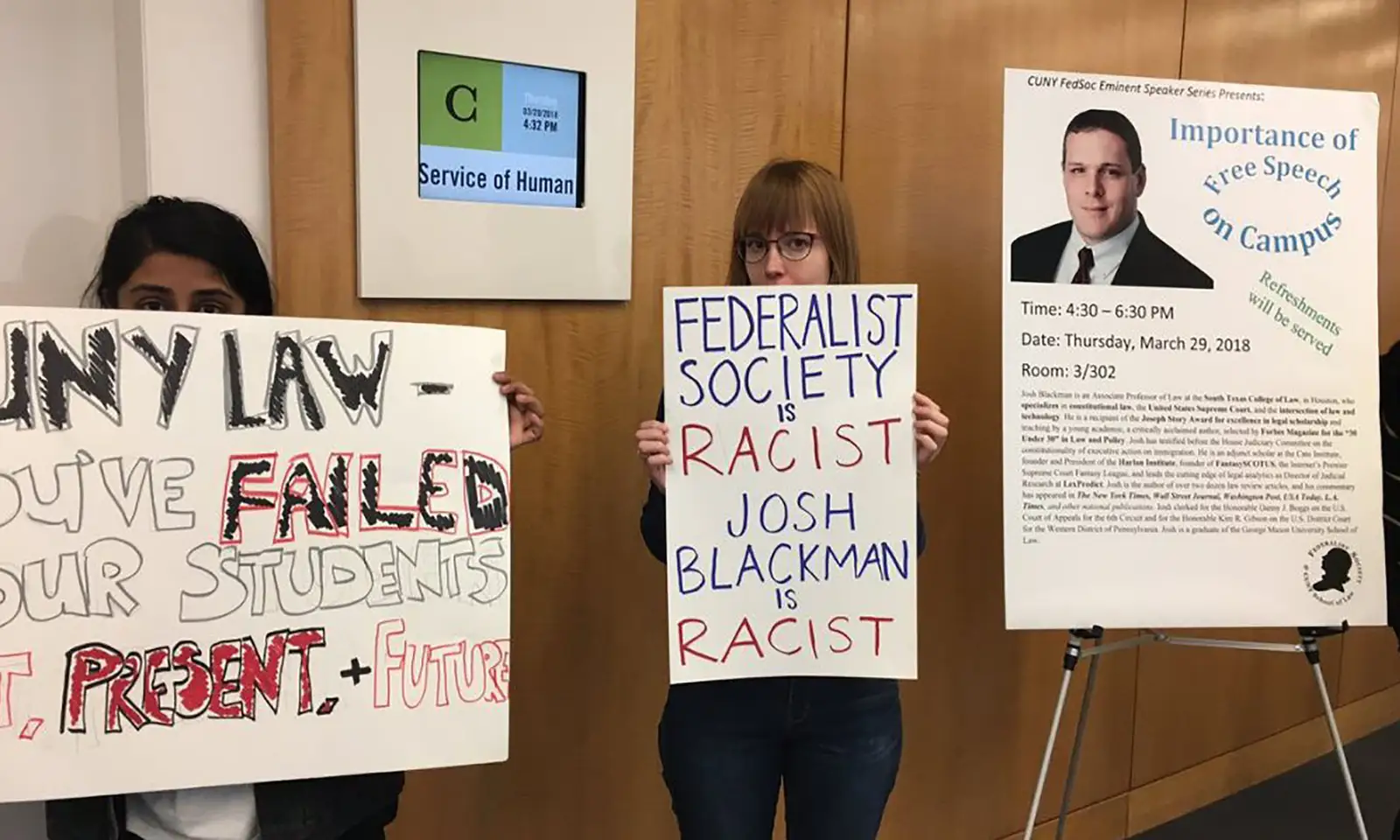
The video, which is posted above, illustrates the scene as I entered the classroom. Several dozen students (I will leave the count to others) held up signs and chanted “Shame on you,” booed, and hissed.
Several students even posted photographs of these signs to social media.
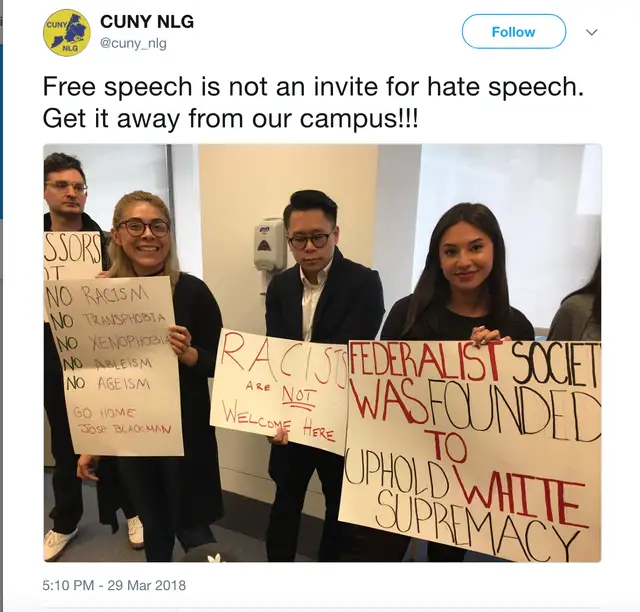
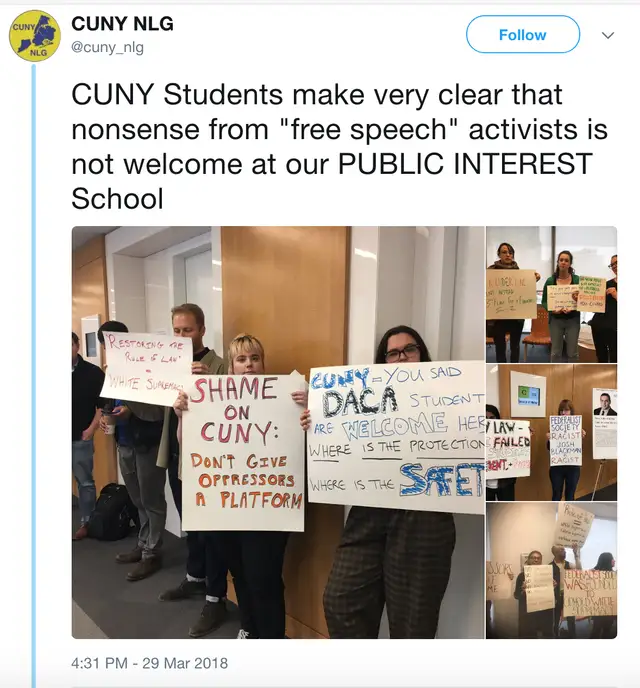
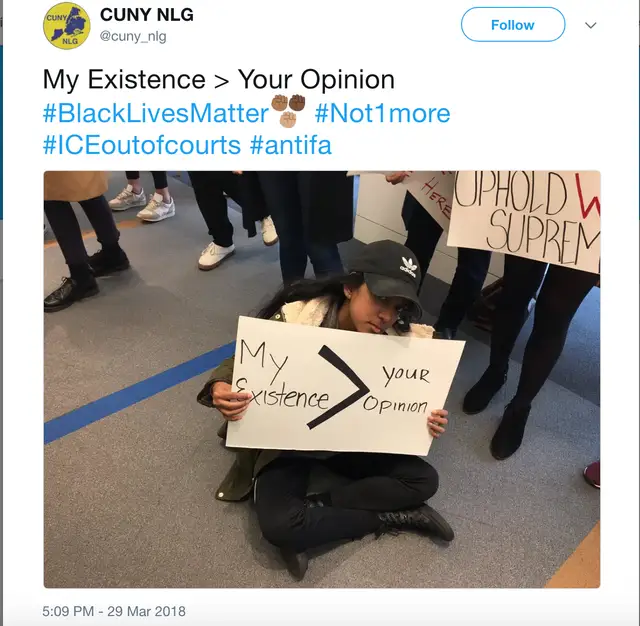
One student made a halfhearted effort to block my entry into the room with his backpack, but I easily moved past him.
Much to my surprise, when I entered the room after that rude welcome, there were only about five people in attendance. Moments later, the protesters with signs filed in and surrounded all four sides of the room. About a dozen of them were standing directly behind me.
The president of the Federalist Society chapter asked the students standing behind me to move to the back of the room. They refused. I didn’t raise any objection. Had they stayed there, and not made any noise, it would have been fine with me.
The protesters called out: “Shame on you.” “I don’t understand how CUNY allows this.” “There are students that are directly affected by this hate speech.” “Legal objectivity is a myth.” “You still have an opportunity to leave.”
As the president began my introduction, the protesters heckled him: “This is not okay.” As he said my name, someone called out, “He’s a white supremacist.” Others booed: “I don’t understand how CUNY law allows this.” One of the protesters observed, “He’s filming us. Just so everyone is aware, he is filming us.” I told her, “I am.” (New York is a one-party-consent-recording jurisdiction.
A few students in attendance clapped as I began to speak. “Well thank you very much to CUNY for having me,” I said. In unison, they yelled out, “CUNY is not having you.” “You are not welcome.” Another shouted out something about “white men and those who support white supremacy.” An African-American student who was attending the event replied, “I am not white.” A protester, holding a sign that said “Josh Blackman is not welcome here and neither is the Fed Society” asked, “Then why are you here? Why aren’t you with us?”
A member of the chapter reminded the protesters that they were not allowed to interrupt me once I started. At that point, a member of the CUNY administration entered the room and walked right up to the protesters:
All right, listen. Everybody stop. Let me tell you something. The university rules are people get to speak. You may protest. You may protest. But you may not keep anyone from speaking. If you do, I have other things to do, I will be back. Or you can resolve this yourselves. Or you can have me resolve it.
As she began to walk away, a student asked, “Why are you bringing racists into your school. Can you answer that?” “Why are you not providing support for students affected by this hate speech.”
The administrator repeated, “Did you hear me?” A student replied, “We are not children. You can’t talk to us like that.”
Professor Franklin Siegel, who was seated in the back, urged the students, “Please don’t take the bait.” A student muttered, “Franklin, come on.” He repeated, “Don’t take the bait.” A student said, “He is threatening us.” The students then discussed among themselves that it was within the administration’s discretion to punish them.
At this point, about three minutes in, I had managed to say only a single sentence. I decided to start, though I abandoned my prepared remarks. Instead, I decided to respond to attacks the students made against me in flyers that were distributed throughout the school. “For those of you who are actually here to hear me speak, I’ll try.”
In unison, the students interrupted me, “Nahh.” I continued, “When I came to campus, there was a sign that said, ‘Oppressors not welcome.’” A student shouted out, “You!” I continued, “It says at the bottom, ‘We reject the idea that his views,’ — my views — ‘merit space on this campus and reject the myth of legal objectivity. Josh Blackman is not welcome at CUNY Law.’ Congratulations, you’ve made me feel very unwelcome. But I’m still going to say what I’d like to say.”
A student interrupted, “You’re very brave.” I told him, “Thank you, thank you I try.” They continued to shout over me. One said, “CUNY Law is threatening us and protecting speakers.”
“I actually want to start by using the one legal argument you actually made.” (I deliberately paused to give them a chance to get the laughter out of their system.) I continued, “The violence exists in the law, and it is a myth that law is inherently neutral. You said there is a myth of legal objectivity. So let me talk about legal objectivity for a few minutes. Someone did some excellent opposition research. Whoever did this, I applaud you. You found seven or eight bullets on various videos I’ve given over the years. I’d like to make a few points. You wrote that I supported the president’s decision to rescind DACA. Now let me tell you something. I actually support the DREAM Act.”
There were audible gasps in the room. “This might surprise you. I think the DREAM Act is a good piece of legislation.” Someone yelled out “Gaslighting.” I continued: “Were I a member of Congress . . .” Someone interrupted me. I said, “Let me speak, please.” A number of students shouted out, “Nah.” I continued, “Were I a member of Congress, I would vote for the DREAM Act. My position is that the policy itself was not consistent with the rule of law. Which teaches a lesson.” Someone started snapping and booing. “The lesson is you can support something as a matter of policy.” Someone shouted, “What about human rights?” I continued, “but find that the law does not permit it. And then the answer is to change the law.”
A student shouted out “F*** the law.” This comment stunned me. I replied, “F*** the law? That’s a very odd thing. You are all in law school. And it is a bizarre thing to say f*** the law when you are in law school.” They all started to yell and shout over me.
One student yelled at me, “You chose CUNY, didn’t you? You knew what would happen.” At the time, I didn’t appreciate the significance of her question. The students apparently believed I picked CUNY because I wanted to be protested. This was the meaning of the “Don’t take the bait” comment. To the contrary! I had never been protested before. I was shocked that a lecture about free speech would occasion such a protest. Yet, once I found out they were going to protest me, I was not going to back down and withdraw. The hecklers at this public institution would not veto my speech. I would stand there as long as needed to make my point.
Amid the cacophony, I interjected, “Let me speak. Let me speak. F*** the law, right? That’s a good mantra. F*** the law.”
A student, looking at the very few number of people in attendance, said, “Look how many of us and how many of them there are.” I replied, “I am actually very impressed, let me say this, I am actually impressed that there are so many of you. You could be anywhere right now, and you chose to come out here and exercise your constitutional rights. You want to exercise your rights. And I’ll do to do the same.”
A student shouted, “CUNY Law is not acting right.” I continued, “I’ll do the same. I’m going to express my views. Let me go down this check list. I think DACA . . .” I started to make a comment about DACA, when the student standing immediately to my right said, “I don’t want to hear this.” Then they started to exit.
I said, “You want to go? Please leave, by all means.” They began to exit. I said, “I think DACA is a good policy.” A student replied, “I think you’re tired.” I admitted, in full candor, “No, I’m feeling pretty good.” At that point, the speakers realized that the heckler’s veto had failed and that I was going to speak. A student shouted, “You’re lying to yourself.” Another said, “You’re a white supremacist.” “This is really about CUNY Law and how you let this happen.” Another said “Shame on you” to the students in attendance.
Then the dialogue shifted to the back of the room. The African-American student I mentioned earlier said, “I don’t support this guy” but “I want to hear him speak.” The protesters tried to shame him for attending. He continued, “I want to ask him a very hard question. And we should all try to ask him very hard questions. Like about the notion of legal objectivity.” Sensing the event had taken a different direction, I said, “Let’s talk about that.” The protesters then heckled and shouted over the student asking the question. I interjected, “Let him talk, let him talk.” After the protest died down, he said, “I respect the fact that you have a right to speak and you came here. I do not support anything you are writing or your politics, but I do respect the fact that we can have a dialogue and ask some tough questions.”
At that point, the protesters left the room and, I learned, they marched to the dean’s office to complain. After they left, I took questions from the students for over an hour. I did not present any of my prepared remarks, but it didn’t matter. I spoke on originalism, textualism, the separation of powers, DACA, affirmative action, criminal procedure, and a wide range of other topics. The conversation was civil and professional. I was very proud of the students who stayed till the end. (Well, there was one Trump supporter in the room who called me a “cuck” for not being MAGA enough — I can’t win.)
Indeed, though there were only five people at the start of the event, by the time it concluded I counted about 30. I learned that some students were either ashamed or intimidated and did not want to be seen attending the event. A number of students thanked me after the event, and explained that conservative speech is stifled on campus not by the faculty but by the students. The students swarm on anyone who does not toe the progressive line.
Less than 24 hours before the protest, the South Texas College of Law Houston granted me tenure. I am deeply grateful to my colleagues for their vote of confidence. This security will ensure that I can effectively engage protesters and challenge their ideas for many decades to come.



Comments
On “Students at CUNY Law Protested and Heckled My Lecture about Free Speech on Campus”