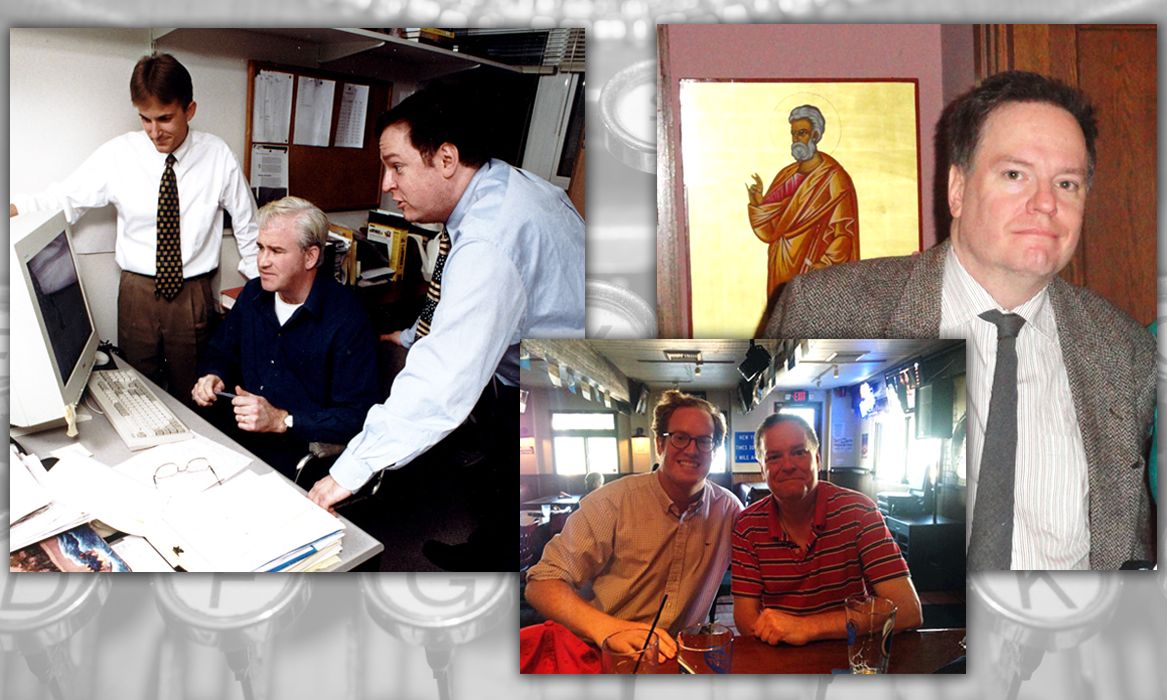
Every one of us is unique, our kindergarten teachers tell us, and it’s true. But can we agree that some are uniquer than others, so to speak? Mike Potemra was unique. (How bizarre to write of him in the past tense.) He was a true individual. (There I go again.) I never knew anyone else like him, or even remotely like him. He was a “oner,” as they say in the crossword puzzles. I knew him for a long time — since 1986 — and he was a big deal to me. Is.
Rich Lowry wrote an R.I.P. yesterday, here.
Mike spent his first years — or months? (I’m not sure) — in Youngstown, Ohio. So we would kid that he could claim “working class” roots (despite his upbringing in Montreal). He liked to mock the pretensions of politicians, especially of demagogues.
He went to the Catholic University of America, in Washington, D.C., majoring in philosophy. He once wrote me, “I wanted to major in English but figured I shouldn’t major in something I love. (In my experience, academe takes the joy out of things.)”
At CUA, one of his teachers was Paul Weiss, who had also taught William F. Buckley Jr., at Yale, many years before. (Weiss was very long-lived: He lived till 101. Also, he was the first Jew ever to be granted a full professorship at Yale.)
After college, Mike attended Harvard Law School, though not for long. (Law school was not for him; other things were.) We lived across the hall from each other. I was not in law school, but we wound up in the same dorm.
He was an amazing personality — funny, learned, often dazzling. There was a W. C. Fieldsian quality about him. He was like Fields, if Fields had been an intellectual. Mike had read everything, absolutely everything. And he had seen every movie (though not necessarily of the mainstream type).
Years ago, he gave me a list of books — ones that he especially admired. At the top of the list was Proust. He gave me a list of movies, too. His No. 1 was The Conversation, Francis Ford Coppola’s movie from 1974. I watched it and didn’t understand it at all, or like it. Mike told me something like this: “It’s a parable about privacy, essentially.” I said I would give it another try and grow into it. I have never given it another try. I surely should.
When we both lived in Washington, we saw each other, and jawed over the world. Later, in New York, he came to work at National Review (starting out as deputy managing editor when I was managing editor). At a magazine, you want people who can read and write and think — and edit — and who know everything. That was Mike to a T.
In due course (as WFB would say), he became literary editor.
The relationship we shared was not always lovey-dovey, mind you. Oh, no. Mike liked to get under my skin, and was good at it. He razzed me, mainly about being a “far-right-winger,” as he said. (This would come as a surprise to my critics on the far right.)
Man alive, was he funny. For a while in New York, there was a regular meeting of very, very conservative people. “Are you going to the meeting, Mike?” someone would say. “No, my German’s not good enough,” he’d reply. Or, “My armband’s at the dry cleaners’.”
After the invasion of Iraq, one of the U.S. teams found a trailer full of WMD materials — or several trailers. I don’t remember the details. Anyway, Mike said, inimitably, “If this van’s a-rockin’, don’t come a-knockin’!”
He laughed, heartily — loud — at his own jokes. And he enjoyed your enjoyment of his jokes. He was a private person, but he was a born entertainer.
What a mimic, too. A great mimic, possibly to a fault.
He was serious — very serious — as well as funny. For one thing, he was one of the great religious seekers of all time. When we were talking about a figure in the arts, he wrote me this note:
I’ve chatted with her only a couple of times, briefly, and I’ve gotten the impression of brittleness at her core — it makes for a contrast with her physical appearance, which speaks of warmth and welcoming.
God knows the very specific ways each of us is broken, and has healing in his plans — I think that’s what it means when it says in the Book of Revelation (2:17) that he will give each of us a secret name.
Mike was serious, funny, and funny-serious. I’ll try to illustrate. Once, I wrote about Louis Armstrong, and said that he was “a pure soul, for all his whoring and carrying on.” Mike wrote me to say that he would “cherish” that phrase, adding, “I understand gravestones are cheaper if you order them ahead of time.”
(Forgive me for explaining the joke, but he was thinking epitaph, of course.)
Like other people who know a lot — a lot — Mike always claimed he didn’t. For instance, he would say he knew nothing about music. He knew loads about music. It’s just that he had a sense of what he didn’t know. He had very high standards. David Pryce-Jones is the same way.
There are people who know thimblefuls and think they know a lot. P-J is the opposite, and so was Mike.
A few years ago, Mike decamped from New York to Los Angeles. Why? He explained in a letter (a modern letter: an e-mail).
The short answer is, I just fell in love with the place. After a lifetime of bias against L.A. — of the sort Woody Allen used to express — I started spending time out here about three years ago, and realized that this is where I really want to live.
Usually when I would tell people on the East Coast that I was moving to L.A., they would say something like, “Wow, this last winter must have really gotten to you!” But in fact I love snow and cold weather and I expect I will miss these things. It is not so much the physical climate as the moral and psychological climate out here that attracted me — the laid-back-ness, the mellowness, the you’re OK / I’m OK–ness!
That last phrase — “the you’re OK / I’m OK–ness” — is pure Potemra. Anyway, Mike liked the physical climate, too.
I’ve discovered since moving here that late afternoon is my favorite time of day for beaches (and pretty much everything else). I’m basically a nocturnal person and have never enjoyed the full glare of daylight, even on the East Coast where the sun is so much less intense than it is here. But the slanting rays of late afternoon are easier on me.
In another missive, he made a remark about New York: “I felt like a pinball wearing out a groove between tall buildings, with hardly any sky visible.”
Out in L.A., Mike did more than soak up rays. For one thing, he attended concerts.
I went to the Whisky a Go Go two nights in a row this weekend. I don’t think I’ve ever done that before, in my life — go to the same rock club two nights in a row.
Much to my amazement, live rock has become a central part of my life in Los Angeles. As you might remember, I went on a similar binge when I moved to New York back in 1999: In my first three years in NYC, I went to 85 different operas at the Met. (In one especially memorable week, I saw Wagner’s Meistersinger twice! That’s about twelve hours’ worth of one of my favorite works.)
So, I’m doing pretty much the same thing now, with rock — and realizing just how much I like rock qua rock. I have spent the last couple of decades exploring the musical world, trying genres from all over the globe. I like pretty much all of them, some more than others, of course, but rock is the central one in my era and my culture.
He loved America, and he loved cats. (He was not so crazy about dogs. Once, I showed him a picture of a puppy or something, and he said, reprovingly, “I’m not bi-.”) But back to America: He was as patriotic a person as I ever knew. Not a nationalist, far from it, but a deep-dyed patriot, who thought America was a divine gift to the world. “This is America!” he would say, and not ironically.
(Mike was the son of a Slovakian immigrant, I believe.)
He was a big Reagan guy. In fact, Mike worked in the Reagan speechwriting shop. He kept a picture of the Gipper — the official presidential portrait — in his office. He also had a picture of Pope John Paul I.
Mike was an anti-Communist, a free-enterpriser, a free-trader, a pro-lifer — and a great believer in American leadership in the world. He departed from the rest of conservativedom on gay marriage (he was staunchly for it). Also, he was friendly to immigration. He was one of the last believers in E pluribus unum, Out of many, one.
You might have coined a term for Mike: an inclusive conservative. He thought the rest of us could have been a lot better at that. I don’t know, maybe he was right.
Anyway, I once wrote something about the word “capitalism” and the stigma attached to it. Mike’s response was neat:
I confess that the word “capitalism” has always turned my stomach, because it appears to take sides on the question of capital vs. labor, buying into the idea that there must be an adversarial relationship between the two — and thus playing directly into the hands of the Left. (E.g., “They favor capital [which is to say, heartless richies in top hats carrying bags of gold with $$$$ stenciled on them] while we favor workers and farmers and other noble people of honest toil.”)
I think “free market,” “economic liberalism,” “entrepreneurialism,” “opportunity society,” just about any phrase describes the system I favor better than “capitalism” does!
Mike was one of my favorite writers — on subjects both political and cultural. But the public has not seen much of him in recent years.
I try to be thought-provoking in my writing, and I generally succeed. Unfortunately, the thought that gets provoked most often is along the lines of “I WILL NEVER READ NATIONAL REVIEW AGAIN AS LONG AS YOU ARE THE LITERARY EDITOR YOU MISERABLE &^%$#!!”
You will not mind some bluntness, I know: Mike was appalled by today’s Right and felt utterly divorced from it. There is more of that going around than many people know. Mike once gave a haunting and brilliant definition of depression — something like “having a thousand commenters in your head.”
And yet he knew that political passions come and go, rise and fall. And he had faith in the long haul. No matter how gloomy the conversations he and I had — about anything (in any era) — we would often end by saying, “Keep hope alive.” That was one of Mike’s phrases. He borrowed it from Jesse Jackson, of course. We may not have thought much of Jackson, but the phrase is a very good one: “Keep hope alive.”
Way back in student days, Mike explained to me his “Jacksonian theory of the Democratic party.” The party had gone from Andrew Jackson to Scoop Jackson to Jesse Jackson.
Another phrase Mike used was “How goes the struggle?” That was a typical greeting: “How goes the struggle, man?” At a conference one year, I greeted Hamid Karzai, the Afghan president, with “How goes the struggle?” He said those were exactly the right words. I got a kick out of reporting this to Mike.
To say it again, Mike Potemra was a big deal in my life (and is). Frankly, he was already kind of a legend among his friends when he was in his twenties.
A few months ago, he wrote,
I know a lot less than I used to. This is partly on purpose: I joke that I spent the first 50 years of my life learning things, and now — on the Biblical principle that “he that increaseth knowledge increaseth sorrow” — I am dedicating the rest of my life to forgetting what I have learned.
I hope to end up as a child, “the least of these,” in the arms of a loving God.
One final note, if you will.
I saw this message, from Isaiah, in the window of a Christian Science reading room and thought of you: “And the work of righteousness shall be peace; and the effect of righteousness quietness and assurance for ever.”


Comments