If there’s a single idea that has defined the politics of the past 70 years, it is the notion of “the center.”
What constituted the center of American politics has always been up for debate. Did the center mean mushy moderation? Was it the “reasonable” midpoint between the right and left, where most American voters clustered? Was it a set of clear principles most Americans rallied around? Or was the center whatever positions could win over enough people who called themselves “centrists” or “independents”?
The truth is, it varied from one political moment to another. Politics is about building coalitions of support, and how that is done can change with the times and the personality.
When Barry Goldwater was seen as too extreme in 1964, Lyndon Johnson won in a landslide. In 1968, the perceived inability of liberals to keep the Left in check tilted the country to Richard Nixon.
Some politicians had the base in their pocket and needed to persuade the moderates, like Reagan in 1980. Some politicians had the moderates in their pocket but needed to persuade the base that their heart was in the right place, like George H. W. Bush in 1988.
But this idea that each party had to win over enough of the great American middle in order to be the majority party informed pretty much every presidential election since the end of World War II.
All of that seems to have vanished.
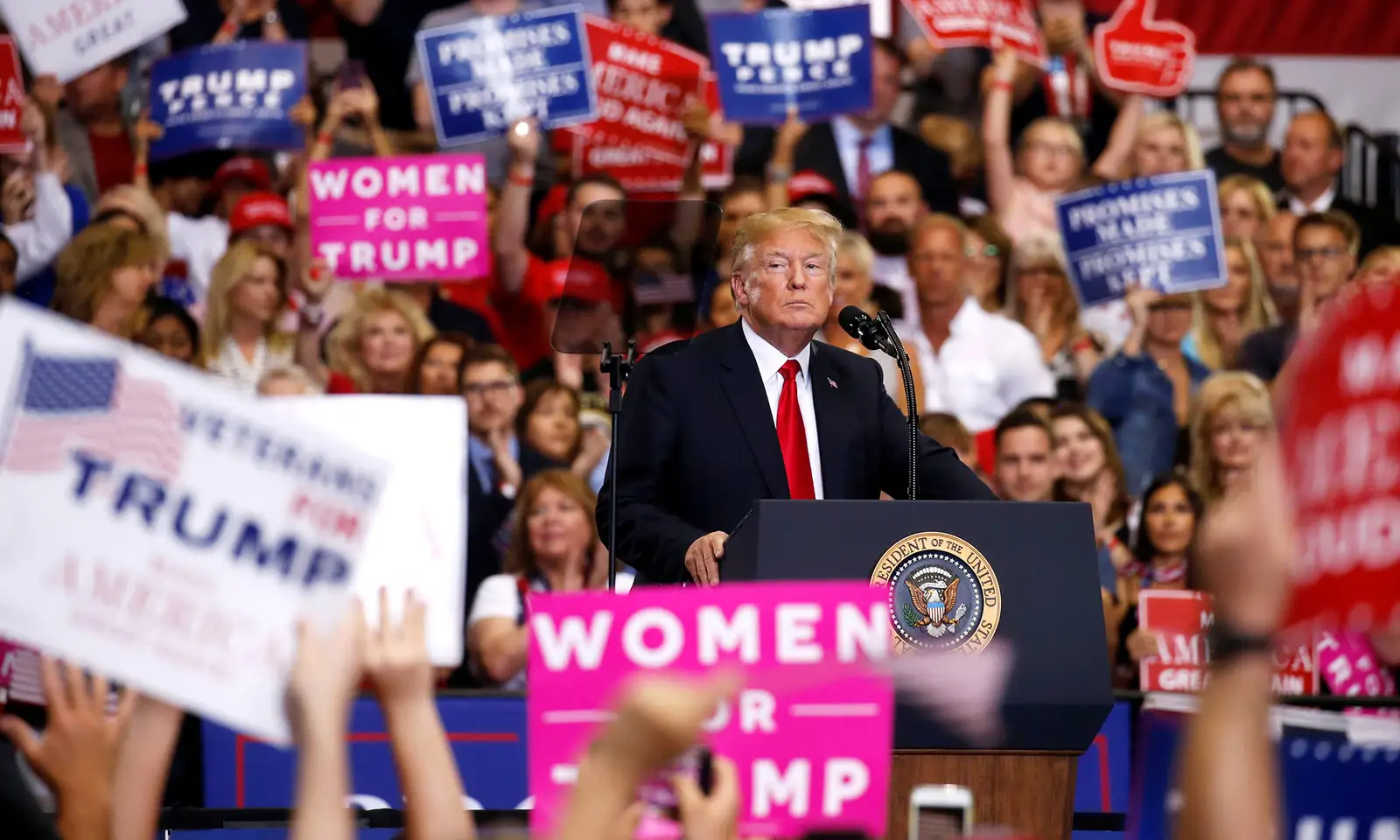
Donald Trump is the first president in living memory who seems utterly contemptuous of even appearing to care about voters outside of his base in a sustained way. He often refers to “my people” as if he were president of his fan base and no one else.
The bizarre irony is that Trump is less extreme on (some) policy issues than media coverage might lead you to believe. Trump doesn’t want to touch entitlements, and neither do most voters. When pressed, most Americans don’t like it when NFL players kneel for the national anthem. On countless other issues, from trade and foreign policy to immigration, Trump’s underlying positions are much less controversial than the way he talks about them and the way he handles them. Most Americans don’t want immigration increased, and most Americans don’t like the way Trump talks about immigrants. Most Americans don’t want to see Confederate statues toppled, and I suspect that most Americans don’t like the way he talks about that issue, either.
As we’ve seen in recent primaries, GOP candidates are taking their cues from Trump. The main issue in race after race was which candidate was more supportive of President Trump rather than any public-policy issue. It’s no wonder that only 33 percent of Americans think Republican congressional candidates are within the mainstream.
[pullquote align=”left”]It’s no wonder that only 33 percent of Americans think Republican congressional candidates are within the mainstream.[/pullquote]
Meanwhile, Democrats, in part as a reaction to Trump’s base-appeasing style, have become policy extremists. The competition among Democrats is to see who can be the most reasonable-sounding defender of unreasonable policies, from midwifing a new socialist era to abolishing ICE. So it’s also no surprise that only 33 percent of Americans think Democratic congressional candidates are within the mainstream.
I don’t think Trump created this dynamic, but he’s accelerating it.
Much of this political transformation is downstream of a demographic transformation. Because of what has been called “the big sort,” Blue America is becoming bluer, and Red America is becoming redder. Thus, the political incentive for most politicians isn’t to cultivate the center to cobble together a majority coalition, but to gin up the base as much as possible.
Barack Obama refused to “pivot to the center” when he got the nomination in 2008. Instead, he brilliantly blew up the standard model by increasing turnout among minorities and young people. He received fewer votes in 2012, but the strategy worked for him again. It didn’t work very well for the rest of his party. In response to Obama, Republicans gained more elective positions than at any time since the 1920s. Moderate Democrats were all but wiped out as a force within the party, leaving what was left to be even more ideologically extreme.
The GOP didn’t moderate under Obama, either. Trump, blessed with an ideal 2016 opponent in Hillary Clinton, adopted a mirror-image strategy to Obama’s and torqued up white turnout.
For both parties, the notion of appealing to the center, or simply expanding their coalitions, faded from collective memory. The challenge for the GOP in the long run is that this strategy depends on an ever-shrinking supply of white voters.
© 2018 Tribune Content Agency LLC
IN THE NEWS: ‘New York Governor Andrew Cuomo: America “Was Never That Great”’
[jwplayer bfZ2GCGj-wKJ9CRQU]




Comments
On “The Center Does Not Hold”