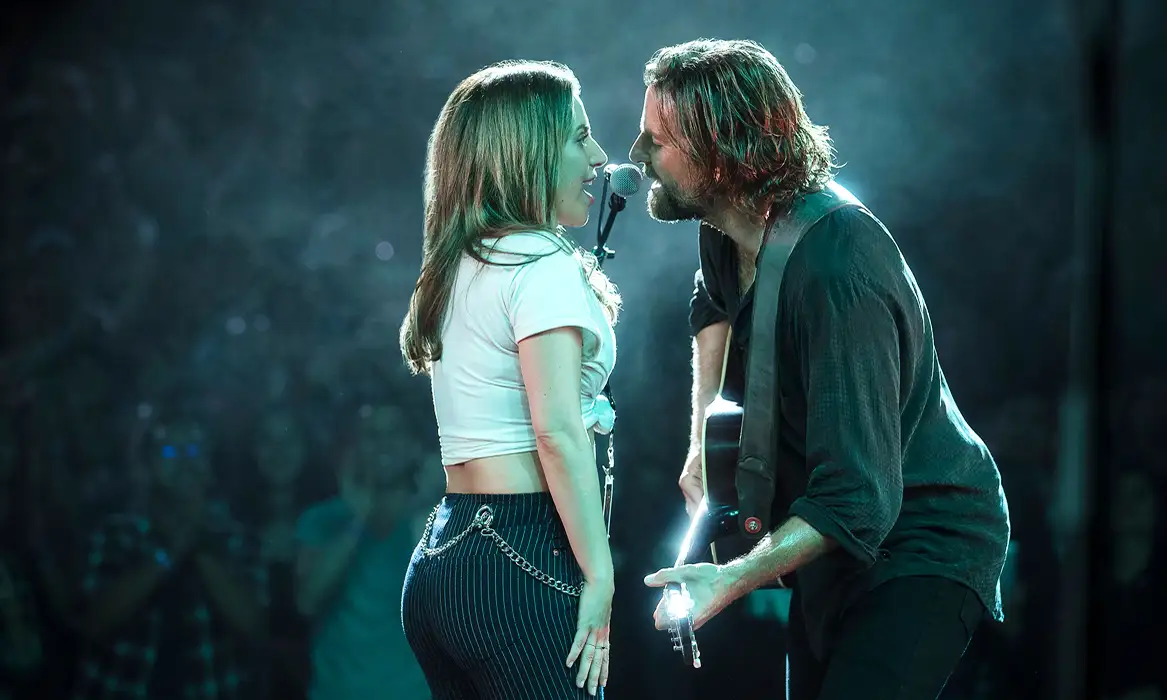
Every few decades, Hollywood trots out a remake of A Star Is Born to exhibit its shameless self-pity and beg for the public’s sympathy. Now is the wrong time for that. This decade’s version stars and is directed by Bradley Cooper, the good actor from American Sniper, American Hustle, and Silver Linings Playbook. Cooper assumes the piteous role of a damaged but basically good guy who pits his own career ambition against the ruthless pop idol Lady Gaga, who plays his supposedly admirable, ascendant co-star.
A Star Is Born’s hoary tale of a showbiz veteran (Cooper) being eclipsed by the ingenue (Gaga) he mentors and falls in love with is now whorier than ever. It can challenge the 1932, 1937, 1954, and 1976 editions only by relying on audience ignorance of those versions and worshiping contemporary showbiz shallowness. Lachrymose at its base, this version is just unabashed Hollywood merchandising. It sells a bald-faced PC checklist: white-male weakness, feminist bravado, servile and obsequious blacks, Latins and queers — none of this particularly enlivened by Cooper and Gaga’s competing narcissism.
This is A Star Is Born for the American Idol generation, a movie so out of touch with the artistic expression of universal feelings (what was formerly the pride of entertainment adepts) that it winds up simply promoting the present-day system of showbiz crudeness.
Cooper’s sunburnt, singing drunk, Jackson Maine, happens upon Gaga’s struggling waitress-singer Ally and is wowed by her exhibitionist talent. (Her bizarre rendition of “La Vie en Rose” steals the scene from transvestites at a drag bar, so we’re also meant to be impressed.) Their love story combines his suicidal neediness with her single-minded careerism. This star-crossed update pays homage to the 1976 Barbra Streisand fiasco more than to the 1954 classic Judy Garland–James Mason version by focusing on the music industry, a significant switch from the story’s original Hollywood film-industry setting.
Apparently, Millennial Hollywood is too conflicted and dishonest to be scrutinized in a modern behind-the-scenes exposé. The music industry is easier to assess and falsify, particularly when Cooper and his co-screenwriters (Eric Roth and Will Fetters) don’t seem to know the ropes but foster the illusion of glamorous hard work: Jackson sings country-rock as if he’s a lost member of the Eagles, and Ally is a thinly veiled Gaga, totem of freakishly vulgar modern pop.
Cooper employs an admirably low, sharp, scratchy voice; like Omari Hardwick in Next Day Air, he looks sidelong and away from everyone but Ally, as if struggling through sensitive inner wounds. In 1976, Kris Kristofferson used his specialty of cruising through a performance to play the doomed, stoned hero, but Cooper can, in fact, “act” as a star, making Jackson sexy, shy, and insecure. He’s like a handsome combination of Willie Nelson and Eddie Vedder.
But Gaga’s Ally, a girl of great confidence (and anger), is vulgar and foul. She pretends “innocence” by presenting “goomara” toughness as an ethnic- and gender-based essence. But confidence alone could not make Madonna into an actress, and something harsh and brazen in Gaga thwarts the movie-musical fantasy that desire and sincerity bloom and naturally burst forth during the “Far from the Shadows” number that is staged as the film’s star-making moment. But it doesn’t work. Gaga’s over-singing lacks the crucial emotional release. Ally’s reticence about her looks, lamenting her large nose, is unconvincing since Streisand forever erased that ethnic insecurity from showbiz. Instead, bug-eyed Gaga seems anomic and never conveys emotional depth. She has already internalized too many personality shticks and takes the stage as an already fully formed performer (pointing a tyrannical finger at new adoring fans), part of her post-postmodern Cindy Sherman act. It’s laughable that Ally’s makeover into a bump-and-grind redheaded vamp is supposed to certify her rise. What this characterization needs is a meat dress.
The Me Too movement ruins the myth that A Star Is Born tries to peddle. Ally gets to punch a barroom lout, but she’s never vulnerable to men. The unforgettable moment of A Star Is Born legend — when the drunk husband accidentally slaps the sweet, waifish wife at a public award ceremony — never happens here. This is a major miscalculation in the history of Hollywood’s camp self-image — a slap felt throughout the history of romantic melodrama, homing in on the husband’s descent and the woman’s humiliation — so this fairy tale has no battle-of-the-sexes tension. Jackson’s loss of self-control and Ally’s gratitude and forgiveness and triumph are unconvincing.
The reasons may have less to do with Cooper’s superficial concept than the diminished texture of modern sexual relations, which this film translates into its shallow presentation of showbiz standards. George Cukor’s legendary Judy Garland–James Mason version survives through its artistic accomplishments (Sam Leavitt’s dazzling cinemascope imagery and Garland’s unforgettable “The Man That Got Away”). Streisand’s musical soliloquies were of a lesser order but still were tours de force. All Cooper and Gaga do is repeat a self-congratulatory Hollywood motto about artists “having something to say.” Now is the wrong time for that.






Comments
On “A Star Is Born Is Remade the Wrong Way”