
When you think of the sheer vindictiveness of what happened to Oklahoma quarterback Kyler Murray, it takes your breath away. On the very night of his greatest career triumph, a reporter dug up his old tweets (composed when he was a young teenager), reported on the most offensive insults, and immediately and irrevocably transformed his online legacy. Now he’s not just “Kyler Murray, gifted quarterback and humble Heisman winner,” but also the man who was forced to apologize for his alleged homophobia. And for what purpose? Which cause did the reporter advance? Where was the cultural gain in Murray’s pain?
And he’s but the latest victim of a malicious online world that seeks to destroy people in the moment of their triumph. It’s happened to athletes, to entertainers, and even to “regular” folks who enjoy the slightest bit of fame or acclaim in the public eye. It’s almost a joke at this point — when are we going to find out that this person who did this wonderful thing is actually terrible on Facebook or dreadful on Twitter?
The incidents happen so fast, and the firings are so quick, that they start to blur together. Can you remember November’s victims? October’s? Who lost their jobs this summer? Who was forced to apologize this spring?
Well, if you can’t remember, I can assure you that the victims do, and the experience transforms their lives. Yesterday, First Things published one of the most powerful essays I’ve ever read. Helen Andrews, a former NR associate editor, recounts her own experience in the crosshairs, when an ex-boyfriend went after her publicly in a viral moment that I’d long forgotten. No matter what she did, where she moved (Australia), or even that she changed her last name in marriage, the incident and video dogged her. It hindered her career, it led to continued personal and public mockery as new acquaintances consistently found her worst moment, and — worst of all — she discovered that there was absolutely nothing she could do to make it stop.
In other words, if you’re in the middle of the shame storm, you can only take it. Even the act of self-defense magnifies the incident and magnifies the harm. It’s as if one doesn’t just wear the scarlet letter: It’s tattooed on one’s forehead in ever-brighter and bolder shades the longer the controversy endures.
Moreover, don’t think that vindictive public dragging and shaming is limited to the unlucky few. Spend much time in teen or young-adult culture (or spend any time on Twitter), and you’re immediately familiar with the micro-dragging — the little cloudbursts of outrage that are entirely confined to Instagram, Facebook, or a single Twitter thread and pass without larger public notice, but can deeply shake and even shatter the individual at the center.
I know that complex social phenomena have multiple and complex causes, but consider the terrible surge in teen depression and suicides — a surge that led Jean Twenge to ask in The Atlantic, “Have Smartphones Destroyed a Generation?” She tracks the tipping point at the moment when smartphone ownership became ubiquitous with young Americans. In 2012, the percentage of Americans who owned smartphones passed 50 percent. In 2012, the mental health of teenagers declined dramatically.
Of course, the “smartphone” is a stand-in for what’s on the phone, and what’s on the phone is a stunning amount of fury and intolerance. Look, for example, at this chart of political hatred in the United States, from the new book Prius or Pickup: How the Answers to Four Simple Questions Explain America’s Great Divide:
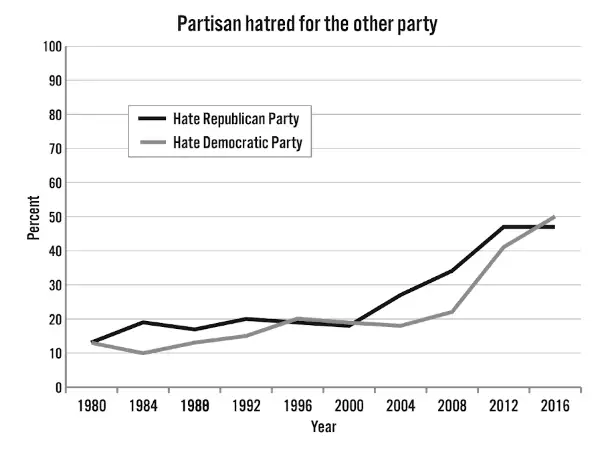
Teen depression, adult political anger, adult “deaths of despair,” shame campaigns — I don’t think we can look at any of these things entirely in isolation. Instead, I see them as symptoms of a post-Christian America that has become intolerably intolerant. It is a society without grace. It’s a society that’s all too often devoid of mercy — or in which the merciful don’t have nearly the same cultural power as the merciless.
Human beings need forgiveness like we need oxygen. The thing that is so shattering about the shame storm is that it is usually grounded in something a person did wrong — even if it’s a minor transgression. Even if it’s just momentary thoughtlessness. Even if it’s just a tweet. In her essay, Andrews described how the attack from her boyfriend was grounded in her very real mistreatment of him during their relationship. Take any given controversy, and you’ll usually find that the person at the center isn’t proud of what they did. They wish they hadn’t done it. At some level, the person at the center of the shame storm is also ashamed of themselves.
But then, in this terrible new world, you can’t ever shake the wrong thing you did. Never. It clings to you. It defines you. It becomes, to some people, the entirety of who you are.
Also, in this terrible new world, we lack the glorious grace of Christ — who declared to the Pharisees who sought to stone the guilty woman caught in adultery, the person who did something wrong: “Let him who is without sin among you be the first to throw a stone at her.” With those words Christ did not excuse sin; he reminded every person present that all fall short of the glory of God.
We have totally rejected the fundamental command that echoes through Judaism and Christianity, “He has told you, O man, what is good; and what does the Lord require of you but to do justice, and to love kindness, and to walk humbly with your God?”
Oh, we can “do justice” — with vindictive glee. But are we kind? Do we have the slightest trace of humility? As any Christian who grew up in the bonds of fundamentalist legalism can tell you, justice untempered by mercy grinds the human heart into dust. And now we’re besieged by a secular fundamentalism that positively delights in inflicting pain on its enemies.
Of course we can and should disagree — even sharply — with bad ideas, but we should take very great care before any person uses the power of their platform — great or small — to attempt to humiliate another human being. Criticism can be conducted with respect and with the humble awareness that our own mistakes are ample and easily found. In fact, it’s hard to improve on Helen Andrews’s wise counsel:
The solution, then, is not to try to make shame storms well targeted, but to make it so they happen as infrequently as possible. Editors should refuse to run stories that have no value except humiliation, and readers should refuse to click on them. It is, after all, the moral equivalent of contributing your rock to a public stoning. We should all develop a robust sense of what is and is not any of our business. Shame can be useful — and even necessary — but it is toxic unless a relationship exists between two people first. A Twitter mob is no more a basis for salutary shaming than an actual mob is for reasoned discussion. That would be true even if the shaming’s relics were not preserved forever by Google, making any kind of rehabilitation impossible.
Or, perhaps it is better to end less with an exhortation than a warning — one grounded in ancient truth: “For with the judgment you pronounce you will be judged, and with the measure you use it will be measured to you.” An intolerant nation is a miserable nation. Only forgiveness can light the trail out of the darkness.





Comments
On “America Is Intolerably Intolerant”