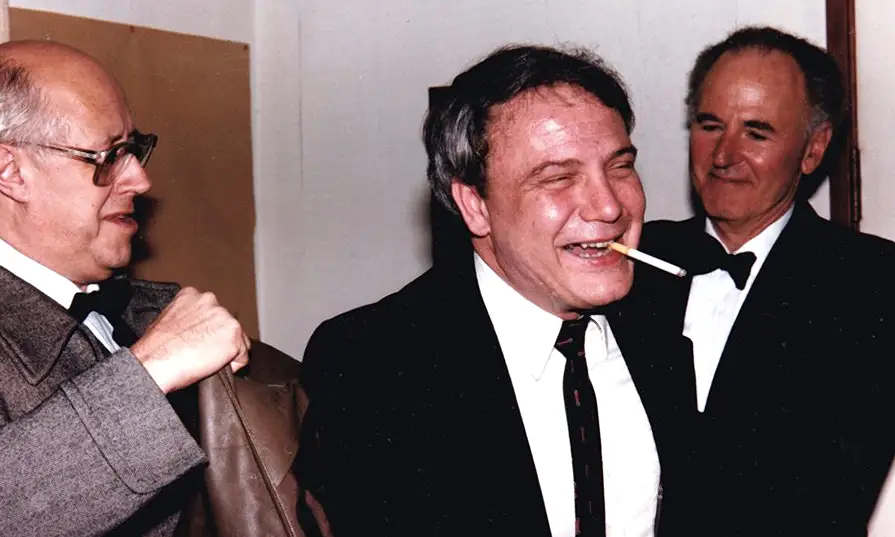
Editor’s Note: Jay Nordlinger recently interviewed Vladimir Bukovsky, the legendary Soviet-era dissident, at Bukovsky’s home in Cambridge, England. The first installment in this series is here.
When Bukovsky was released to the West in 1976, he was in his mid-thirties. He wanted to continue his education, which had been rudely interrupted by the Soviet authorities, who confined him to the Gulag for twelve years.
Bukovsky got invitations from two universities, he tells me: Leiden in Holland and King’s College, Cambridge. He wished to study biology, and, in particular, neurophysiology. Leiden had a program that lasted five years, and King’s had a program that lasted three.
For Bukovsky, every minute counted. Or, as he puts it, “Every year meant a lot to me.” He felt the need to get on with life. He opted for the three-year program over the five-.
There was another reason to choose King’s, not Leiden. Instruction at Leiden was in English, but “the everyday language of communication,” says Bukovsky, “was Dutch, and Dutch is an impossible language to master.” He was loath to begin this language in his mid-thirties.
Bukovsky has a memory: “Even their prime minister, Lubbers, once said, ‘Of all the languages in the animal kingdom, Dutch is the closest to human.’”
• In the Soviet Union, Bukovsky studied English in formal school settings, but the Soviet method of teaching was “outrageous,” he says. No one really learned anything. “They taught you to translate a foreign text with a dictionary. That was the whole idea, when it came to the teaching of languages.” The last thing they wanted was for you to be able to communicate in a foreign language. That could lead to trouble.
Say you were an engineer. The authorities wanted you to be able to read articles in English concerning your subject, and to be able to translate those articles into Russian. They did not want you gabbing with foreign colleagues.
Bukovsky taught himself English in prison, he says. He did it in one year.
“You were allowed to have books?” I ask. “You were allowed to buy books published in the Soviet Union,” says Bukovsky. “We were not allowed to have books published abroad” — though these books got smuggled in.
Also, “in prison libraries, you could find novels by Dreiser and Dickens, because they put capitalism in a bad light.”
Bukovsky read all of Dickens. “It was a torture,” he says, “because he was writing in sentences that might take a page and a half, and by the time you got to the end, you’d forgotten about the beginning!”
• “Do you have a lot of math?” I ask Bukovsky. “Yeah,” he says. “I love math.” I say, “Must be something in the Russian water. Russian kids seem to be math whizzes.” This is a misimpression, says Bukovsky. “It’s like chess,” he adds. “Everyone says, ‘Oh, the Russians are so good at chess!’ To begin with, it’s the Jews who are so good!”
• At the beginning of Part I, I mentioned a new book by Bukovsky, or rather, an old book, newly available in English. What’s the story there?
Go back to 1991, the year the Soviet Union collapsed. The new president, Yeltsin, banned the Communist Party. The party then sued, and Yeltsin’s government asked Bukovsky to serve as an expert witness at trial. He agreed, on one condition: that he would have access to the archives — the archives of the Central Committee, the beating, black heart of the party. He got it.
Off he went to Russia, armed with a laptop, a scanner, and other equipment. These had been provided to him by his French publisher.
By day, Bukovsky combed through the archives, finding eye-popping material. “Was it as bad as you had thought?” I ask. “Worse,” he says. “Worse.” The depravity of the Soviet Communist Party was practically boundless, and the willingness of foreigners to cooperate with the party, or accommodate it, was appalling.
By night, Bukovsky copied the material, surreptitiously. It was expressly forbidden to do so. Copying the material entailed a laborious process, but Bukovsky was determined to do it. He worked virtually ’round the clock.
He felt strongly that the archives would not be open for long — to him or anyone else. “I had a very limited window,” he tells me.
The trial? It turned out to be a dud, not the Nuremberg-like reckoning that Bukovsky, along with many others, had hoped for. But Bukovsky had the documents in the West — the documents that he had copied, then smuggled out.
He put them in a book, along with his comments on them. He called his book “Judgment in Moscow.” (In 1961, there had been an American movie, Judgment at Nuremberg.) It was published in nine languages, including Russian.
That was “thanks to Solzhenitsyn, by the way,” says Bukovsky. “He gave money for it” — the Russian edition. (Alexander Solzhenitsyn was tremendously philanthropic, as all Soviet dissidents and their families are aware.)
Judgment in Moscow was not published in English, the preeminent language in the world. Why? Thereby hangs a tale. It has been told by others, including Bukovsky, at length. I will tell it in brief.
In the United States, Random House had the rights to the book. But, in the end, the house refused to publish it. Bukovsky’s book was judged too hot to handle. Random House demanded extensive revisions, which the author refused to undertake. In his characteristic fashion, he said, “Owing to peculiarities in my biography, I am allergic to political censorship.”
Judgment in Moscow is not a warm and cuddly book, let me say. Most dissidents, in my experience, are not warm and cuddly. Otherwise, they might not have been dissidents in the first place. Judgment in Moscow is a damning book. Its subtitle is “Soviet Crimes and Western Complicity.” Many people in the West are uncomfortable with the “complicity” part. Bukovsky thinks they should be.
After Random House backed out, John Murray, a British publisher, was set to publish an English edition. This house, too, ultimately backed out — chickened out, Bukovsky and his supporters say.
“Was it frustrating not to have the book in English?” I ask. “It was annoying,” says Bukovsky. “I wouldn’t say it was frustrating. I knew that you couldn’t hide this book, that it would get through anyway.” He continues, “The amazing part was that the Left was so powerful as to block a book, recommended by the top experts on the subject. Their power, their ability to do things like that, is amazing. It’s tantamount to dictatorship. I mean, just think of it.”
Let me note that, when the book was written, 25 years ago, Richard Pipes and Robert Conquest praised it. I thought of this when Bukovsky said “top experts.” He surely has more in mind as well.
Flash forward to a few years ago: Evgeny Kissin, the pianist, wanted to discuss something with Bukovsky. (Kissin, Russian-born, has been a British citizen since 2002.) It was not music. It was Judgment in Moscow. The book was greatly meaningful to him, and he wanted to see it published in English. He went ahead and made it possible, with money and drive.
Bukovsky had long before given up on an English edition. He himself would not have bothered, he tells me. But Kissin and others — including volunteers — very much wanted to bother. It is their project, says Bukovsky, rather than his.
The book has been brought out by a small publisher in California, Ninth of November Press. (The Berlin Wall came down on November 9, 1989. The publisher’s motto is “Dissident books brought back for today’s readers.”) This new edition has a foreword by Edward Lucas and an afterword by David Satter. They are two leading Russianists of today.
Lucas writes, “Elizabeth Childs and her small publishing house deserve plaudits for having stepped in where the big beasts of the literary world have quailed and failed.”
The new edition has an expanded chapter, an expansion made possible by Pavel Stroilov, a Russian lawyer. He served as Bukovsky’s eyes and ears in Russia. (Bukovsky is not exactly welcome in his native land.) “I was his spy,” Stroilov tells me. He obtained thousands of documents via the Gorbachev Foundation, and these serve to expand Bukovsky’s Chapter Six.
Stroilov, like Bukovsky, is now an exile, in Britain.
Back to Kissin for a moment — Kissin and Bukovsky, and their interesting, surprising connection. I ask Bukovsky, “Do you like music?” “Yes, I do,” he says. “Did you have piano lessons?” I ask. “No, I never played the piano,” he says. Elaborating, he says, “I liked Rachmaninoff and other famous composers, but I never played myself. I wasn’t a musical man at all.”
Judgment in Moscow has left a deep impression on Kissin, Stroilov, and others, known and unknown. Bukovsky cites a verse by Fyodor Tyutchev, a 19th-century Russian poet: “We cannot guess ahead / What echo our words will have.”
Thanks for reading, everyone. I’ll see you tomorrow. The main question in Part III will be, “How important is it that Russia and the former Soviet empire have never had a Nuremberg — a decommunization, as there was a denazification?” This is a very important question.

Comments
On “Echoing Words: A Talk with Vladimir Bukovsky, Part II”