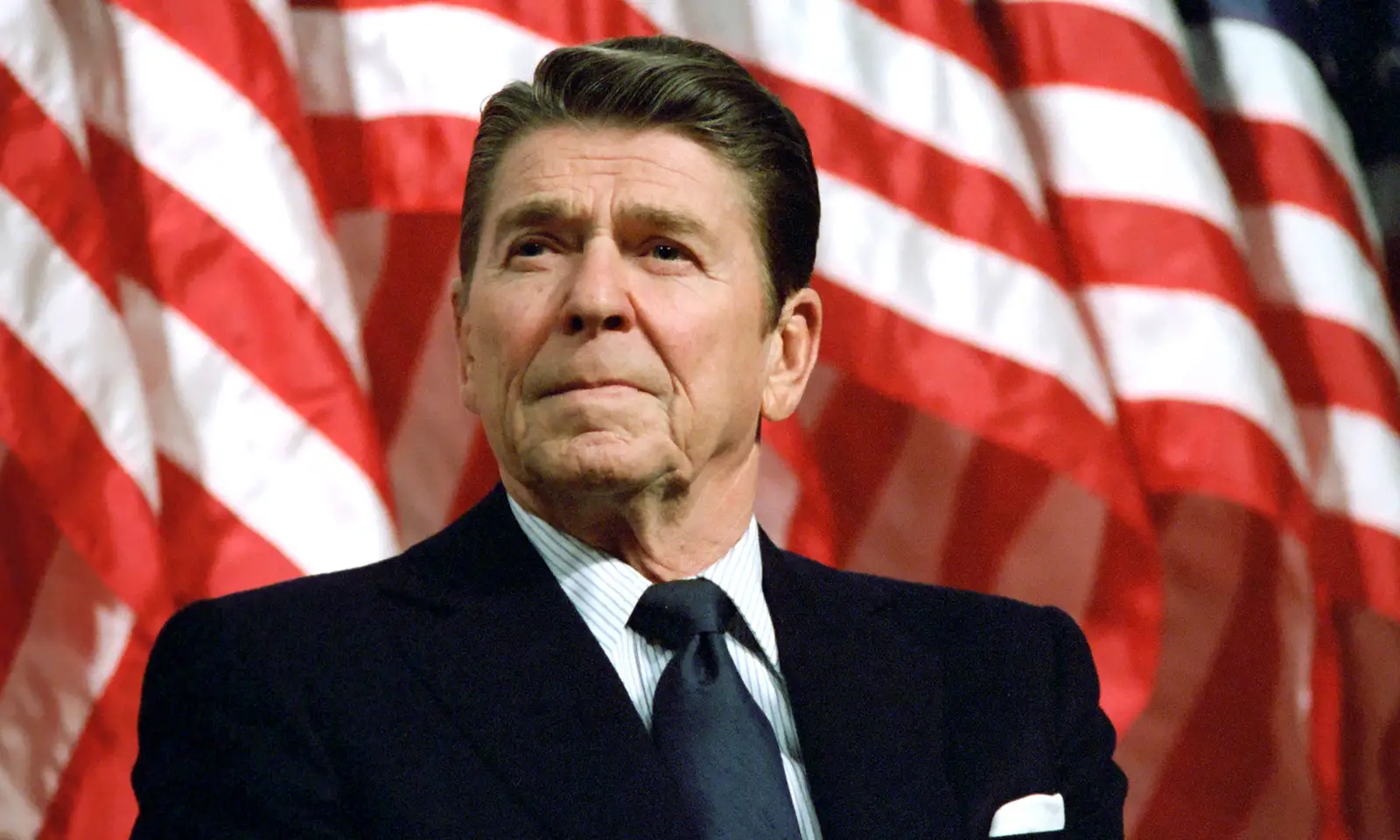
On Tuesday, The Atlantic published an article by Tim Naftali headed “Ronald Reagan’s Long-Hidden Racist Conversation with Richard Nixon.” The subheading: “In newly unearthed audio, the then–California governor disparaged African delegates to the United Nations.”
I will quote Professor Naftali’s article:
The day after the United Nations voted to recognize the People’s Republic of China, then–California Governor Ronald Reagan phoned President Richard Nixon at the White House and vented his frustration at the delegates who had sided against the United States. “Last night, I tell you, to watch that thing on television as I did,” Reagan said. “Yeah,” Nixon interjected. Reagan forged ahead with his complaint: “To see those, those monkeys from those African countries—damn them, they’re still uncomfortable wearing shoes!” Nixon gave a huge laugh.
Many of us found this line sickening — especially the word “monkeys.” We also found it uncharacteristic of the Reagan who lived for more than 90 years — 1911 to 2004 — and has been studied and pored over from every possible angle.
I wanted to talk, right away, to Lou Cannon, the veteran journalist and book-author. He has written a slew of books on Reagan, beginning in the 1960s. I once heard someone on television — I can’t remember who — describe Lou as “Reagan’s Boswell.”
Lou wrote me,
Reagan was often cavalier in what he said about African nations in contrast to what he said about black Americans. One of his lines was the following (about African nations): “It wasn’t so long ago that, when they had you for dinner, they had you for dinner.” When Reagan used this line he would emphasize the second “for” and it usually drew a laugh from his mostly white audiences. In one of my books I used this as an example of something that Reagan could get away with that most politicians couldn’t. Not sure when he stopped using this line. But he definitely was using it at the time of the cited exchange with Nixon.
I also went to Lou’s book President Reagan: The Role of a Lifetime. He spends several pages on Reagan and race, treating the subject with nuance and depth. Cannon begins as follows, speaking personally:
I do not believe that Reagan was racially prejudiced in the normal meaning of the term. He had been taught by his parents that racial intolerance was abhorrent, and the many people I interviewed who knew him as a young man were unanimous in believing that he absorbed these lessons. In his autobiography Reagan tells how he volunteered to take Eureka College’s two black football players into his home in Dixon after they were refused admission at a hotel. . . . The players were welcomed by Reagan’s parents, as Reagan had known they would be. One of these players was William Franklin Burghardt, who had played center on the line next to Reagan. The two became friends and corresponded regularly until Burghardt’s death in 1981.
Yes. I next went to a collection of correspondence: Reagan: A Life in Letters. “Dear Burgie,” Reagan would begin his letters to his old teammate, and he would sign himself “Dutch.”
Throughout his career, or careers, Reagan corresponded with movie fans, constituents, et al. Here is a note to Mr. Freddie Washington of Moss Point, Miss., published in A Life in Letters. The date of the note is November 23, 1983 (during Reagan’s first term as president).
I’ve been frustrated and angered by the attempts to paint me as a racist and as lacking in compassion for the poor. On the one subject I was raised by a mother and father who instilled in me and my brother a hatred for bigotry and prejudice, long before there was such a thing as a civil rights movement. As for the poor, we were poor in an era when there were no government programs to turn to. I’m well aware of how lucky I’ve been since and how good the Lord has been to me.
In many of his letters, Reagan defends his record as governor of California — this is particularly true of letters written between his governorship and his presidency. In August 1979, he sent a long, detailed letter to Mr. Lennie Pickard. Here is just a taste:
I realize there is a great lack of information about what I did as governor of California and it increases the farther east you go. As a result of this, I know that the minority community has an impression that I have little or no interest in their problems. When I became governor I discovered that after eight years of liberal Democratic rule in Sacramento, very little outside of rhetoric had been done for the minorities. The civil service regulations were such that it was virtually impossible for a black employee of state government to rise above the very lowest job levels. We got those rules changed.
Etc., etc. One more taste, from this letter:
My first few years as governor were during the period when people talked of long hot summers to come. We had had the Watts riots just prior to my taking office and racial tensions were very high. Without informing the press, I traveled up and down the state meeting with minority groups and leaders, sometimes in private homes, sometimes in headquarters they had in various community projects. I wanted to know firsthand what their problems were, what was on their minds, and what we could do to change things.
In quoting these things, am I excusing Reagan’s remark to Nixon in 1971? No, no. I am saying: For chrissakes, there is a bigger picture. Life is often messy, and Reagan had a long one, not without messiness — personal, professional, political, and so on. He was a man.
One more letter. In January 1983, Reagan wrote to one of his fiercest antagonists, Benjamin Hooks, the head of the NAACP. Here are the final two paragraphs:
Ben if only it were possible to look into each other’s hearts and minds, you would find no trace of prejudice or bigotry in mine. I know that’s hard for you to believe and that’s too bad because together we could do more for the people you represent than either of us can do alone.
Prejudice is not a failing peculiar to one race, it can and does exist in people of every race and ethnic background. It takes individual effort to root it out of one’s heart. In my case my father and mother saw that it never got a start. I shall be forever grateful to them.
I hate what Reagan said to Nixon, in that phone call. It is a mark against him. I also think he was a greatly admirable man, who advanced the cause of freedom, democracy, and human rights. Was he guilty of inconsistencies and hypocrisies along the way? Of course. To say it again, he was a man. Who would ’scape whipping?
What if your phone calls, and other conversations, were recorded? Would you ’scape whipping? If so, you should not be here. You would have ascended by now.
When Reagan was elected president in 1980, I was against him. (I sent a letter to President Carter, commiserating with him.) (In 1976, I had sent a similar letter to President Ford, commiserating with him!) (Maybe I sympathize with the losing side?) In November 1980, I was in eleventh grade, age 16. My town was Ann Arbor, Mich., “a small citadel of the Left,” as I call it.
My views on Reagan began to change at the end of March in 1981 — a little more than two months into his presidency. I wasn’t with him on policy, either foreign or domestic. (What did I know, by the way?) But I took a new look at the man: because, when a bullet ripped through his chest, he handled himself with real courage and grace.
No longer was he for me a cartoon: the dunce, the Neanderthal, the bigot. The nuclear cowboy (“Ronald Ray-gun”). The B-movie actor who, with a smile and some Deaver-crafted hocus-pocus, had gulled people into electing him president. That cartoon was over for me forever.
I could go on, but I’m getting too autobiographical. I want to return to Lou Cannon, and what he said to me after the Atlantic story broke. (Obviously, I publish these words with his permission.)
I do NOT consider Reagan a racist. He promoted black staffers and such. Wilson Riles, a Democrat and the superintendent of public instruction when Reagan was governor, didn’t consider him a racist either and said nice things about how California moved forward under his governorship. Riles was the first and only black person to hold the position. He’s deceased. In all the conversations I had with Reagan, and there were many, he never said anything, even a joke, that was racist in any way.
But I do think Reagan was backward in some ways on racial issues. He didn’t understand the obstacles faced by people of color.
Cannon concludes, “One way to see this is that Reagan was advanced for his generation, but his generation wasn’t very advanced on race issues.”
Back to the personal, I’m afraid — I mean, to me, moi. (You know why George Bush — the first one — often omitted the words “I” and “me”? It made his speech stilted, but when he and his siblings were growing up, their mother would say to them, if they spoke about themselves too much, “Now, that’s enough of the great I am.”)
On the night of President Trump’s rally in Greenville, N.C., last month — the send-her-back rally — my fingers twitched, hotly:
I’m gonna write a tweet that’s gonna tick a lot of people off. Reagan conservatives like me have been called racists — falsely and maliciously — all of our lives. So, to many Americans, every charge of racism, no matter how legitimate, rings hollow. Good job, wolf-criers.
The Left came down on me like a ton of bricks. I was called “racist” over and over. I wrote about the experience here. Then the Atlantic story broke, and my antagonists had a field day. “See, see! Reagan was a racist and you are a racist and your Reagan people are racist and racist racist racist.” They demanded that I say something. I did. (“Sickening,” I called Reagan’s remark to Nixon.) Then they said, “Shut the hell up, you have no right to talk. Just listen and learn.” (I have sanitized the language.)
Today, I have been thinking about the Reaganites, or “Reaganauts,” as Richard V. Allen dubbed them. (He was an early and strong one.) Some of them are dear, close friends of mine: Mona Charen, Bill Kristol. I think of — hell, let me call some of the roll — George Shultz, Thomas Sowell, Cap Weinberger, Mitch Daniels, Elliott Abrams, Linda Chavez, James Q. Wilson, Jeane Kirkpatrick, Dick Thornburgh, Paul Wolfowitz, Peggy Noonan . . .
I admired them. I still do. I thought they were right about the world, by and large — and I still do. I don’t think Reaganism equals racism. I think those who think that are bonkers.
The chief Reaganite was Reagan, of course. That he had his lapses, we have seen. We can talk about “welfare queen,” the Neshoba County Fair, etc. Garry Wills wrote a biography of Reagan, very tough on him where race was concerned. This bothered Reagan (he confessed in a letter).
Personally, I think Reagan and his administration hung on to apartheid South Africa too long — not out of racism, but out of an erring sense of Cold War needs.
But I’ll tell you this: The Left around me talked a good game about freedom, democracy, and human rights when it came to (1) South Africa, (2) Chile, and (3) the Philippines. (These were autocratic regimes that were pro-American, alas.) How about the rest of the world, including China, Cuba, and the Soviet Union, along with its empire? Oh, that was different . . .
I had better wind up now. I would invite people to reflect on, or get to know, the totality of Reagan’s life — his presidency in particular. Don’t just rely on rah-rah Reaganites — even me! — or Reagan demonizers. Get to know him: the real guy.
As president, he constantly emphasized the common humanity of Americans. Frankly, he emphasized the common humanity of people in every corner of the world, whatever their race or creed. This is not an emphasis you hear from the Right today, to put it mildly. Indeed, Reagan’s universalism — which he coupled with his true-blue patriotism, and his sense of the American interest — is scorned.
He emphasized E pluribus unum, “Out of many, one.” He never stopped soap-boxing for that. Even some of his fans rolled their eyes, I think. Contrast this with the regnant politics of today, on left and right. Think of the Balkanizers, “identitarians,” and their ilk (as Bob Novak would say). (“Ilk” was a big word for him. I can’t say it without thinking of him.)
Yeah, I’ll take Reagan and his guys, warts and all. And above all — political labels aside — you and I are individuals. At least, that’s the way I see it. We are responsible for ourselves, day by day.
Speaking of which: have a good one. Day.



Comments
On “Reagan and Race”