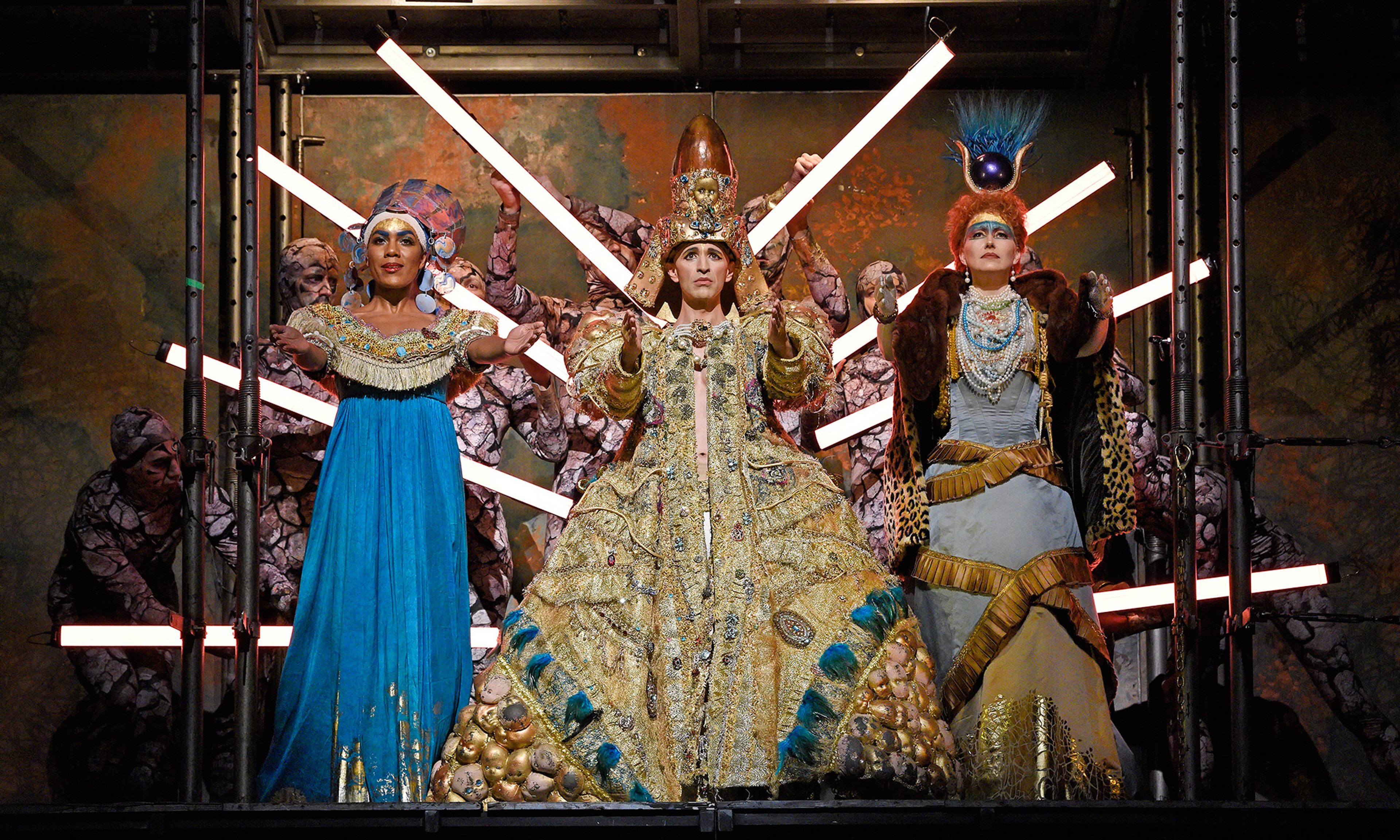
The final opera in Philip Glass’s “portrait” trilogy, Akhnaten, which premiered in 1984, had its Metropolitan debut this season. (The first two in the trilogy, Einstein on the Beach and Satyagraha, are about the lives of Albert Einstein and Mahatma Gandhi, respectively.)
The score is minimalist with maximal effect, repetitive and slowly building on themes. The libretto is primarily in English, but also makes good use of Hebrew, ancient Egyptian, and Akkadian. The performance is intrinsically ritualistic. “If Einstein epitomized the man of Science and Gandhi the man of Politics, then Akhnaten would be the man of Religion,” Glass once said of the work. Akhnaten’s most affecting passion is not physical but spiritual. While the opera, as directed by Phelim McDermott, is bright and opulent, it makes clear that its protagonist is driven not by hedonism but by principle. Akhnaten is remarkable in its depiction of the Egyptian ruler’s piety, its immemorial-sounding rhythms, and its visual composition of illumination and acrobatics.





Comments