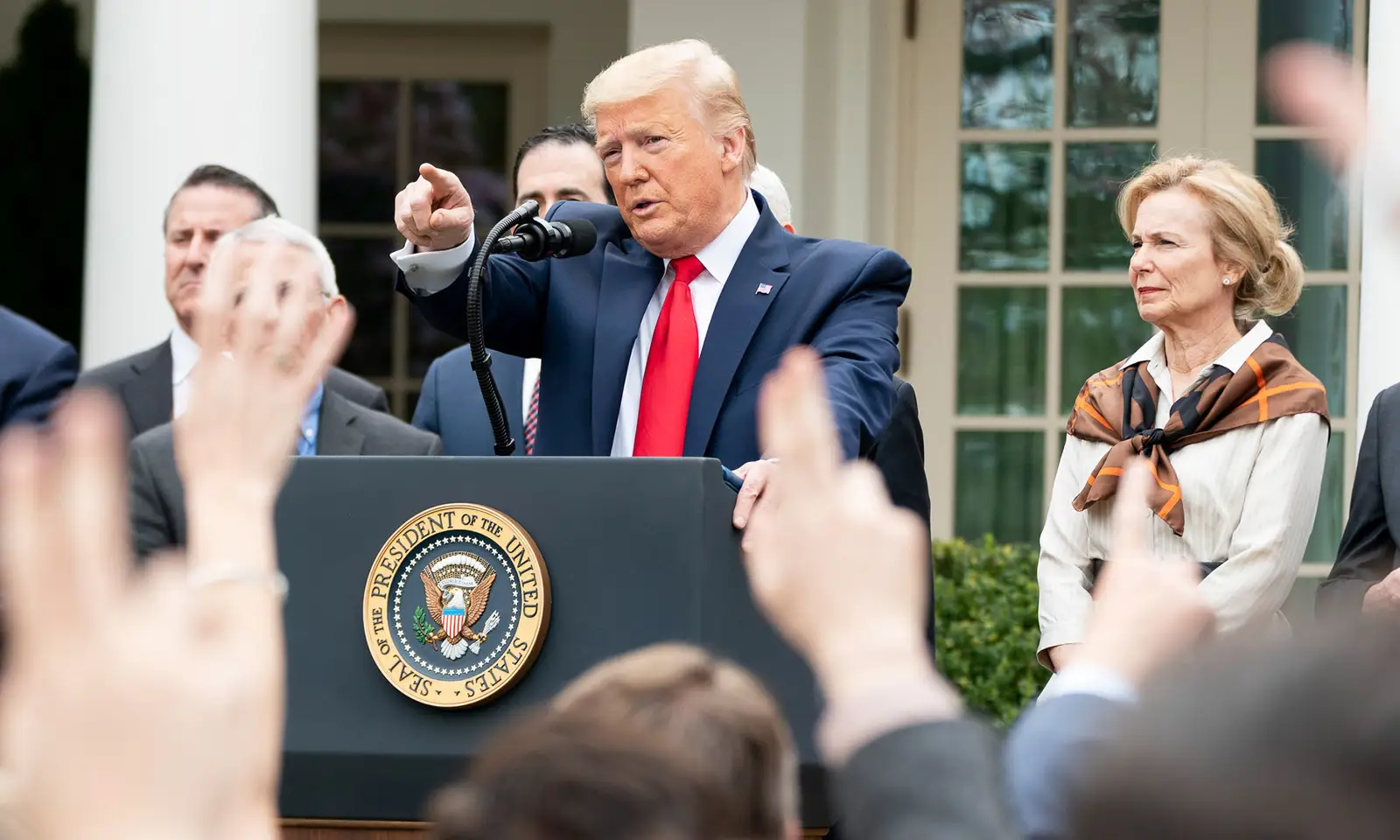
Three years before the novel coronavirus appeared in Wuhan, in a city more than 7,000 miles away, Lawfare’s Quinta Jurecic published an essay titled “Donald Trump’s State of Exception.” It hadn’t arrived yet, Jurecic conceded, and perhaps it never would. But our then president-elect had already exhibited warning signs: hedging on whether he’d accept the election result, attacking federal judges, threatening (off-the-cuff) to his 2016 rival that he would “lock her up.”
Thus Jurecic’s concern. The “state of exception” is a concept pioneered by Nazi political theorist Carl Schmitt, and means something like an emergency dictatorship — precipitated by a crisis so big and sudden and scary that it demands the suspension of law itself. This, Schmitt thought, was liberalism’s Achilles’ heel: No constitutional order could predict every possible peril that might befall it, or what exceptional measures would be needed to weather the storm; only a person could do that. The sovereign, then, is not “the law,” but he who decides on the exception to the law — on whether the peril is so great that extreme, extra-constitutional steps are warranted. (Schmitt believed they were warranted in the case of Weimar Germany — hence his steadfast support for the Third Reich.)
Jurecic’s worry — and not hers alone — was that Trump would behave as if there were a crisis when there wasn’t one, suspending the legal order for reasons of paranoia or amusement or for no reason at all. He would be America’s “first Schmittian president” — and, Jurecic assumed, a Schmittian without a cause.
That assumption was plausible the year Trump took office. It remained somewhat plausible for the next three, kept afloat through Russiagate by the possibility of self-pardon. But it is less plausible now. Now there is an emergency, there is a crisis, there is an exception, there is COVID-19 in our streets and schools and lungs — and thus far, Trump has done almost nothing to stop it, much less initiate a state of exception.
Yes, he declared an emergency. Yes, he slashed a few regulations. Yes, he regurgitated CDC “guidelines.” But this weekend, bars were still packed, parties were still happening, shops were still open. “SOCIAL DISTANCING” Trump tweeted Saturday morning. By nightfall, young people had congregated in major cities nationwide, inches apart, celebrating St. Patrick’s Day as though it were their last hurrah. For some, perhaps, it was.
For others, it was something worse. The virus may not kill the young with the same alacrity as the old, but it does infect them—as often or more so than the elderly—and they infect everyone else in turn. Experts expect hospitals across the country to be overwhelmed within two weeks. An optimistic estimate is 200,000 deaths; a pessimistic one is 2 million. And even if mortality is under 1 percent once all “mild” cases are identified, I think that it is safe to say the dead don’t care about denominators.
We won’t “flatten the curve” via tweet. If the skyrocketing number of cases in Europe is any indication, we must react to COVID-19 as forcefully as Italy, before the Italian scenario is fully upon us. And that means pushing for things that, in any other circumstance, at any other time, would rightly alarm Trump’s critics: restricting interstate travel, quarantining cities, closing non-essential stores, ordering people to stay in their homes — and punishing, with fines or worse, everyone who don’t comply.
The president can probably only do the first two things, legally speaking; state governors would have to do the rest. But Trump could tell the governors what to do. He could use all of his presidential powers, never mind his Twitter account, to cajole and coerce states into a de facto nationwide lockdown before it’s too late — and it is getting very, very late. “If Italy had strongly acted just 10 days ago,” a team of Italian doctors wrote, “there would have been much fewer deaths and economic tumble.” We are at most two weeks behind Italy on the epidemic curve — which gives us about three days to take drastic action.
It is possible that enough governors will realize this in the next 72 hours; some, to their credit, already have. It is possible — desirable — that a kind of decentralized Schmittianism will emerge, as local officials take unprecedented steps to enforce social distancing without federal direction. (The decision by Ohio’s governor to delay Tuesday’s primary contests, despite initial roadblocks, was a good example of local exception-making.)
But it’s also possible that none of this will happen, or that it won’t happen fast enough — in which case Trump will face a truly existential choice: let the equivalent of multiple 9/11s happen on his watch; or do whatever it takes to stop the virus, from commandeering hotels to military-enforced quarantines.
The president may not have the authority to do those things. A Schmittian president would do them anyway.
And the reason Trump hasn’t (and most likely won’t) is that he is too narcissistic to flex his muscle when the public good requires it, too obsessed with self-image to override a demos that, until Monday, seemed hell-bent on suicide. If COVID-19 destroys his presidency, it won’t be because of his authoritarian instincts or contempt for democracy; rather, it will be because he indulged “the people” against their own best interests, in what has already proved a self-defeating elevation of markets over men.
To be clear: I’m not suggesting Trump go full authoritarian, or that his doing so would be good, and if anything his incompetence as president speaks against the sagacity of letting him play Caesar.
I’m just saying that if America were to have a Schmittian president, or even a quasi-Schmittian one, now would be the time. That Trump hasn’t jumped at the chance confirms that the real danger of his presidency was never fascism but fecklessness—a danger which, with COVID-19, has finally come home to roost.
Editor’s Note: This article has been updated to correct an editing error.

Comments
On “Donald Trump Was Never a Carl Schmitt Acolyte”