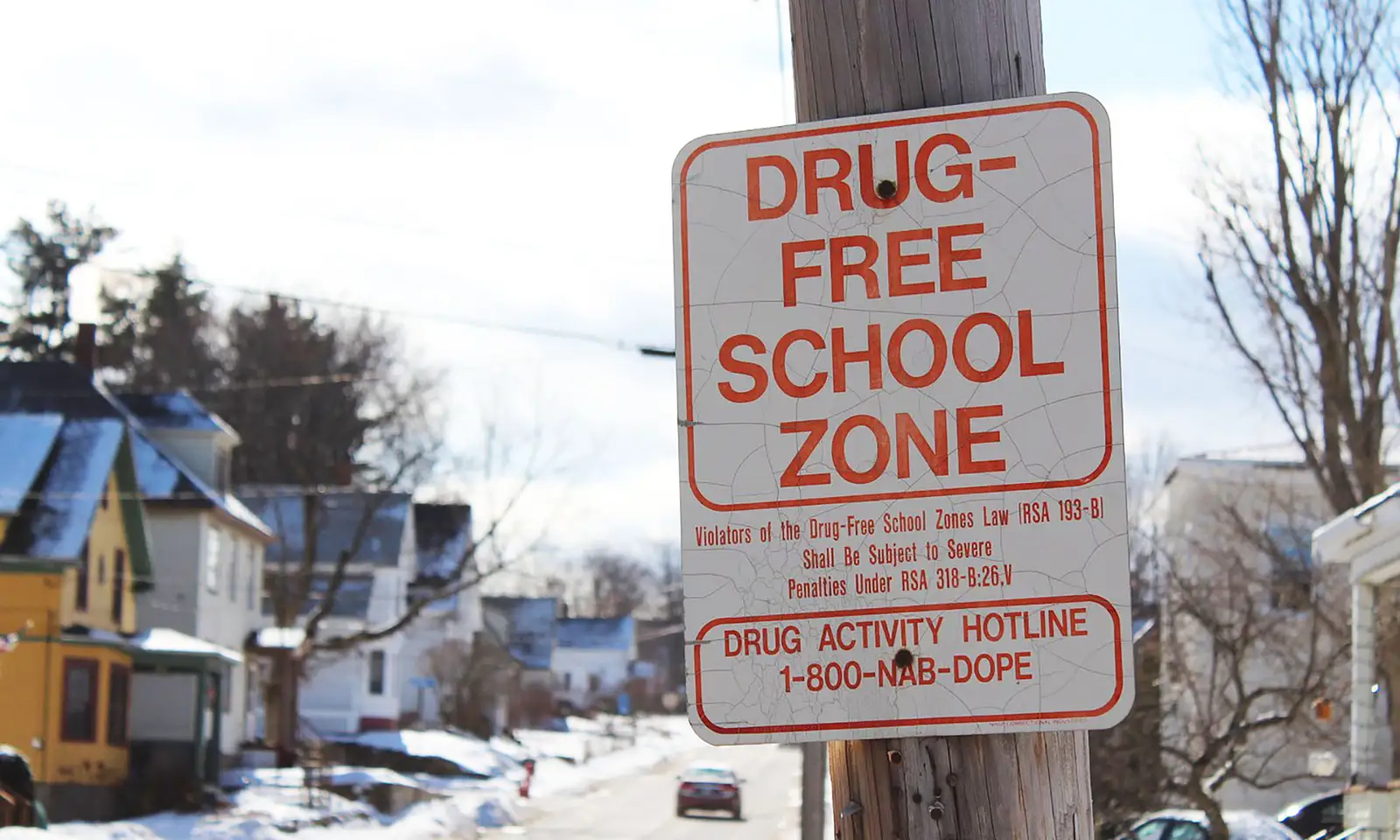
Tennessee legislators are currently considering a bill that would ease the state’s drug-free-school-zone laws — and passing it would be a huge step toward a more just government.
According to a piece in Reason, the bill, which was sponsored by Republican state representative Michael Curcio, advanced in the Tennessee House Judiciary Committee on Wednesday. It would reduce the size of the zones (from 1,000 feet to 500 feet from any school, park, library, or day care) and also do away with the mandatory-minimum sentencing requirements, allowing judges to use their discretion when punishing offenders.
“While 1,000 feet might not sound like a lot, over a quarter of the state’s total land area within city limits are within a zone,” Curcio said during Wednesday’s committee hearing, citing data from a Reason study on the laws.
As Reason notes, the sentencing enhancement has, in some cases, resulted in sentences for nonviolent drug offenses that are sometimes even stricter than those for rape and murder — and to make it even worse, “civil liberties groups, and even some prosecutors, say the laws are rarely if ever used in actual cases of dealing drugs to minors.” This is because, under the current law, it doesn’t matter whether or not any children were actually involved, whether or not the offender was in a private residence or passing through in a vehicle, or even whether or not school was actually in session at the time — the law still always applies. (The new bill also allows courts to waive the enhancement if the arrest occurred inside a private residence, while the offender was simply passing through, or during any time when there were no children on school grounds.)
In other words? The current law is straight-up draconian, it harms entire communities by levying punishments that are far too severe for the offenses, and the state desperately needs to reform it.
Take for example, the case (which I wrote about for National Review in 2018) of Calvin Bryant, who was finally freed after serving eleven years of a 17-year sentence for a first-time drug offense. Bryant had been arrested in 2008 for selling ecstasy and other pills to an informant out of his Nashville apartment, which just happened to be located within 1,000 feet of an elementary school. No children were actually involved whatsoever, but the sentencing enhancement automatically placed his case on the same level as second-degree murder or rape.
Bryant was freed only because Davidson County district attorney Glenn Funk convinced the Tennessee attorney general’s office to allow him to plead guilty to a reduced charge and be released on time served.
It’s wonderful, of course, to see that Bryant was freed — but unfortunately, it’s hard to be too happy when this law is still on the books. Reason refers to another case in which a 20-year-old man was sentenced to a mandatory 15 years in prison for selling $80 worth of psychedelic mushrooms to an informant — and notes that, overall, Tennessee Department of Corrections data shows that there are 358 Tennessee inmates serving sentences for drug-free-school-zone offenses, not including those who had originally been charged with them but agreed to plead guilty in exchange for having them dropped.
It’s far past time for Tennessee to address this issue, and it’s actually infuriating that it hasn’t done so already. After all, as Reason notes, a similar bill died in committee in 2018 — and I would hate to see the chance for an important reform go missed again.
It’s not, of course, that the legislation being considered now is perfect. In fact, I personally won’t call it “justice” until people are no longer being incarcerated for nonviolent drug offenses between consenting adults at all. The United States is, after all, supposed to be a free country — and it has never made any sense to me that choices about what to put into our own bodies aren’t ours and ours alone.
What’s more, I also agree with Bryant when he’s said he would like to see a bill that would address the people who are already suffering due to these sentence enhancements.
“It’s kind of rough when you’re sitting in prison and your injustice is being used for other people’s justice that haven’t really committed crimes yet,” Bryant said, according to Reason. “I pray there’s some relief for them down the line.”
In short, I totally acknowledge that this bill doesn’t go far enough — but honestly, it is still better than doing nothing at all.
Any adult who is actually involved in exposing a minor to drugs is guilty of a serious offense and should be punished with a severity that reflects that seriousness.
The truth is, though, it makes no sense to dole out these punishments — which are explicitly intended to deter people from selling drugs to children — in situations where there weren’t any children involved. Kids shouldn’t be out there getting high, that’s obvious; but what’s equally obvious is that no kid is going to get high because a pill happened to be in someone’s car on a nearby road. The reality is, punishing people by using a sentencing enhancement that was clearly intended to punish people who had been doing something far worse is, by definition, a miscarriage of justice. In all practicality, it amounts exactly to punishing a person for a crime he didn’t commit, and it has to stop now.





Comments
On “Tennessee, Do the Right Thing and Reform Your Harmful Drug-Free-School-Zone Laws”