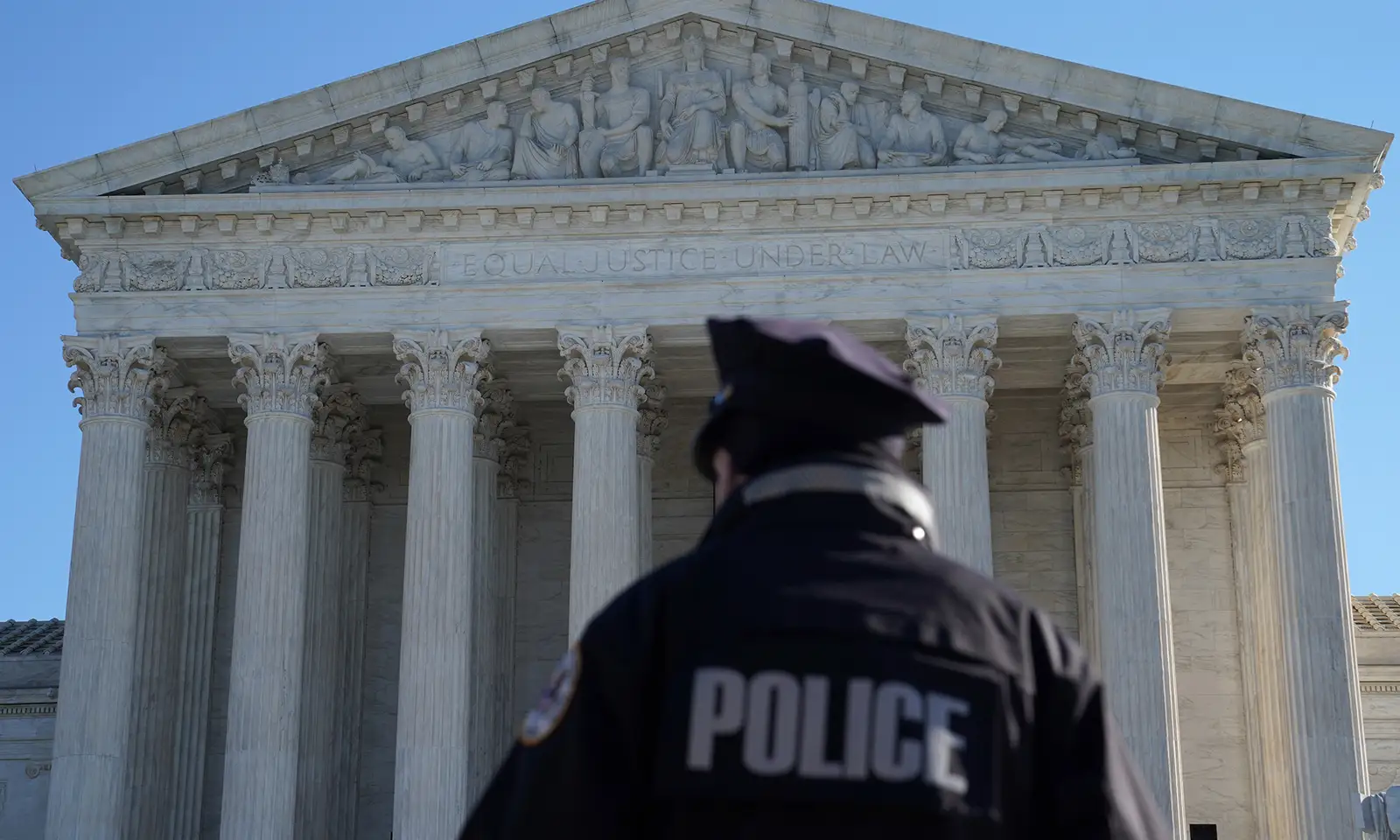
The Supreme Court has managed to transform a very straightforward issue into something quite complex. Don’t blame the current justices, though. On the issue in question, the right to have criminal cases decided by a unanimous jury, this is not the Court’s first rodeo.
In Monday’s decision, Ramos v. Louisiana, the Court correctly ruled (a) that the right to a jury trial, which is specified in Article III, Section 2, and yet again in the Sixth Amendment, includes the right to a unanimous verdict and (b) that this federal constitutional right applies to the states.
The case centers on Evangelisto Ramos, who stood to spend the rest of his life in prison for a serious crime on which he was convicted at a state trial in Louisiana by a jury whose verdict was 10–2 against him. That would not be good enough to convict him in 48 states or federal court, which require unanimous verdicts. But two states, Louisiana and Oregon, have permitted non-unanimity since shortly before the end of the 19th century.
These two states are lonely outliers from the centuries-long understanding of what a jury trial is. The reprehensible rationale for their diversion, at least originally, was racial prejudice. In the legacy of Jim Crow, Louisiana was attempting to water down Reconstruction-era constitutional amendments and civil-rights legislation that ensured the fundamental rights of African Americans to serve on juries. Oregon, similarly, was attempting to dilute the influence of racial, ethnic, and religious minorities.
Louisiana and Oregon have long since renounced the racist underpinnings of their non-unanimity rule. Yet they nonetheless retained it on less noxious but still ill-conceived reasoning: the theory that non-unanimity discourages hung juries, which waste resources, since cases then have to be retried. Besides ignoring that a unanimous jury is a fundamental right, this theory proceeds on two faulty assumptions: (1) Hung juries are worse than wrongful convictions or acquittals and (2) permitting non-unanimous verdicts makes hung juries less likely — to the contrary; it undermines the spirit of open-minded deliberation that encourages juries to arrive at a consensus.
The Ramos case should have been as simple as: The Constitution requires a unanimous jury, that applies to the state, Ramos was “convicted” by a non-unanimous jury, conviction reversed, case closed. It was not closed, because of a confusing precedent from the Seventies, the era of confusing precedents: Apodaca v. Oregon (along with its companion case, Johnson v. Louisiana).
The nine justices in that 1972 case acknowledged unanimity as a constitutional requirement, and four dissenters were prepared to reverse non-unanimous convictions. But four justices, leaning against imposition of federal constitutional mandates on the states, reasoned that the issue, in “contemporary society,” was whether unanimity’s costs outweighed its benefits. Deciding it did not, they voted to uphold non-unanimous convictions. It was left to Justice Lewis Powell to break the tie. He sided with the states’-rights plurality, pressing his peculiar theory that the Court’s doctrine of incorporating constitutional rights against the states should proceed on a “dual track.” That is, Powell believed that the states had to honor the incorporated rights in some form but that they were free to interpret those rights differently from federal law. This theory had no support then and has been rejected since.
To summarize, Apodaca has stood as precedent for nearly half a century, even though it denied the right to jury unanimity, the wrongness of its result has been patent, and its deciding vote was based on a wayward theory of dual-track incorporation that is untenable — and was untenable even when Apodaca was decided.
In Monday’s 6–3 ruling, the justices threw Apodaca overboard and vacated Ramos’s conviction. The majority opinion by Justice Gorsuch was essentially joined by Justices Ruth Bader Ginsburg, Stephen Breyer, Sonia Sotomayor, and Brett Kavanaugh. Justice Clarence Thomas concurred in the judgment, but on importantly different reasoning that I shall come to momentarily.
Justice Samuel Alito dissented in an opinion that was a ringing endorsement for stare decisis. That is the doctrine of promoting predictability in the law by adhering to precedent, even precedent conceded to be wrong, if too much upheaval would be wrought by reversal in light of longstanding reliance on those rulings. It is not surprising to find Chief Justice John Roberts signing on to such a dissent, but some eyebrows will be raised at Justice Elena Kagan’s joining in. More indication, perhaps, that she and Roberts are the Court’s emerging center of gravity, along with Kavanaugh — who, though in the majority, wrote a separate concurrence in a dubious effort to add more clarity to the stare decisis jurisprudence. Justice Kagan, I suspect, sees robust stare decisis as the best strategy for the liberal bloc in fending off any future rollback of progressive sacred cows by the conservative majority.
Key to the dissent was its insistence that the original racist underpinnings for allowing non-unanimous juries had been superseded. In the dissenting justices’ view, this stripped things down to the inadvisability of undoing an infirm but decades-old precedent.
Justice Gorsuch’s majority opinion — aside: he is such an engaging writer — convincingly countered that the legacy of racism was essential to understanding what an unwelcome departure non-unanimous juries were from the basic constitutional and common-law understanding of what a jury trial is. As for stare decisis, Gorsuch illustrated that Apodaca is not just wrong but indefensible. Moreover, it has been relied on by only two states, meaning that reversal will cause much less disruption than several of the Court’s past reversals, which have roiled the criminal-justice system nationwide.
Justice Thomas emphatically agreed that the Sixth Amendment requires unanimous jury verdicts. He could not agree with the majority’s ruling, though, mainly because he does not accept the Supreme Court’s incorporation jurisprudence.
As Thomas points out, the privileges-and-immunities clause of the Fourteenth Amendment plainly and expressly ensures that the enumerated rights of the Constitution may not be abridged by the states. Yet the Court has failed to interpret the clause this way. To compensate for this error, the Court’s incorporation doctrine purports to apply the Bill of Rights to the states through the Fourteenth Amendment’s due-process clause. Thomas, however, has long rejected the notion that a mere guarantee of process before fundamental rights may be infringed somehow defines the substance of those rights. I believe that he is correct, and that the hocus-pocus of using a procedural guarantee to craft substantive rights (many that turn out not to be in the Constitution at all) is sheer judicial legislating. In any event, Justice Thomas would hold that the right to a unanimous jury verdict in state criminal cases is among the privileges and immunities safeguarded by the Fourteenth Amendment.
So, yes, this seemingly simple case generated five separate opinions (Justice Sotomayor wrote one, too). That’s a lot of telling us how to build a clock, but the justices did get the time right.




Comments
On “The Supreme Court Holds That Jury Verdicts in State Criminal Cases Must Be Unanimous”