Probably my favorite cinematic swipe at groovy Nordic collectivism is the 2000 comedy Together, Lukas Moodyson’s droll and dryly funny look at the dynamics of a Seventies Stockholm household in which several families are living communally. From the eyes of kids who haven’t yet been fully brainwashed by utopian socialist dogma, it all looks pretty skeevy. One of the film’s gentle, soft men explains the wisdom of gentle, soft collectivism to two kids in these terms:
You could say that we are like porridge. First we’re like small oat flakes — small, dry, fragile, alone. But then we’re cooked with the other oat flakes and become soft. We join so that one flake can’t be told apart from another. We’re almost dissolved. Together we become a big porridge that’s warm, tasty, and nutritious and yes, quite beautiful, too. So we are no longer small and isolated but we have become warm, soft and joined together. Part of something bigger than ourselves. Sometimes life feels like an enormous porridge, don’t you think?
The punch line is when the soft man serves his soft meal — a big glop of sticky, ghastly, gray, tasteless mush — as though this were the endpoint of all world cuisine, not to mention world politics. Thought bubble over the kids’ heads: “Er, yum?”
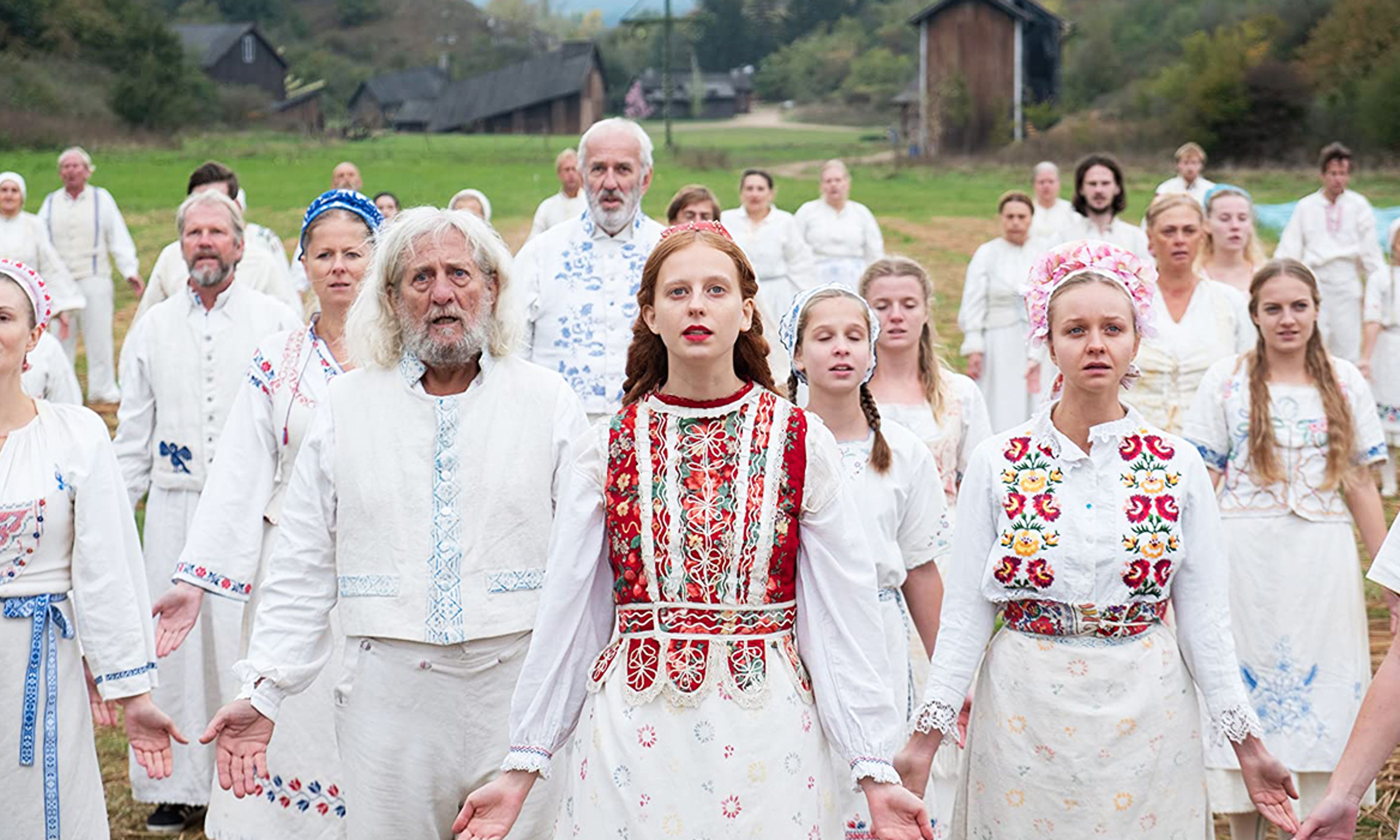
Last year, Midsommar, from the young auteur Ari Aster, dismantled Nordic collectivism from a fresh and wickedly effective angle: the horror-thriller. Midsommar (streaming on Amazon Prime) is what you should show your half-bright nephew after he has worn out his first Eurail Pass and comes home saying, “Europeans are so much more sophisticated than we are. They’re so much less uptight about sex and drugs. They’re not hung up on Christianity like we are. They’re in touch with nature. Everything is designed for the common good . . .”
Midsommar, which combines the nightmare paganism of The Wicker Man with the stately, painterly elegance of The Shining, initially struck me as a tangy satire about loutish men getting their comeuppance for their cruelty towards a woman. But it can also be read as a vicious riposte to the typical naïve college kid’s notions of the superiority of European collectivist thinking.
Spoilers follow. The film takes place in the context of ongoing tension between Dani (the captivating Florence Pugh, one of today’s most brilliant young actresses) and her boyfriend Christian (a first-rate Jack Reynor). She desperately needs emotional support from him both before and after her manic-depressive sister kills herself and their parents in a murder-suicide, but Christian remains coolly aloof as his friends push him to dump her for being a clingy bore. They’ve been dating just shy of four years, which he refers to as just over three and a half years. His lack of commitment to her is ugly, and it’s evident in every moment they spend together, but instead of breaking up with her, he’ll evidently just keep stringing her along indefinitely. If she ever walks away, he’ll just move on to behave the same way with the next girlfriend.
Christian, his two American dude-bro friends, and a Swedish exchange student, Pelle (Vilhelm Blomgren), are planning a big trip to Sweden in two weeks, but Christian hasn’t told her this and she finds out only by accident. He issues a half-hearted invitation to join them, hoping she’ll get the hint and say no, but she can’t be alone in such a fragile state and says she’ll come along. The decision irks everyone except Pelle, who promises to treat them to joining his native area’s commune to take part in its nine-day midsummer festival, which to the others sounds like a fun party and also interests them as anthropological research. They’re graduate students. (Old line from Tina Fey’s 30 Rock: “We might not be the best people, but we are not the worst. Grad students are the worst.”) Pelle shows Dani a picture of last year’s May Queen and his glance lingers meaningfully on her.
After the action moves to the Midsommar festival on a small commune in a meadow in northern Sweden, things get increasingly dicey. At each stage Dani counsels caution while her boyfriend and the other two dude-bros agree to jump right into whatever the commune is doing, starting with taking whatever drugs they’re given. When the male half of a London couple they meet disappears, this is a red flag to Dani. When she mentions it to Christian, he takes half a second to listen, then carries on with an anthropological conversation he was having as if nothing had happened. “For the first time, she actually looks scared of him,” says a side note in Aster’s script. Among Christian, Dani, and the two other guys, she’s the only one who thinks like an individualist American. The rest of them have been sucked into the ways of the commune, where everything is unified. Everyone eats the exact same things at the exact same time according to rigidly enforced etiquette. Everyone sleeps under the same roof. Later we’ll discover that everyone feels (or at least pretends to feel) pain at the same time, and a bunch of women participate in a group sexual experience.
Life on the Midsommar commune is just a step or two beyond the Euro-socialist vision, and not too far from the preferences of American liberal Democrats who dream of turning America into a nice, warm, Nordic porridge-state, where pesky individualist oat flakes get subsumed into the mass. The stages of life on the commune are defined as spring, 0 to 18; summer, 18 to 36; autumn, 36 to 54; and winter, 54 to 72. Dani is the only one who asks what any American individualist would ask: What happens when you turn 72? The answer from the American progressive Left today is similar to the answer on the commune: Joe Biden’s coronavirus adviser, Ezekiel Emanuel (Rahm’s brother), believes that he and others should die at age 75 rather than become frail and pathetic. In Midsommar, you must depart this life at 72. “Instead of getting old and dying with shame and pain and fear, we give our life. As a gesture. Out of gratefulness. Before it can spoil,” one of the Swedes says, and this is the part of the movie where Emanuel leaps to his feet and shouts, “Bravo!”
By the time this principle has been enacted bloodily before her eyes, Dani has seen enough, and wants out of this Scandinavian utopia. “Are you not at all disturbed by what just happened?” she asks Christian. His answer is classic lefty relativism: “I mean, of course it was shocking. But I’m also trying to keep an open mind.” As Dani gives him a stare of disbelief, he says, “It’s cultural. We abandon our elderly to nursing homes. I’m sure they find that disturbing.” Christian and his fellow dudes deserve what’s coming for them, both for being horribly insensitive to Dani’s suffering and for believing all the Scandi happy talk in this ink-black satire of a socialist society.






Comments