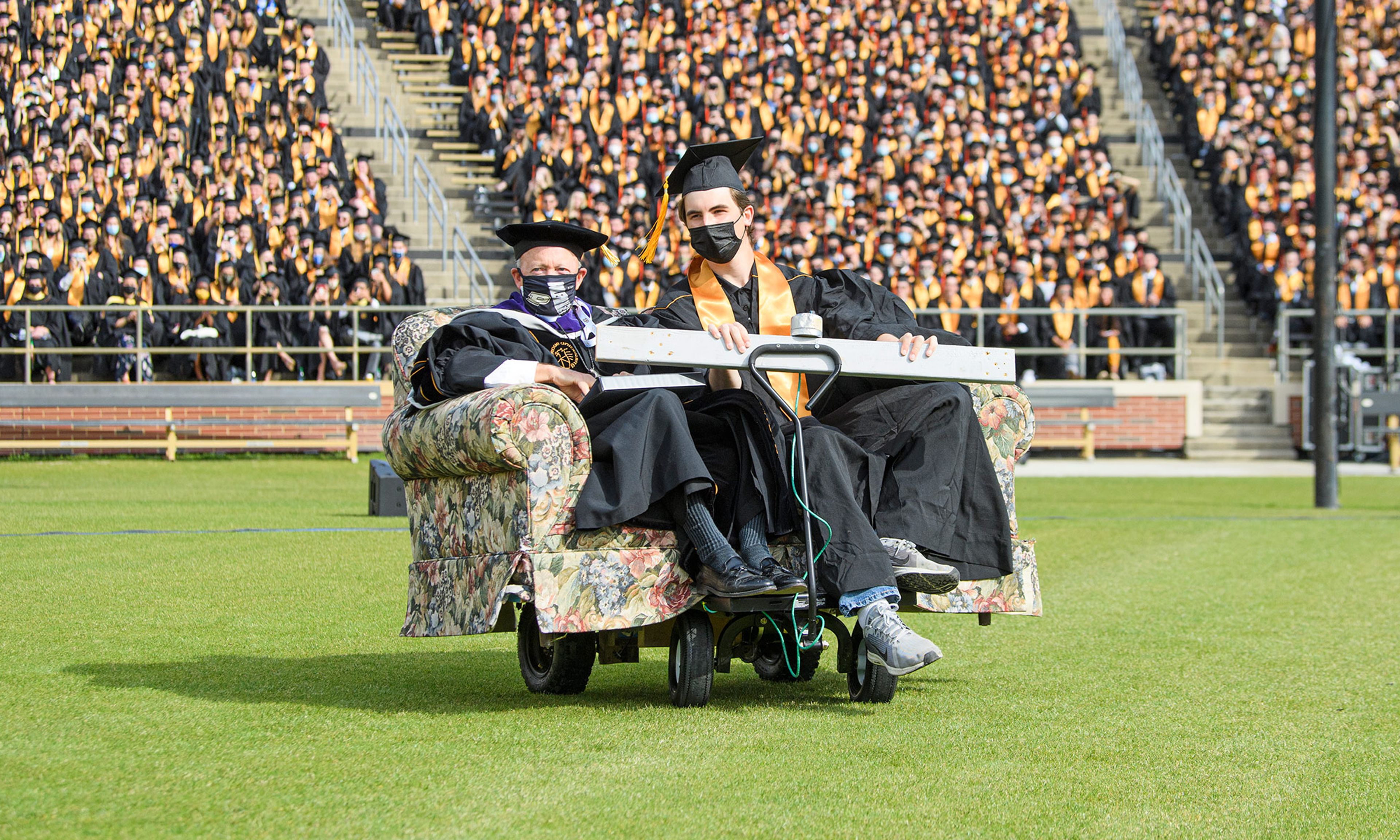
A Purdue official wrote me to say, “Nothing says college like a nasty couch, and a couple of our STEM-minded students here at Purdue took theirs and motorized it.” They rode it around town, and garnered some media coverage. Eventually, Mitch Daniels asked for a ride. He rode the couch into Purdue’s graduation ceremony.
Couch as coach? Yes.
Mitch Daniels, as you know, is the president of Purdue. He is a former governor of Indiana, a former White House budget director, a onetime Reagan aide, etc.
You can see a video of Daniels and his couch ride here. And you can read his commencement address here. Interesting to think of graduation as a beginning, a commencement, instead of an ending, isn’t it? Daniels’s speech was about risk-taking — he’s in favor of it. Sensible risk-taking, that is.
Is there such a thing? Is “sensible risk-taking” a contradiction in terms? I don’t think so.
“Great societies before us tended to look backward for their inspiration,” said Daniels. They tended to “locate their golden ages in the past.” But “here our eyes have always been forward.” He means America at large, not Purdue specifically. “Now signs abound that Americans are losing that eagerness to move ahead boldly.”
Daniels continued,
Before the virus visited us, there were already troubling signs that fearfulness was beginning to erode the spirit of adventure, the willingness to take considered risks, on which this nation’s greatness was built and from which all progress originates. Rates of business startups; moving in pursuit of a better job; or, the strongest of all bets on the future, having children — all have fallen sharply in recent years. And now there are warnings that the year 2020 may have weakened that spirit further.
Concluding his address, Daniels said that “the biggest risk of all is that we stop taking risks at all.”
Well, this makes me determined to take more risks than ever. The YOLO spirit swells up. (“You only live once.”) (Actually, in perfectly correct English, that should be, “You live only once.” But I’m not doing a language item here . . .)
• I would like to share an obituary with you: “Yitzhak Arad, Who Led Holocaust Study Center in Israel, Dies at 94.” What a life. “A survivor of the Nazis, Mr. Arad was an esteemed scholar and the longtime chairman of the Yad Vashem complex of museums and archives in Jerusalem.” I would like to make maybe three points.
Says the obit, “His parents and 30 close family members would perish before the war ended in 1945.” I don’t know about you, but I can’t stand the word “perish.” This is strictly personal. I mean, there’s nothing strictly wrong with it. But I think you perish of hunger or something — in an earthquake — not murder.
“Mr. Arad remained active with Yad Vashem until his last weeks.” Here was a man who never embraced darkness but who determined to live, and wring every last drop out of life.
Said Yitzhak Arad, alluding to the Holocaust, “What happened in the past could potentially happen again, to any people, at any time.”
Oh, yes.
One more point, kind of an idle one: In my lifetime, we saw the passing of the last World War I vet. Fairly soon, there will be no more World War II vets. Or Holocaust survivors. I’m glad we have so many — so many — on record.
• I received a letter from a reader in Virginia:
The recently nominated Republican candidate for governor, Glenn Youngkin, advertised himself during the primary campaign as a “Christian conservative.” Gee, Jay, I didn’t know that there is now a religious test for office in the United States. Or, being Jewish, am I too sensitive? I’ll try to find some Muslim, Hindu, Buddhist, and atheist conservatives to see if they share my sensitivity. Nice way to grow a party.
I must say I understand his point. I think most of the Right would come down on this reader like a ton of bricks. I do understand him. Sometimes you have to slip into the other guy’s shoes.
• Does it matter how you kill someone? Does it matter how a state executes someone? I recently raised this with some colleagues, and the general answer was, Hell, yes, it matters. You want to tie some rocks on someone and throw him in the river?
I’m not sure. I was thinking about the matter because of news out of South Carolina. Let me quote a CNN report:
Republican South Carolina Gov. Henry McMaster on Friday signed into law a bill allowing death row inmates to elect execution by electric chair or firing squad if lethal injection drugs are not available . . .
The change in South Carolina’s law comes as states nationwide have hit barriers executing those on death row due to problems administering lethal injections, the widely preferred method in the US.
I’ll tell you what I object to: the prettying up of killing as some kind of medical procedure — nice ’n’ clinical. Sort of like a vaccination. I mean, if you’re going to kill someone — and Lord knows there are arguments, in favor of capital punishment — kill ’im. And if deterrence is your aim? The more gruesome, the better, maybe.
• Here is a fascinating — absolutely fascinating — article by Andrew Higgins in the New York Times. “A Scratched Hint of Ancient Ties Stirs National Furies in Europe.” Huh? The subheading makes things clearer: “Czech archaeologists say marks found on a cattle bone are sixth-century Germanic runes, in a Slavic settlement. The find has provoked an academic and nationalist brawl.”
Yes, absolutely.
Let me quote a paragraph:
Because past and present are so intertwined, the runic bone discovered in Lany has stirred passionate debate, with some nationalist-inclined Czechs denouncing it as an effort to undermine national identity in service of the European Union, a project founded on the idea that Europeans must and can get along. One of the members of the team who identified the markings as German runes even received death threats.
I have an observation, just tentative — bear with me: Except for certain religious people, with a universalist outlook, and certain romantics and eccentrics, people are naturally tribal and nationalistic, and there’s not a damn thing you can do about it. You just duck, and hope the wreckage is not too great.
Can America keep its “exceptionalism”? Can it remain a “creedal nation”? An important question — a mega-question, as John McLaughlin would say — but I’m moving on . . .
• . . . to Wales. “A Curious Golfer, a Lawn Mower and a Thousand Hours in Lockdown.” The explanation comes, once more, in the subheading: “During the coronavirus pandemic, Chris Powell became obsessed with his Welsh town’s golf course, long lost to time and the land. Then he rebuilt it, to play for a single day.”
Marvelous. May there always be an England — and may there always be a Wales.
• May there always be a Dick Van Dyke, too. I have another article to recommend: “At 95, Dick Van Dyke is still the consummate showman. And he’s desperate to get back onstage.” The magnificent spirit of the subject shines through the article. The very thought of him makes me smile — same with you?
• I have one more obit to mention, which has taken me on a trip down Memory Lane. Paul Kellogg, who ran New York City Opera, has died at 84. I’d like to quote a stretch of the obit:
The defining moment of Mr. Kellogg’s career came just four days after the terrorist attacks of Sept. 11, 2001. City Opera had been scheduled to open its fall season on the evening of Sept. 11 with a grim new production of Wagner’s “Flying Dutchman.” At the behest of city officials, the company opened with a matinee performance of the Wagner on the 15th instead.
Nervous audience members wondered whether it was even appropriate to be at the opera. Then the curtain rose to reveal a large American flag hanging above the stage and, standing closely together, almost every member of the company: singers in costumes, administrators in business attire, stagehands in dusty jeans and T-shirts, and Mr. Kellogg, in the middle.
The performing arts, he said in a quavering voice, have many functions: “catharsis, consolation, shared experience, reaffirmation of civilized values, distraction.” So, he added, “We’re back.”
Everyone in the house joined in singing the national anthem. Then Mr. Kellogg, engulfed in hugs, led the City Opera family offstage and the performance began.
I attended a performance on 9/13 — in other words, two days after the attacks. It was of a Broadway show, Contact. Something similar occurred: a lining-up of everyone on stage; a brave, defiant, patriotic speech; and the singing of the national anthem. It could have been “God Bless America” or “America the Beautiful.” I can’t remember. I’m slightly sketchy on the details. I wrote up the experience in Impromptus, immediately, but can’t find it on Google.
Anyway, a stirring moment.
• There is worry about the performing arts, in this pandemicky period. Will they come back? What will they be like? Will the audience be there? George F. Will sometimes describes himself as “a short-term pessimist and a long-term optimist.” I know the feeling.
Obviously, we have always had the performing arts (whether they have been called that or not). Ever since man first emerged from the swamps or caves, he has sung, danced, played, etc. It goes without saying that the performing arts will last. They will last until man takes his final breath.
But for the time being, I’m a little worried. You remember Keynes, don’t you? “In the long run, we’re all dead.” The long run is very important. But short runs, too, mean something . . .
Last week, I received a note from a friend:
We heard our first live concert yesterday since the start of the pandemic. Anthony McGill played a Schubert sonata beautifully, and it brought tears to my eyes. The audience was very moved, too.
Good, good. Thanks for joining me today, everyone, and see you soon.
If you’d like to receive Impromptus by e-mail — links to new columns — write to [email protected].




Comments