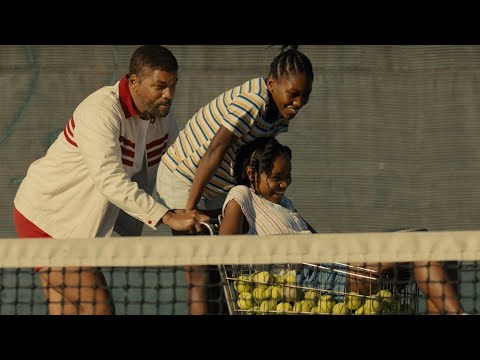
Will Smith serves up aces in King Richard, but the film makes Venus and Serena Williams almost incidental characters in their own rise to greatness.
Will Smith serves up aces in King Richard, but the film makes Venus and Serena Williams almost incidental characters in their own rise to greatness.
V enus and Serena Williams didn’t get to be who they are by accident. But the new Will Smith–produced movie starring Will Smith, in which practically every scene is built around Will Smith giving a prophetic speech or a motivational speech or an angry speech, makes the sororal tennis champs seem almost incidental to their own rise to greatness. “You gonna be the greatest of all time,” Smith tells the sisters as their father. “You know how I know? Because I planned for it.” Well, it’s in the bag, then, Dad.
Smith, however, is still one of the most charming men on Earth, so King Richard, the story of Richard Williams, mostly works. As a portrait of a fiercely dedicated father who was born poor in Shreveport, La., in 1942 and knew what traps awaited people from Compton, Calif., where he raised the two girls and their three half-sisters with his wife Oracene Price, the movie is uplifting in the way 1980s Oscar movies used to be. Unfortunately, it also falls prey in spots to contrivance, and has a very-2020s habit of making knee-jerk references to white racism that don’t belong here. Out of nowhere, for instance, it brings up the Rodney King story, as though police brutality were a major potential obstacle to Venus (Saniyya Sidney) and Serena (Demi Singleton).
But Richard — who is still alive, though in poor health— emerges as a kind of exasperating genius and a prodigy in his own right, an out-of-nowhere coaching virtuoso. As you’d expect, the movie downplays his faults, of which there were many. He wasn’t an ideal dad to all of his children, for instance; there were five older ones from whom he was estranged and of whose existence Oracene (nicknamed Brandy) was unaware.
Not that any of this diminishes the impressiveness of his determination and the accomplishments it produced. Richard maps out his girls’ future when they’re little kids, in a 78-page manifesto. Meanwhile he works as a security guard and becomes a self-taught tennis expert by studying magazines. Despite not enjoying a life of leisure, he and Oracene (Aunjanue Ellis) get the girls out on the public tennis courts at four years of age, spend lots of time practicing with them, and give them superb technical advice. Early on, Richard accurately predicted Venus would be the top-ranked player in the world, and that Serena would be even better. He not only pushed them to that level, he also placed a lot of value on forming them into educated, well-rounded people instead of single-minded tennis brats. In a bold and questionable move that is ultimately vindicated, he pulls them out of the junior-tennis circuit to practice out of the public eye for several years because he doesn’t want them to burn out like several young female stars before them, notably Jennifer Capriati, who veered off-track at age 17 and whose story looms as a warning in the background of this picture.
Directed in straightforward sentimental style by Reinaldo Marcus Green from a script by Zach Baylin, King Richard is infused with hearty American optimism, packed wall to wall with motivational one-liners and projections of titanic self-confidence. Is there any other country where so many people believe they can simply will themselves to greatness? Is there any other country that is so eager to prove dreamers like Richard correct?
All along the way, generous white folks help the family out, including a coach named Paul Cohen (Tony Goldwyn) who offers free lessons to Venus. The family meet Cohen when they simply barge onto a court where he is overseeing a practice session between John McEnroe and Pete Sampras. Color me skeptical that it happened that way. I also find it hard to believe that Richard, after getting beaten up twice by local gang members, went to shoot one of them at a store, only to have his work done for him when the leader of the crew got gunned down before his eyes. These kinds of Hollywood contrivances used to be routine, but they’ve become less and less forgivable as audiences have become more sophisticated.
Moreover, the movie cuts against itself in a ludicrous scene when Richard storms out of a deal smarting like an Oberlin student who has just suffered a microaggression at a poetry seminar: He doesn’t like it when a white guy refers to Venus’s story as “incredible” because that’s obviously racist. When told (accurately) that athletes have only a brief window in which to shine, Richard says, “Peoples like us, we get shot when we go through those!” Huh? Not long after this, Nike is offering a 14-year-old Venus a $3 million contract before she has even played a pro match. That doesn’t sound much like getting shot crawling through a window.
Richard also declares “This junior circuit is worse than the ghetto.” Preposterous. By this point in the movie, we’ve seen one murder and two savage beatings, all of which are considerably more gruesome to behold than the bitchy tennis parents Richard hates. And after the events depicted here, Venus and Serena’s sister Tunde (lovingly portrayed in the film by Mikayla LaShae Bartholomew) was murdered outside a trap house by members of the Crips. Tennis moms may be tough, but they’re not Crips.