

Powersports visionary Ken Block’s death shocks, largely because we fans came to believe he was invincible.
Powersports visionary Ken Block’s death shocks, largely because we fans came to believe he was invincible.
K en Block is dead. The entrepreneur and powersports celebrity met his end beneath an overturned snowmobile on the vertiginous slopes of Utah’s Wasatch County on January 2. He was 55 years old, leaving behind a wife and three children. After a life witnessed by many fans through the fisheye lens of dozens of GoPros, he died on a relatively routine snowmobile outing.
His death is a shock, not because he never risked his life but because he was ever flirting with mortality within and without fire-breathing machines. Block’s fans and peers observed him scud around the reaper’s blade at 110 mph with rear wheels churning dirt and asphalt for traction hundreds of times, so it’s difficult to square his end with such a legacy of invincibility.
At his core, Ken Block was an American capitalist and practical physicist in the constant pursuit of joy, or as he’d put his philosophy, “Go Fast Risk Every Thang.” Through his commercial success as a SoCal snowboarder-turned-gear developer, he and a friend co-founded DC Shoes in the mid ’90s. A novel concept at the time, the shoe brand sought to reinforce the footwear components that see the most of the pavement during skating. If you’re like me, those fat-tongued shoes are synonymous with skate parks and longboarding, with recorded wipeouts and landed tricks in 480p YouTube clips. DC was so popular that Block ultimately sold the company for many millions in the mid ’00s and moved on to what would make him a household name — his rally racing and Gymkhana drift videos.
As a racer, Ken met with success in the X Games and Rally America, wending through forests, down earthen tracks, and up mountainsides with only the curt instructions of his navigator telling him what was around the corner. It was a testament to his self-discipline that he did as well as he did with such a late start to the sport. But his time there would have been relatively unremarkable if not for his decision to take the highly technical rally elements and transcribe them to city streets and warehouses worldwide. As he did with footwear, he did also with the automotive sport he loved, making it popular with the multitudes as the head “Hoonigan” of “hooning” (the art of throwing cars around bends and up inclines at precisely the correct speed and angle while appearing to be wildly out of control) — and making good money for the welcome innovation.
As Block explained in a 2014 interview with John Pearley Huffman:
I wanted to be in the car more. When I grew up skateboarding, I didn’t compete in skateboarding, I just went out and had fun. Well, it’s the opposite with race-car driving. The only time I see my car is when we’re racing or testing for racing. The fun time is that time in the race. And sometimes, if the race isn’t going well, you’re not having very much fun. So, I was trying to devise ways to get the car away from the racing. And I really didn’t understand back then that most race-car drivers never get to do that. That there isn’t like a ‘fun side’ of motorsports. I discovered Gymkhana as a grassroots way to go out and play with the car. But it wasn’t until I started doing the videos and filming it that we began exploring the limits of the car and having fun.
My favorite video of Block is when he and “Captain Slow,” James May of BBC’s Top Gear, tear across an airstrip and launch off a dirt ramp with a dirt bike and military cargo plane in tow. While a British program, the enthusiasm and imagery of the piece are so totally American — brash and ebullient. Even the repressed Englishman May has to crack a smile at the G-forces washing over him as the Subaru’s exhaust offers jubilant tintinnabulations.
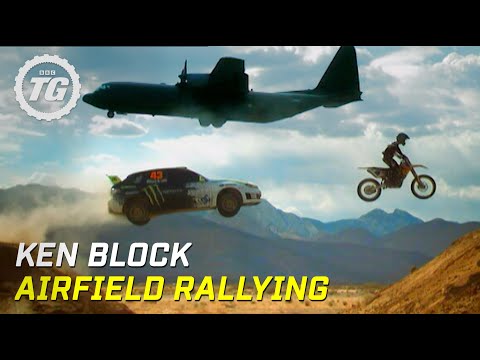
The scenes are a delight that would not have existed except for Block’s combination of vision and intelligence coupled with gobs of cash to develop parts to thrash. As he explained in another interview, to drive as he does means he has to avoid “mechanical sympathy” as it can “get in your way.” Instead, if a part can’t hold up, it gets replaced with something more robust — for instance, the French transmission for his naturally aspirated 850 hp “Hoonicorn” Mustang RTR is the same used in Dakar rally cars. Block wouldn’t accept the limitations of a machine; he’d improve it until it responded as he willed.
But for all of his perfectionism, Ken was a beloved dude; he comes across as your dad’s buddy who has a bit of money and likes fast cars and dresses like a guy 20 years younger than he is with flat-brimmed hats and T-shirts. Unlike the corporate drones in Formula 1 and the whooping NASCAR guys, Block’s manifold interests and professional obligations did not appreciably alter his SoCal cool. Months before his death, Block’s largest project was rebuilding an ’80s Audi hatchback with his eldest daughter — a car that he intended to be her first car. As he self-deprecatingly describes his own academic challenges, Block delights in explaining his daughter’s scholastic excellence and how she’s earned the right to purchase her vehicle.

Ken Block was the rare combination of self-imposed discipline married to a humble demeanor and a shrewd understanding of opportunities in the markets that mattered to him. We are richer for his successes and pastimes.
8,000 rpm for 55 years. God bless.