

A hipster director takes revenge on American pop genius.
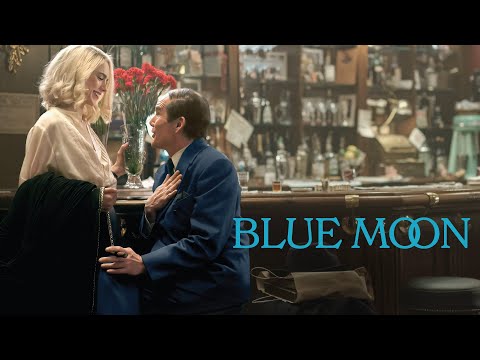
The great lyricist Lorenz “Larry” Hart first received biopic treatment in the 1948 Words and Music, a sanitized telling of his collaboration with composer Richard Rodgers. Its tribute to Hart — who had died in 1943 but was already legendary for “Blue Moon,” “Bewitched (Bothered and Bewildered),” and “My Funny Valentine” — was less a biography than a musical revue featuring performers under contract at the Metro-Goldwyn-Mayer studio, renowned for its lavish movie musical production unit. MGM understood how to celebrate the richness of Hart’s artistry in contrast to his unhappy life. Without such cultural understanding, the new Hart biopic Blue Moon is a gloomy, miserable experience.
Director Richard Linklater and screenwriter Robert Kaplow are ill-suited to enshrining the glories of American pop sophistication. Their glum approach to Hart (played by Ethan Hawke, pale-faced and with a wretched comb-over) focuses on his decline, after the partnership with Rodgers is over, leaving Hart to envy Rodger’s new writing partner, lyricist Oscar Hammerstein, on the opening night of their success Oklahoma! It was a sea change for the Broadway musical, but Linklater and Kaplow choose to let Hart belittle it as “cornpone Americana, nostalgia for a past that never existed.”
Linklater, best known for the hipster films Dazed and Confused and Boyhood, disrespects the exhilarating culture that Hart represented. The film takes place in the dark saloon and gentleman’s restroom of the famous Sardi’s restaurant in New York’s theater district. Stranded at this one-act-play conceit, the movie offers no way of understanding Hart’s depression, or showing that his past glories with Rodgers peaked during the heyday of Broadway sophistication when shows were noted for songs of singular, distinctive delight — show tunes, a.k.a. the American Songbook
Blue Moon is the result of cultural ignorance. Linklater’s generational distance from American exceptionalism limits him to thinking of Hart only in terms of failure. Had the songwriter indeed grown weary of the mantle “Blue Moon” yoked around his neck, a genuine American sophisticate might have connected that albatross to Hammerstein’s own acknowledgement of it in the Oklahoma! masterpiece “Many a New Moon.”
Instead, Linklater and Kaplow show the opposite of respect. They pity Hart for being homosexual before the age of sexual enlightenment. Hart suffers in the closet, pretending to court young theater sycophant Elizabeth Weiland (Margaret Qualley) and hiding his true inclination. Opposite the cheap yet alluring Elizabeth, the lonely, ugly Hart becomes a pathetic theater troll.
True, the unprepossessing Hart made a Mutt-and-Jeff contrast to the taller, thin Rodgers. They played it up like a vaudeville number in the 1929 short film Makers of Melody. Hart was diminutive, almost dwarfish, with features simultaneously pugnacious and hangdog — looks that belied a romantic creative intelligence. Though not a belle among the boys in the backroom, he shaped their language and defined everyone’s desires.
MGM discreetly gainsaid Hart’s secrets (platonic female relations and constant headaches). But here Hart’s pursuit of the blousy Weiland — listening to her narrate a past seduction (“I can smell the maleness coming off of him”) while she borrows and puffs on Hart’s cigar for emphasis — is creepy, aural voyeurism. Hawke’s infelicitous performance combines José Ferrer’s Toulouse-Lautrec with Joel Grey’s Emcee in Cabaret, not an improvement over Mickey Rooney’s MGM impersonation of Hart, which at least allowed intermittent joie de vivre between celibate tension headaches. It is especially creepy that Linklater and Kaplow patronize Hart’s self-loathing jokes: “I’m ambisexual, meaning I can jerk off with either hand.” “What do you call a tireless, relentless homosexual? Indefaggotable.” Do Linklater and Kaplow not know this was the era of Noël Coward, Somerset Maugham, Monty Woolley, Jean Cocteau, and Luchino Visconti?
The pity-party approach of Blue Moon betrays its subject. The emphasis on Hart’s cynicism (haranguing Andrew Scott’s testy impersonation of Rodgers, sniping at the cartoonish figures of Oscar Hammerstein and a young, already snobbish “Stevie” Sondheim) is questionable. Hart’s urbane rejection of Oklahoma! for answering “the urgency of a nation at war” caters to contemporary nihilists.
Hart’s perfectionist demand for “hard-earned joy, unsentimental joy” becomes a hipster cop-out. Blue Moon lacks the emotional complication of Alan Rudolph’s Mrs. Parker and the Vicious Circle, a candid and moving Dorothy Parker biopic. This film comes close only when Hart and E. B. White (Patrick Kennedy) parse the word “ineffable” for naughtiness. Otherwise, Blue Moon mostly hides pathos behind misplaced bitchiness. The film hits bottom when Hart the drunkard beckons “Weegee! Weegee!” to take his photograph. That self-pitying moment shows Linklater’s crude surmise about genius. There’s no need to mourn the poet whose “I Wish I Were in Love Again” survives alongside Billy Strayhorn’s “Imagine My Frustration” as the wittiest self-defense.