

Sean Spiller hopes to lead the National Education Association, yet he’s had no qualms about co-opting educators’ voices and dollars.
Sean Spiller hopes to lead the National Education Association, yet he’s had no qualms about co-opting educators’ voices and dollars.
A t the National Education Association’s annual meeting early this month, delegates will pick a new president to lead the nation’s largest teachers’ union. New Jersey’s Sean Spiller, one of four vying for the position, may seem like a model candidate. He’s a former college hockey star, mayor, science teacher, and statewide union president who recently ran for governor. I also agree with his campaign rhetoric that teachers need leadership that “defends our rights” and “elevates our voices.”
But as a New Jersey teacher and union member for the past three decades, I believe his actions as New Jersey Education Association (NJEA) president contradict his message and disqualify him from this leadership position. In fact, those actions ultimately prompted me to sue Spiller and the union he led, which was his biggest political benefactor.
In last year’s Democratic primary, Spiller ran for governor and brought in minimal direct financial support. But pro-Spiller ads still flooded the airwaves and swamped mailboxes. I had no plans to vote for him, so it was no big deal, I thought.
Then I found out teachers like me had funded those ads, whether we liked it or not. Behind the scenes, the NJEA had allegedly funneled tens of millions of dollars in mandatory teachers’ dues to a super PAC supporting Spiller’s gubernatorial campaign. Spiller says he wants to “elevate our voices,” but he coopted mine.
I know unions engage in political advocacy, but contributions to the NJEA’s political action committee are supposedly separate from regular dues — that’s what the union has said in its membership materials. There’s a separate box for political contributions on our membership application, and I clearly didn’t sign it. The NJEA’s own website even said, “By law, dues money cannot be used for partisan political campaigns,” until the union stealthily changed it in the months leading up to the primary.
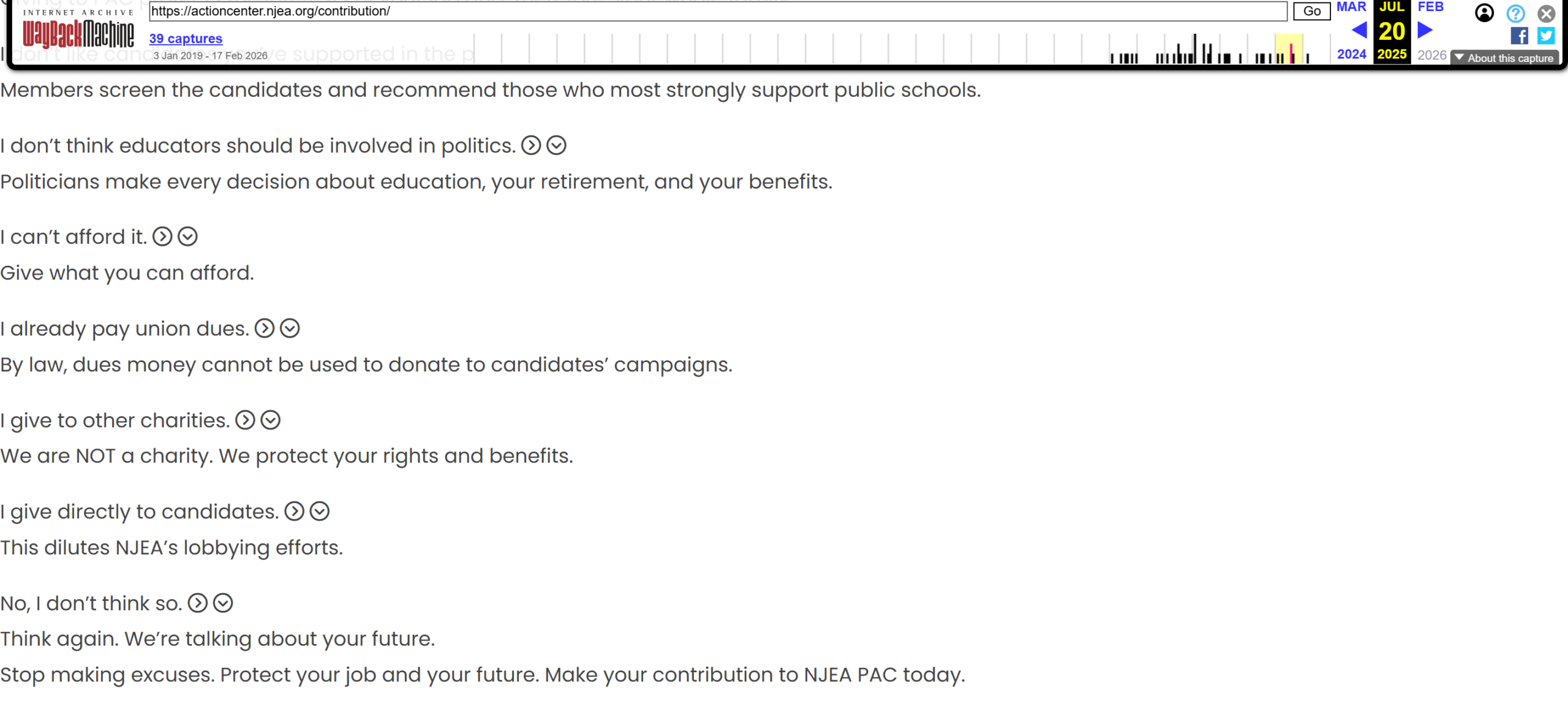
This past September, I filed a lawsuit alongside a fellow New Jersey educator, Dr. Marie Dupont of Roselle, alleging the NJEA breached its contract with members by sending our dues to a PAC called Garden State Forward without our consent. According to our lawsuit, Garden State Forward then sent the money — more than $40 million — to two groups run by or connected to union insiders (Working New Jersey and Protecting Our Democracy), which promoted Spiller’s candidacy.
As NJEA president, Spiller had a fiduciary duty to act in union members’ interests, not his own. Instead, he engaged in self-dealing, as union-funded political groups spent to benefit his own campaign.
Delegates choosing a new NEA president should not assume that the national union is immune from similar questionable uses of members’ dues.
A recent Network Contagion Research Institute report on the union’s finances and governance alleges that “[NEA] leadership has been directing member dues to organizations they personally control.” The report finds that under the tenure of current NEA executive director Kim Anderson, the union sent nearly $20 million to the Strategic Victory Fund, which is affiliated with Democracy Alliance, a national progressive network. Meanwhile, according to the report, Anderson previously served as Democracy Alliance’s executive vice president, and she also sat on the Strategic Victory Fund’s executive committee until at least 2024, the group’s latest available federal tax forms reveal.
The next NEA president must strengthen its internal safeguards and financial oversight to ensure union officials can’t siphon members’ dues to fund their own pet projects. I believe Spiller’s history shows that he would be very unlikely to do that.
I will give Spiller credit for one thing: audacity. In response to my lawsuit, the man who used my money to advance his own political career without my consent tried to claim that we were silencing him. Spiller and the NJEA filed anti-SLAPP motions in court, invoking a legal tool meant to protect individuals like whistleblowers from lawsuits designed to silence their speech on matters of public concern. In New Jersey, a successful anti-SLAPP motion can end a case and force the other side to pay attorneys’ fees. In other words, Spiller and the NJEA are asking the court to make two teachers pay for challenging what we believe was the illegal use of our own money.
The judge rejected their argument, writing that our claims were in fact based on the “alleged misuse of general union membership dues.” But Spiller and the NJEA have appealed that ruling. I believe Spiller and the NJEA are sending a message to teachers who might question union officials’ political spending: Don’t speak up, or you could have to pay up.
Now, Spiller wants to speak on behalf of the nearly 3 million educators the NEA represents. If he wins, how will he treat the next teacher who disagrees with him?