
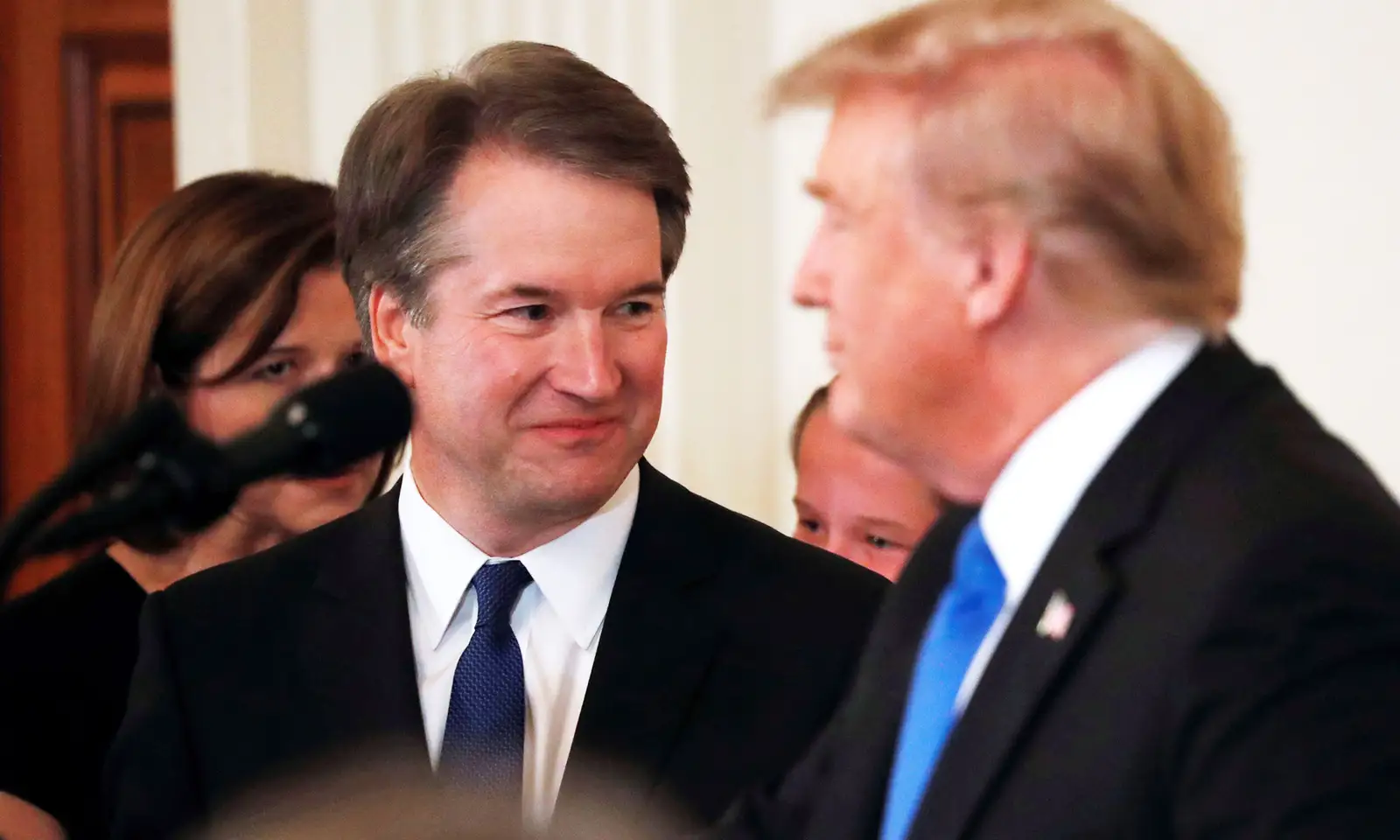
Yesterday, I looked at a case where Judge Brett Kavanaugh, on the DC Circuit, sided with a criminal defendant asserting a “battered woman syndrome” defense. Today, let’s look at an opinion that aired his skepticism about an “ever-metastasizing” tool of federal prosecutors: 18 U.S.C. § 1001, the statute that makes it a federal crime to lie “in any matter within the jurisdiction of the executive, legislative, or judicial branch of” the federal government. That language has been read to include lying on federal forms or to federal employees, giving it an astonishingly broad scope. Section 1001 has become a go-to tool federal prosecutors to indict people for lying to investigators, often in politically charged cases where such “process crimes” are the only crime that can be charged, or proven. As a veteran of the Kenneth Starr’s investigative team, Judge Kavanaugh has had a lot of exposure to the usefulness, and hazards, of Section 1001 and similar statutes.
Marlin Moore was – this is unclear – most likely either a buyer, user, or dealer of cocaine, who made the mistake of signing for a package of cocaine sent through the U.S. mail. With limited evidence, the government was unable to convict him on drug charges, resulting in two hung juries. Instead, like Al Capone going down for tax evasion, he was convicted of a federal felony for signing a phony name on a Postal Service delivery receipt for the box of coke.
The D.C. Circuit’s opinion in United States v. Moore recites that Postal Inspectors – by means undiscussed – flagged the box of cocaine before it was delivered, and believed it was addressed to a fictitious person, “Karen White.” So they set up a sting to arrest whoever claimed it. Moore arrived at the address while the Postal Inspector was on the scene, claimed to be Karen White’s boyfriend, and at her request he signed a delivery form as “Kevin Jones.” When he came back to retrieve the box from the house, they concluded he must have been the intended recipient, and arrested him. But in the end, they could only convict him of the fake name on the receipt.
Section 1001 makes it a crime to “knowingly and willfully make[] any materially false, fictitious, or fraudulent statement or representation.” Moore argued on appeal that his lie was not “material” because the Postal Inspector was going to arrest him for claiming the box no matter what name he wrote down on the form. Judge Douglas Ginsburg’s opinion upholding Moore’s conviction conceded this, but fell back on the general rule in federal criminal cases of this type that “material” false statements are judged by whether they could affect a government function or investigation, not whether they actually did:
Moore’s false statement was capable of affecting the Postal Service’s general function of tracking packages and identifying the recipients of packages entrusted to it. Moore’s use of a false name also could have impeded the ability of the Postal Service to investigate the trafficking of narcotics through the mails….Had Moore not returned, his having given a false name could have prevented the Postal Service from identifying and locating him in pursuit of its investigation.
This is the same basic logic that was used in the Section 1001 and perjury cases against, among others, Bill Clinton, Scooter Libby, Martha Stewart, and Michael Flynn: it doesn’t matter if you lied to somebody who already knew the truth.
Judge Kavanaugh concurred in the decision, but wrote his own separate opinion. He was willing to go along with the majority’s broad definition of materiality, despite its air of big-government creepiness, so far as it went. After all, the Postal Service in this context does have an interest in deterring people from using it as a drug courier service, and it’s not up to judges to decide if it’s good policy to use package-tracking services to ensnare people who try. But he was concerned about the trap for unwary citizens created by a government that can prosecute anyone for a felony for lying on what appear to be trivial forms, and argued that the way to check this is to hold the government to a strict standard of proving criminal intent in these cases:
[T]his case highlights one of the difficult issues that can arise in prosecutions under the ever-metastasizing §1001…Unlike many government forms, PS Form 3849 contained no warning that an inaccurate statement might be a crime. And it is not otherwise clear that Moore (or most people) would know that signing the wrong name on a postal delivery form is a crime….As many others have noted, §1001 prosecutions can pose a risk of abuse and injustice. In part, that’s because §1001 applies to virtually any statement an individual makes to virtually any federal government official—even when the individual making the statement is not under oath (unlike in perjury cases) or otherwise aware that criminal punishment can result from a false statement.
His solution: read the term “willfully” in Section 1001 to require the government to prove that the defendant not only knew the statement was false, but also “that the defendant knew that making the false statement would be a crime”:
To be sure, “ignorance of law is no defense” is a hoary maxim. But it does not automatically apply to today’s phalanx of federal regulatory crimes…For some regulatory offenses— particularly statutes like §1001 that proscribe only “willful” conduct—the Supreme Court has recognized an ignorance-of-law or mistake-of-law defense, or has required affirmative proof of the defendant’s knowledge that his or her conduct was unlawful.
The general line the Supreme Court and other courts have drawn – and which makes more sense in cases where Congress used both the words “knowingly” and “willfully” in the same statute – is to require a particularly heightened knowledge-of-law requirement when the statute bans something that’s only bad because it’s part of a government regulatory scheme, as opposed to being an ordinarily bad thing like, say, assault. (The Latin terms are malum prohibitum and malum in se; more on this body of caselaw here.)
Judge Kavanaugh admitted that the DC Circuit had not read Section 1001 to impose any such requirement when it upheld the indictment of Clinton fundraiser Maria Hsia in 1999, and that the issue of whether to reconsider that prior decision wasn’t before the court anyway because Moore had not raised the issue. But he argued that intervening decisions made it time to revisit the issue to prevent further abuses of Section 1001:
[T]he Supreme Court’s precedents arguably require district courts in §1001 cases to give a willfulness instruction that requires proof that the defendant knew his conduct was a crime. To be sure, in many false statements cases the Government will be able to easily prove that the defendant knew his conduct was unlawful. But in some cases, it will not be able to do so— and those of course are precisely the cases where it would seem inappropriate and contrary to §1001’s statutory text to impose criminal punishment.
Was Judge Kavanaugh right? It’s not hard to see why he was concerned that Section 1001 prosecutions could lend themselves to serious overreach, especially in politically-charged cases like those of Libby, Flynn, and Hsia. And there is a serious argument that he is right about the language of the statute. That argument is sufficiently serious, in fact, that four years after his 2010 opinion in Moore, Judge Kavanaugh was vindicated when the Justice Department reversed course and conceded in briefs to the Supreme Court that Section 1001 and a related statute require proof that the defendant knew his conduct was unlawful. In one of those cases, United States v. Ajoku, the Supreme Court – without writing an opinion – vacated the defendant’s conviction “in light of the confession of error by the Solicitor General in his brief for the United States filed on March 10, 2014.”
The question of which federal crimes require this stringent standard of proof will probably come before the Supreme Court again, and it might even come up again in the Section 1001 context (despite Ajoku, the section of the Justice Department U.S. Attorney’s Manual dealing with Section 1001 still doesn’t appear to instruct prosecutors to apply the “acted with knowledge that his conduct was unlawful” standard). But one way or another, Judge Kavanaugh’s experience in the Betlway’s investigative wars has taught him to be particularly careful about ensuring that federal prosecutors aren’t throwing the book at people who didn’t mean to break the law.




Comments
On “Judge Kavanaugh on Lying To Federal Agents”