
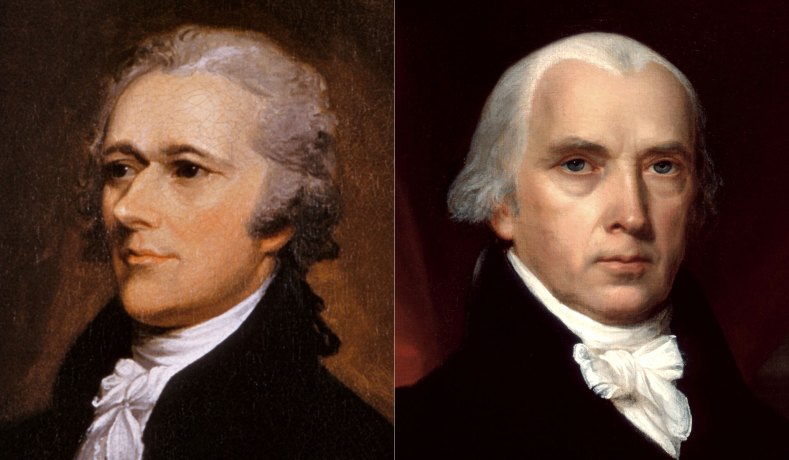
The Federalist Papers remind us that America was a leap of genius beyond the known.
I’ve been reading and re-reading many texts from the early years of America, and I’ve found my way back to The Federalist Papers. By the end of this summer, I’m hoping that my second-hand paperback copy of Madison and Hamilton’s eighty-five essays will be thoroughly annotated and loved.
Federalist No. 1 reminds us how America was originally an experiment:
After an unequivocal experience of the inefficiency of the subsisting federal government, you are called upon to deliberate on a new Constitution for the United States of America. The subject speaks its own importance; comprehending in its consequences nothing less than the existence of the UNION, the safety and welfare of the parts of which it is composed, the fate of an empire in many respects the most interesting in the world.
We had successfully fought back the British and defended our land, but the New World’s fate was yet undetermined in 1787. Would we collapse under the burden of self-government? Would we succumb to demagogues, tyrannies, or simply tire out?
Hamilton, writing under the pseudonym “Publius,” understood the gravity of the American project. He highlighted the pitfalls on both sides of the debate over the ratification of the U.S. Constitution. He assesses the consequences of ratification with an open mind and earnest inquiry.
It is in full knowledge of the Constitution’s significance to Western civilization that Hamilton writes. The Founding Fathers were scholars of history and politics. They had studied natural law, Roman history, and classical literature. They were educated in the rhetoric of Cicero, the treatises of Locke, and the volumes of Montesquieu.
Many conservatives have understood the American tradition to be merely a historical progression of existing Anglo and Enlightenment sentiment. They might downplay the genius of individual men in favor of demonstrating the continuity between the Magna Carta, the Glorious Revolution, and the year 1776, for example.
In Hamilton’s own words:
It has been frequently remarked that it seems to have been reserved to the people of this country, by their conduct and example, to decide the important question, whether societies of men are really capable or not of establishing good government from reflection and choice, or whether they are forever destined to depend for their political constitutions on accident and force.
Reflection and choice were precisely what our founders possessed. Despite the truth and utility of their intellectual heritage, the Framers knew that they were undertaking something entirely new. They hoped — dear God, they dreamed! — of an America that could escape the fatal flaws that had plagued the Athenian and Roman experiments in self-government.
What an opportunity this summer offers to consider the judiciousness with which the Framers approached America. Let us never forget the considerate deliberation of the men who forged the future we now reside in. America began as a debate and turned out to be one of the most successful political experiments in the history of the world.