
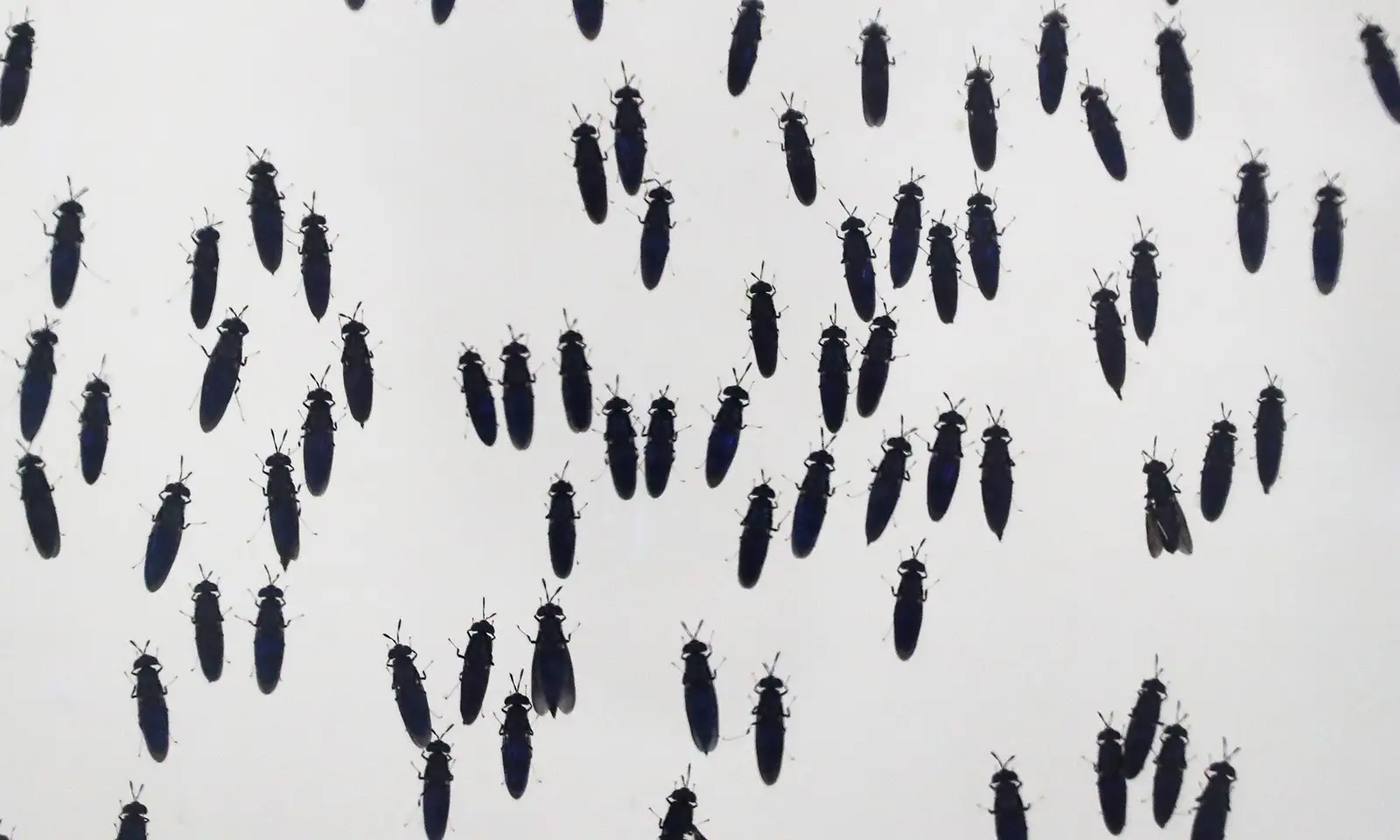
Understandably annoyed and angered by a professor who compared him to a bedbug, New York Times columnist Bret Stephens declared on MSNBC this morning, “Analogizing people to insects is always wrong . . . Being analogized to insects goes back to a lot of totalitarian regimes in the past.”
No doubt there is a long and ugly history of hateful people seeking to dehumanize their political or social opponents by comparing them to animals and stating, explicitly or implicitly, that they’re something less than human: rats, snakes, pigs, apes, “vermin,” and yes, insects like cockroaches and lice. As David Livingstone Smith observed, to most people it is morally wrong to kill another human being, but permissible and in fact necessary to exterminate rats or insects. If you can get people to mentally reclassify other human beings into something less than human, you’ve set the stage for brutal behavior and policies; Hutus involved in the Rwanda genocide called Tutsis “cockroaches.”
When George Washington University professor David Karpf called Stephens a bedbug, he was being . . . I’d say a jackass, but that would be another animal analogy. From Karpf’s comments, he clearly sees himself as the victim in this exchange and seems to think there’s nothing wrong with calling Stephens a bedbug, but there is something wrong with Stephens calling his boss’s attention to that tweet.
Karpf vehemently disagrees with Stephens and expressed it in an ugly and snotty way. But our public discourse is going to get worse if we interpret every insect analogy as a repressed or not-so-repressed homicidal or genocidal desire.
I hate to be the fly in the ointment, but not every reference to an insect is necessarily calling for someone’s extinction.
Yes, Twitter and the Internet are a hive of this kind of name-calling, with every troll as busy as a bee, and it’s easy to stir up a hornet’s nest. These comments bug people. One day you think you’re the bee’s knees, covering a race that’s as tight as a tick, and then the next you’re bug-eyed in shock at some nasty insult and that leaves a bee in your bonnet. You’re a nice guy, who wouldn’t hurt a flea, but the idea of somebody hating you like that leaves butterflies in your stomach and has really loused up your day. For a while everybody was on Twitter, but now those who can’t stand the nasty name-calling are dropping like flies.
In a better world, our debates would be principled, respectful and focused on issues; the personal stuff wouldn’t be anybody’s beeswax. When somebody saw the value in our perspective, we would answer, “you have learned well, grasshopper.” It’s tempting to cocoon ourselves in a small circle of like-minded souls. But perhaps we ought to just follow Muhammad Ali’s advice: “Float like a butterfly, sting like a bee.”






Comments
On “When Does an Insect Analogy Cross the Line?”