
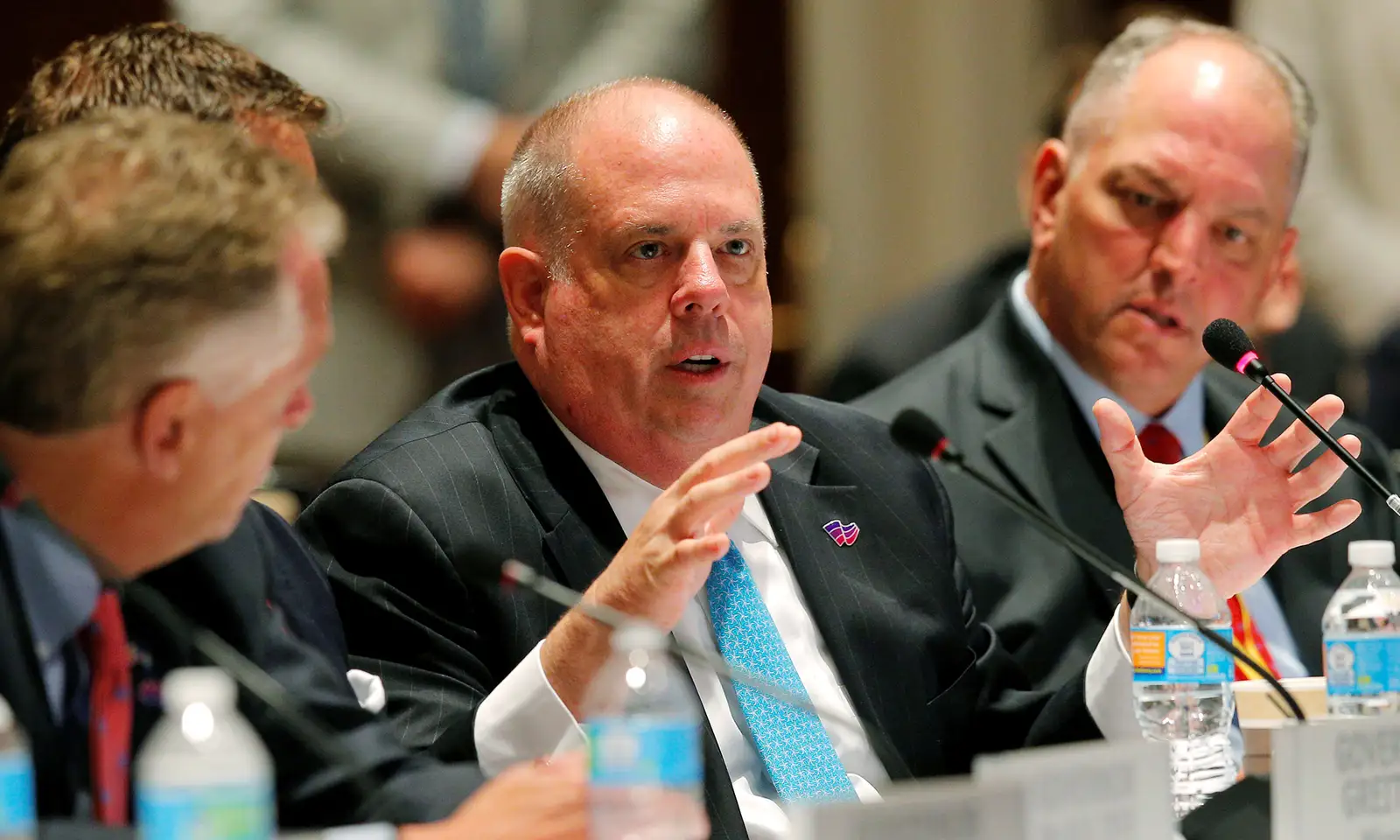
A Politico report this morning about Maryland Governor Larry Hogan – including a scheduled trip to Iowa in March – has people buzzing about whether Hogan will launch a primary challenge to President Trump in 2020. Hogan, prudently, is coy on the subject, but let’s assume for the sake of argument that he actually decided to run. Would it make sense for Hogan to do that?
To answer that question, you first have to ask what “make sense” means. There are three possible reasons to run for president, and while many candidates have more than one such reason, you really only need one. One, you think you can win the nomination. Two, you think there is something that needs to be said, a message that won’t get heard unless you run. Three, you think your career will be advanced by having run.
On the first count, I don’t think Hogan has much chance of winning the nomination, but if he was ever going to run, 2020 is the best shot he would ever get. Hogan has been remarkably politically successful as governor of deep-blue Maryland, regularly ranking as one of the two most popular governors in the country (a January 2019 Morning Consult poll has his approval rating at 68%, second only to Massachusetts’ Charlie Baker), and he was re-elected by a 12-point margin with 55.4% of the vote in 2018. Like Chris Christie in 2012, that means his political moment would probably be now and not later even under normal circumstances, and his ability as a blue-state star and cancer survivor to present a calm, sane, no-drama get-it-done contrast to Trump only accentuates that. Hogan’s stock is as high as it will get, and at 62, he’s not a guy who’s likely to see a better moment return a decade or two later.
In a national election, however, Hogan’s status as a pragmatic, tax-cutting, infrastructure-building moderate would matter less than his moderate-to-liberal stances on abortion, the morning-after pill and Planned Parenthood funding, immigration, guns, and other social-issue hot buttons. In either a crowded field or a two-horse race without an incumbent, those positions would normally relegate Hogan to collecting the scraps of socially liberal voters at the margins of the Republican primary electorate. In a head-to-head race against Trump, Hogan would probably stand to gain some additional votes from socially conservative voters casting protest ballots, but it’s hard to see how that gets him anywhere near the critical mass needed to topple an incumbent. As I’ve noted before, “the core of any campaign to oust Trump in 2020 needs to be built around not just the 14.2 percent of primary voters who voted for Kasich in contested primaries and the 1 percent who voted for Jeb Bush, but also the 40.6 percent who voted for Ted Cruz and Marco Rubio.” By early 2020, some of those voters may see Trump as either morally unacceptable or politically no longer viable, but that’s an awfully big bloc of voters who chose one of two solidly socially conservative Senators in 2016 and would be asked to back someone quite different this go-round.
Now, it’s possible that Trump could be so badly wounded by then that Hogan – as the only one willing to jump in the race – could grab the nomination by default. He’d stand a better chance of doing so than a 2016 retread like John Kasich or a 2018 failure like Jeff Flake. But if Trump actually ends up in such bad shape by then, Hogan could instead wind up as the Eugene McCarthy of the race, proving the incumbent’s vulnerability only to attract more viable challengers into the race. In other words, the very Trump weakness that would be essential to Hogan having a chance to win would also increase the odds that someone else would beat him to the finish line.
That brings us to the second question: the message. There’s a strong case that someone needs to bring an alternative to Trump to Republican primary voters, and remind them that a conservative agenda doesn’t need to be encrusted with all of Trump’s many faults – his endless lying and bragging, his crudeness, his chaotic management style, his instinct for racial and gender divisiveness, etc. Hogan may well share the conviction that such a candidacy is a moral imperative and an act of long-term benefit to the party. If he does, he would be well-situated to make those arguments; another candidate could as well, but his position as a successful governor who can’t be attacked for a Washington voting record would give him greater standing to do so than Flake or even Ben Sasse.
There are also serious policy arguments to be had within the Republican coalition about foreign policy, trade, and immigration. It’s less obvious, at this juncture, that Hogan has as much to say on those fronts, and his social-issue record would make it easier for Trump to hit him back as being out of the policy mainstream of the party, shifting the terrain of a primary challenge away from Trump’s own vulnerabilities.
Third, we come to the question of how this would advance Hogan’s career. Unlike Sasse, he’s not up for re-election in 2020, so he could pursue a primary challenge without quitting his day job, but he’s term limited as Maryland governor in 2022. His only prior political experience was as a state-level Cabinet official and an unsuccessful House candidate (his 10-point loss in 1992 was the closest anybody’s ever gotten to unseating Steny Hoyer). Maybe Hogan sees his next move as a lobbyist or a “Strange New Respect” GOP-bashing cable commentator like Kasich, but other than the presidency his most logical next steps up would be a Cabinet post in a Republican Administration or a Senate bid.
A Cabinet job is not that big a step up from being a governor unless it’s one of the big jobs, and by 2022 even a re-elected Trump Administration would have only two years to go and a near-certainty of being replaced by an incoming Democrat, after which Hogan would be in his 70s. There’s no Senate race in Maryland in 2020, but what about after that? Chris Van Hollen is up in 2022, at which point Hogan would be ready to leave office, and if Trump loses re-election, a 2022 midterm race could again be favorable for a strong Republican candidate. In 2024, Ben Cardin is up, and he’ll be 81 by then. Either race could be appealing to Hogan.
How would a primary challenge affect that? In the short run, Hogan would be seen by a lot of Trump loyalists and party-establishment Republicans as a traitor to the Administration, and that would be a bad start to a Senate bid if it was in 2020. A Trump general election loss would lead some diehards to blame Hogan, while a Trump victory would leave a vindictive Trump in the Oval Office.
But by 2022 or 2024, things could look different, especially if Trump loses in 2020. Recruiting a top-shelf Senate candidate in a state like Maryland is hard enough that the party bigwigs would forgive a lot to get Hogan to run, and in a general election, his status as the guy who stood up to Trump could be a huge asset of the type that a Republican needs to make the leap from Governor to Senator. It’s not at all irrational for Hogan to calculate that his best path to higher office from where he stands now is to make a quixotic primary stand against Trump.
Maybe Larry Hogan won’t run for president; probably, if he does, he won’t be the nominee. But the decision before him is about more than just his odds of being the next Republican nominee for president.




Comments
On “Would It Make Sense For Larry Hogan to Primary Trump?”