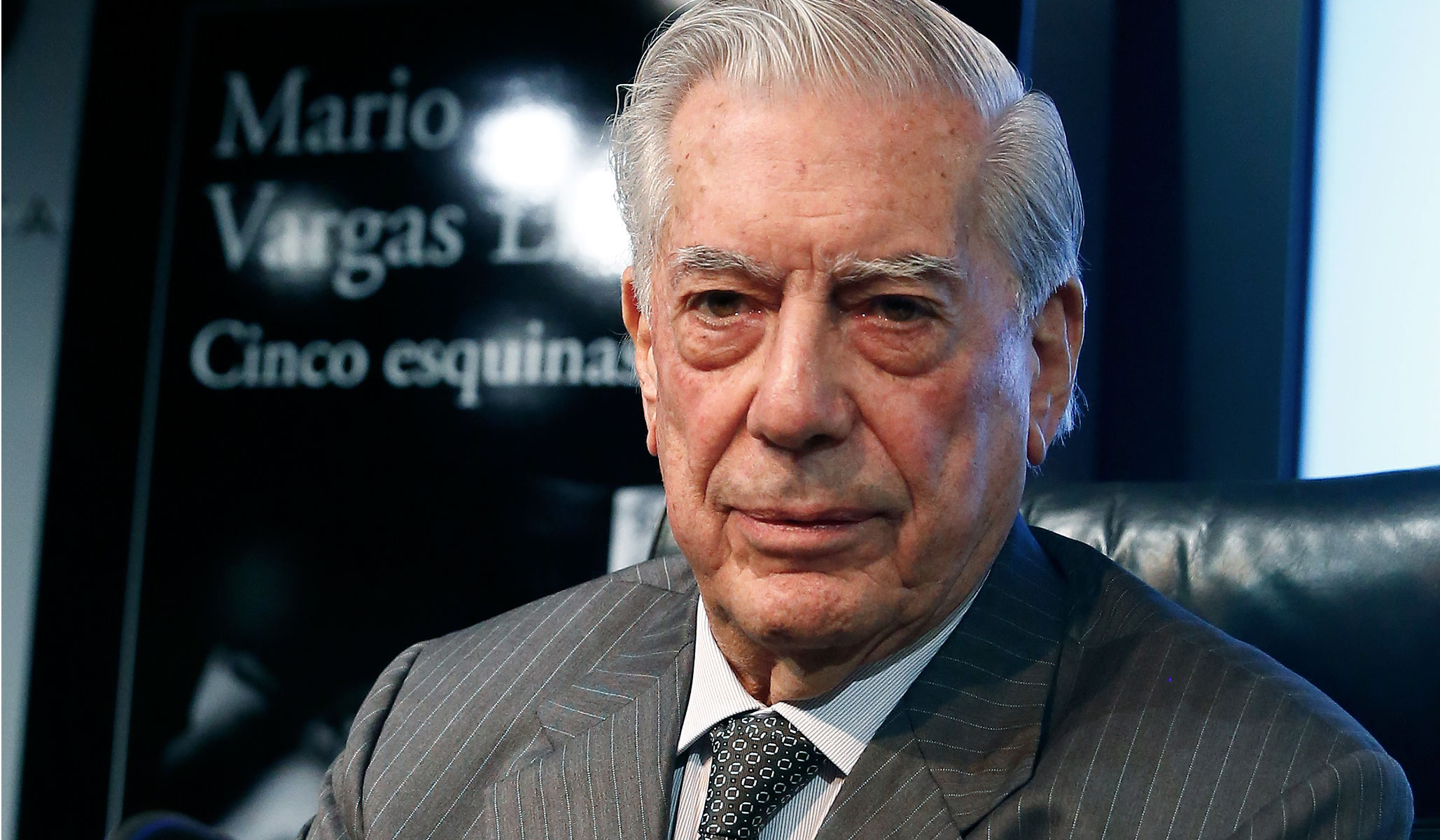
 Mario Vargas Llosa in Madrid, March 2016
(Andrea Comas/Reuters)
Mario Vargas Llosa in Madrid, March 2016
(Andrea Comas/Reuters)
Mario Vargas Llosa in Madrid, March 2016
(Andrea Comas/Reuters)
Editor’s Note: The below is an expanded version of a piece published in the current issue of National Review.
Mario Vargas Llosa is one of the leading novelists of our time, obviously. I say “obviously.” More on that in a moment. In 2010, he won the Nobel Prize in Literature. I did not read a Vargas Llosa novel until 2017. I’m going to tell a story on myself.
I had always thought of Vargas Llosa as a political writer, and sometime politician: one of the leading classical liberals of our time. I had read many, many of his articles and essays (and admired them a great deal). He was an ardent, and elegant, foe of socialists and communists.
In 1987, Vargas Llosa co-founded a political party in his native Peru: Movimiento Libertad. In 1990, he ran for president, losing to Alberto Fujimori.
Oh, I knew Vargas Llosa wrote novels, all right. I did not live completely under a rock. But I thought the novels were . . . sort of a side gig, from a multi-talented writer? (Feel free to laugh. I do, now.)
In 2017, a friend gave me a copy of The Feast of the Goat, the novel that Vargas Llosa published in 2000. It’s about life in a dictatorship, specifically that of Trujillo, in the Dominican Republic. Immersed in music and politics, I have little time for novels. I have rows and rows of them, which I dust once in a while.
I thought I should glance at The Feast of the Goat as a courtesy to my friend — the book was a gift, after all. I picked up the book at about 11:15, shortly before I wanted to go to sleep. I read the first page. It was okay. I read the second page. It was a little better. I read the third page.
Fighting sleep with all my might, I made it to about 2:30. The second I woke up, I resumed reading. I was in the thrall of that book — it had me by the throat — until I finished it. And for days or weeks after.
It is not only a great novel. It is probably the best depiction of life in a dictatorship I know (and I have read many, largely for professional purposes).
I said to David Pryce-Jones — who, like Vargas Llosa, is a journalist and novelist, both — “The guy is a bloomin’ genius. Am I the last to know?” He said, politely, yes.
Mario Vargas Llosa was born in 1936, in Arequipa. Down through the decades, he has written a spectacular variety of books and articles. His novels alone are spectacular in their variety. In the late 1990s, I told a soprano friend of mine that I was about to start work at National Review. I explained that this was the magazine founded by William F. Buckley Jr., in 1955. She looked at me quizzically and said, “Not the spy novelist.”
When I recounted this to WFB, he said that he had a diversity of audiences, which did not overlap much: readers of his spy novels, readers of his syndicated column, viewers of his television program, etc.
One more story, strictly for laughs. An Israeli journalist mentioned to me Ehud Barak. I was trying to remember which one he was — which prime minister, which political figure. “The pianist?” I said. The journalist chuckled. Yes, Barak played the piano, and was a serious music-lover. He also happened to be one of the two or three most decorated soldiers in Israeli history. With a considerable academic background. And so on.
In 2018, Mario Vargas Llosa published a book called “The Call of the Tribe,” which is about his political development, and the people who influenced him. He wrote it in Spanish, his language. It has now been translated into English, by John King.
Incidentally, Vargas Llosa wrote an article last summer about his literary influences, or one of them: Flaubert. Here are the first two sentences:
At some point in the last century, I arrived in Paris and that very day bought a copy of Madame Bovary in a bookstore called Joie de Vivre in the Latin Quarter. I stayed up nearly all night reading it and by dawn I knew what kind of writer I wanted to be.The Call of the Tribe was inspired by To the Finland Station, Edmund Wilson’s study (1940) of the socialist idea, basically. Vargas Llosa wanted to do the same for the liberal idea, or the idea of political and economic freedom, if you like: individual rights, the rule of law, and all that jazz. He begins the book with an essay, both autobiographical and intellectual. Then he writes about seven thinkers, and his encounters with their work. All of these are 20th-century people, with the exception of Adam Smith, who leads off. (Vargas Llosa once made a trip to Edinburgh to lay flowers at his grave.) The next six are José Ortega y Gasset, Friedrich Hayek, Karl Popper, Raymond Aron, Isaiah Berlin, and Jean-François Revel.
Along the way, Vargas Llosa hails other thinkers, too, including George Orwell, Arthur Koestler, and Albert Camus.
“He has a type,” people say of a man and his taste in women. As you can see, Vargas Llosa has a type — though his thinkers are all individuals, and have their differences.
Why does the author call his book “The Call of the Tribe”? Is it because he has sketched out his tribe — his leaders and confrères? No. I think the title is misleading. The call of the tribe ought to be resisted, Vargas Llosa says, and liberal democracy exists to overcome tribe and its often disastrous pull. By “tribe,” he means sect, party, class, and the like.
Are his guys an anti-tribe? An anti-tribalist tribe? I don’t know. Words, though fun, can get cute.
I have always enjoyed asking people about their influences — how they got to be who they are, or to think how they think. Reading Vargas Llosa, I was reminded of Enrique Krauze, the Mexican historian — who gave me these names: Orwell, Koestler, Popper, and Berlin. I also thought of Charles Krauthammer — who gave me Berlin.
When he was in college, he said, he read Four Essays on Liberty. That was it. That sealed him. This is what I believe, young Krauthammer thought. This is true and right.
It seems to be raining Isaiah Berlin, at least in my life. In late October, I podcasted with George F. Will, by whom many have been starstruck. I asked, “Have you ever been starstruck?” Yes, once, long ago: by Berlin.
In The Call of the Tribe, Vargas Llosa writes of a dinner in London, where a group of intellectuals talked with Margaret Thatcher. “She was seated next to Isaiah Berlin, whom she spoke to the entire evening with the utmost respect.” On meeting Vargas Llosa, Mrs. Thatcher asked him where he lived (where in London). When he told her, she said, “Oh, you’re a neighbor of Arthur Koestler.”
Writing about Berlin, Vargas Llosa says something touching (or so I find): He counts himself among those who “did not attend” Berlin’s classes but who feel themselves “to be his students” all the same. Berlin has taught them through his writings.
About Raymond Aron, Vargas Llosa relates something that had me smiling:
I remember reading Bill Buckley, George Will, Norman Podhoretz, and others with varying degrees of stealth.
Aron, writes Vargas Llosa, was a “friend and mentor” to Jean-François Revel. This puts me in mind of Gabriel Calzada, the Spanish economist and university leader. I once asked him about his education. He said that a professor had organized a reading group, for especially hungry students. He gave them a range of books: left, right, and center. The book that first hooked young Calzada was La Connaissance inutile, by Revel. (We know the book in English as “The Flight from Truth.”)
It made an impression on Vargas Llosa, too:
Greg Mankiw is a professor of economics at Harvard (who has participated in government and politics, too). He told me that, as a young man, he read Milton Friedman’s Capitalism and Freedom. It set him on fire. It struck him as true. Now he assigns it — with diverse other readings — to his students. Some of them, too, are set on fire, or at least affected. Friedman is one of the thinkers and influences whom Vargas Llosa hails in his book.
When he himself was young, Vargas Llosa liked Sartre and the Cuban revolution. There were far more dogmatic, far more left-wing, than he, however. A member of his reading group, affronted at Vargas Llosa’s relative latitudinarianism, denounced him as “subhuman.” In any case, Vargas Llosa became disabused over time. He saw his gods fail, so to speak. He read widely, yes. (Where has Vargas Llosa found the time to do all the writing he has done, given all the reading he has done?) But he also looked around — at what Thatcher achieved in Britain, for example, and what Ronald Reagan achieved in the United States.
Eleven years before Thatcher became prime minister — and thirteen before Reagan became president — Vargas Llosa made a trip to the Soviet Union. The year was 1968. “I discovered there that, had I been a Russian, I would have been a dissident in that country (that is, a pariah) or I would have been rotting in the Gulag.”
Vargas Llosa asked “a talkative Russian,” as he describes him, or her, “Who are the most privileged people here?” The answer: “Submissive writers. They have dachas for their holidays and they can travel abroad. That puts them way above ordinary men and women. You can’t ask for more!”
Important in Vargas Llosa’s development, or political journey, was the imprisonment of Heberto Padilla by the Cuban dictatorship in 1971. Padilla was a poet who had been supportive of Fidel Castro and the revolution. He turned critic, however, which turned him into a prisoner.
Writes Vargas Llosa,
Let us return to the subject of books. We all have books that made an impression on us, or maybe even set us on fire. A few years ago, I talked with a group of young people interested in politics and journalism. They had read books saying that liberalism was a mistake, and that America, in particular, needed a new way forward. A post-liberal future. These youngsters were convinced of this. Their political models were not Thatcher and Reagan. Their tastes ran to Orbán and Bolsonaro.
Will they stay with their views, and tastes? Throw them off? Who knows? Mario Vargas Llosa threw off Sartre and Castro. Krauthammer stuck with Isaiah Berlin, forever.
When Berlin died in 1997, Krauthammer wrote a column in which he said, “‘Four Essays’ is available everywhere. Buy it. Make your children read it before they go to college, the last redoubt of romantic neo-Marxism.” I would recommend The Call of the Tribe, too. Politics aside, it is a beautiful book, as how could it not be, from that pen? It is an erudite book, as how could it not be, from that mind?
Krauthammer ended his column, those 25 years ago now, by saying, “The idea of limited government has triumphed. But the moment may not last. The pluralism Berlin championed will be challenged again.”
Oh, hell, yes.