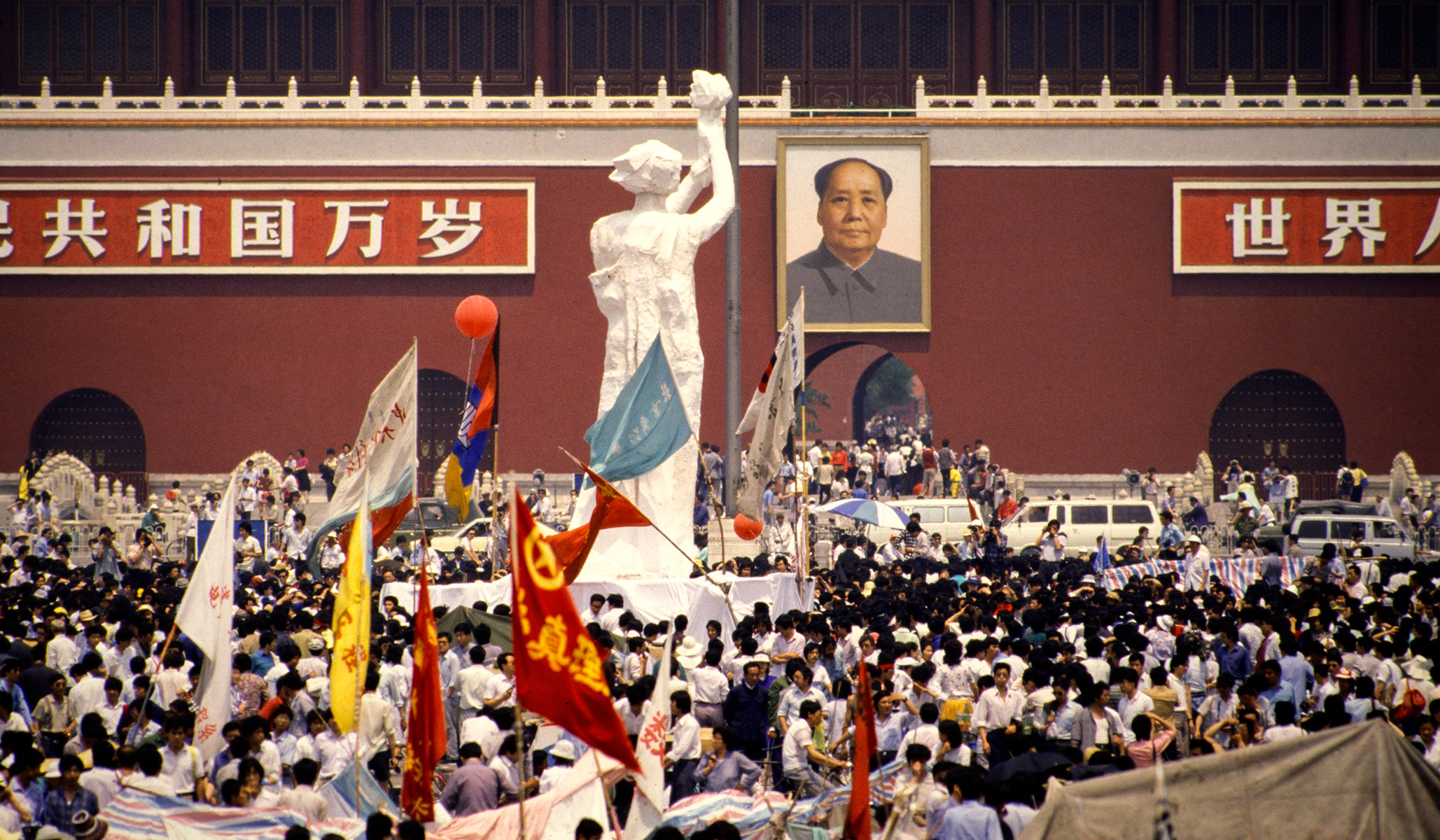
 In Tiananmen Square, during student protests, the Goddess of Democracy faces a portrait of Mao, May 30, 1989. (Forrest Anderson / Getty Images)
In Tiananmen Square, during student protests, the Goddess of Democracy faces a portrait of Mao, May 30, 1989. (Forrest Anderson / Getty Images)
Editor’s Note: The below is an expanded version of a piece that appears in the current issue of National Review.
In some quarters, “democracy” is a fighting word. What is democracy? Is it desirable, or mainly so? Is it a gauzy ideal? Is it something that allows 50.1 percent to boss around everyone else? “Democracy” has been a fighting word since antiquity.
Like “love,” “peace,” and many another word, “democracy” has been subject to abuse. To take an especially hideous example: The genocidalists of the Khmer Rouge renamed Cambodia “Democratic Kampuchea.”
In Europe, for 41 years, there was a country called the “German Democratic Republic.” Some observed, mordantly, that this was three lies in one — for that state was not a republic, not democratic, and not altogether German, given control by Moscow.
Democracy is obviously entrenched in the American story. In the 1830s, a French traveler made notes on democracy in America. In that same decade, James Fenimore Cooper wrote The American Democrat. The observations of Tocqueville and Cooper are fresh as daisies. The American of 2023 might think he is reading an opinion column of today.
Here is just a little taste of Cooper:
In 1982, President Reagan gave a speech to the British Parliament on the theme of freedom, democracy, and human rights. It was a prelude to the establishment of the National Endowment for Democracy, in Washington, the next year. More on this in due course.
Earlier this summer — on June 9 — the Inter-American Commission on Human Rights issued a report. Investigators concluded that the Cuban state was responsible for the death of Oswaldo Payá, along with a young colleague of his, Harold Cepero. They were killed in a car accident — non-accidental — in 2012.
Payá was a leading Cuban democrat. He spearheaded the Varela Project, which was a petition drive, calling for democratic reforms. The project was named after Félix Varela, a venerable Cuban priest and independence leader from the first half of the 19th century. The petition was eventually signed by about 11,000 people. Brave souls.
I have called Payá a “democrat,” and that he was — a believer in, an exponent of, a campaigner for democracy. Jeane Kirkpatrick used this word “democrat.” Once, we were talking about the Nicaraguan election of 1990. In that election, Violeta Chamorro won her historic victory over Daniel Ortega and the Sandinistas. (Ortega and the Sandinistas would return to power, but that is another story.) In the aftermath of the election, Jimmy Carter, who had monitored it, at times seemed churlish about Chamorro’s victory. I mentioned this to Kirkpatrick. She commented, “You would have thought a democrat would be happy.”
On the whole, however, the ex-president played a useful role in Nicaragua that year. And he was very useful in Cuba, in 2002. On a trip to Havana, Carter gave an important boost to the Varela Project. Later in the year, the European Parliament awarded the Sakharov Prize for Freedom of Thought to Payá.
The Varela petition called for the essentials, you might say — beginning with freedom of speech and freedom of association. “These rights, and all human rights,” said the organizers, “existed before anyone formulated them or wrote them down. They are yours simply because you are human beings.”
What other “essentials” did the petition call for? The right to start a business, and to sell one’s labor freely. Amnesty for political prisoners. Regular elections with multiple parties and multiple candidates. Etc.
In March 2003, the Cuban dictatorship cracked down viciously, in what is known as the “Black Spring.” Democrats and dissidents were rounded up and imprisoned. Among them were many people associated with the Varela Project. Twenty years later, the grip of the dictatorship remains tight. But Varela is a blueprint for a democratic future.
In recent weeks, a biography of Liu Xiaobo has appeared: I Have No Enemies, by Perry Link and Wu Dazhi. (That was a statement by Liu: “I have no enemies.”) Liu was the Chinese democracy leader and political prisoner who was awarded the Nobel Peace Prize in 2010. He died in 2017, while a prisoner.
Liu, born in 1955, was one of the “elder” leaders at Tiananmen Square in 1989. Students from the Central Academy of Fine Arts made a sculpture called the “Goddess of Democracy.” She was meant to depict their ideals and aspirations. In a declaration, the students said, “A consciousness of democracy has awakened among the Chinese people!” They knew that their sculpture, made of plaster, would not last long. But “on the day that real democracy and freedom come to China,” they said, “we must erect another Goddess of Democracy here in the square: monumental, towering, and permanent.” They ended, “Long live democracy!”
The Goddess of Democracy stood for five days. Then the Chinese military moved in. The sculpture was a mere plaster casualty amid human ones.
In 2008, Liu Xiaobo and his colleagues issued a manifesto: Charter 08. It had been inspired by Charter 77, the manifesto of Václav Havel and his colleagues in Czechoslovakia. In a preamble, the Chinese democrats said,
Under the heading “Our Fundamental Principles,” the democrats said,
They further said,
The Charter 08 signers knew their Lincoln.
They called for a new constitution, and constitutional order. The separation of powers, including an independent judiciary. Freedom of expression, freedom of association, freedom of religion, property rights — all of it. They called for it in some specificity, too. Democracy has flesh and bones.
Liu Xiaobo was promptly arrested. He would never leave prison. In a final statement to the court — not the kind of court envisioned in Charter 08 — he said, “I believe that my work has been just, and that someday China will be a free and democratic country.”
About a month ago, I spoke with Sardar Pashaei, an Iranian-American human-rights activist. His brother Saman had been arrested and imprisoned in Iran a few weeks before. The Iranian authorities were retaliating against Sardar for his activism abroad. This is what dictatorships frequently do: use families as leverage; take family members hostage.
Sardar and I spoke of the ongoing protests in the streets of Iran. “People want democracy,” he said, and this is especially true of the young. They are fed up with dictatorship. They know that other people live better — more decently, more freely — in other parts of the world. I asked Sardar what he meant by “democracy.” He drew a breath and said,
It seemed so obvious to him.
In June 1982, President Reagan traveled to London — to Westminster, to address the parliament. He was speaking in “one of democracy’s shrines,” he said. “Here the rights of free people and the processes of representation have been debated and refined.” He spoke of a great contest between the democracies and their foes. “Wherever the comparisons have been made between free and closed societies,” he said, “it is the democratic countries that are prosperous and responsive to the needs of their people.”
Democracy “is not a fragile flower,” said Reagan. Nonetheless, “it needs cultivating.” And “we must take actions to assist the campaign for democracy.” What did he want to do? What did he have in mind?
His “objective,” he said, was “quite simple to state: to foster the infrastructure of democracy — the system of a free press, unions, political parties, universities — which allows a people to choose their own way, to develop their own culture, to reconcile their own differences through peaceful means.”
Anticipating criticism, Reagan said, “This is not cultural imperialism. It is providing the means for genuine self-determination and protection for diversity. Democracy already flourishes in countries with very different cultures and historical experiences.” That was certainly true, and is.
And think of the differences between the two Koreas: each sharing a national and ethnic heritage, each the stark opposite of the other. Forms of government matter crucially.
In 1983, the National Endowment for Democracy was born. It published a statement of principles, useful for our purposes. Its principles are
And so on.
Today, democracy is back on its heels, in places far and wide. Last month, Freedom House issued a report on “understanding democratic decline.” There are two “primary drivers” of this decline, said the report. First, authoritarian, or authoritarian-minded, leaders — ones who are elected democratically but who prove no friend of democracy at all. Leaders who go about dismantling the democracy that elected them.
A flagrant example of such a leader would be Hugo Chávez, in Venezuela. Freedom House cited more recent examples, including Nayib Bukele, the president of El Salvador.
And the other “primary driver” of democratic decline? The authoritarian pasts of nations trying to leave those pasts behind and not quite succeeding. Freedom House mentioned, among other countries, the Philippines.
You remember the Churchillian chestnut, concerning democracy. A full version of it reads as follows:
Jean-François Revel was sometimes gloomy about democracy, sometimes hopeful. He was a French intellectual and liberal democrat — an uncommon thing for a French intellectual to be — who lived from 1924 to 2006. The year 1984 (Orwell’s!) found him gloomy. Here are some lines he wrote that year (and you will see a definition of democracy embedded in them):
The corner shrinks and expands, shrinks and expands.
I am maybe not the traveler or observer that Alexis de Tocqueville was. But I have noticed, particularly in the last several years, that a lot of Americans roll their eyes at democracy or even sneer at it. This is especially true of writers at our illiberal poles. I never see eye-rolling, or hear sneering, from people without democracy. Who live under dictatorship. For them, democracy has great meaning and importance, and some are willing even to die for it.