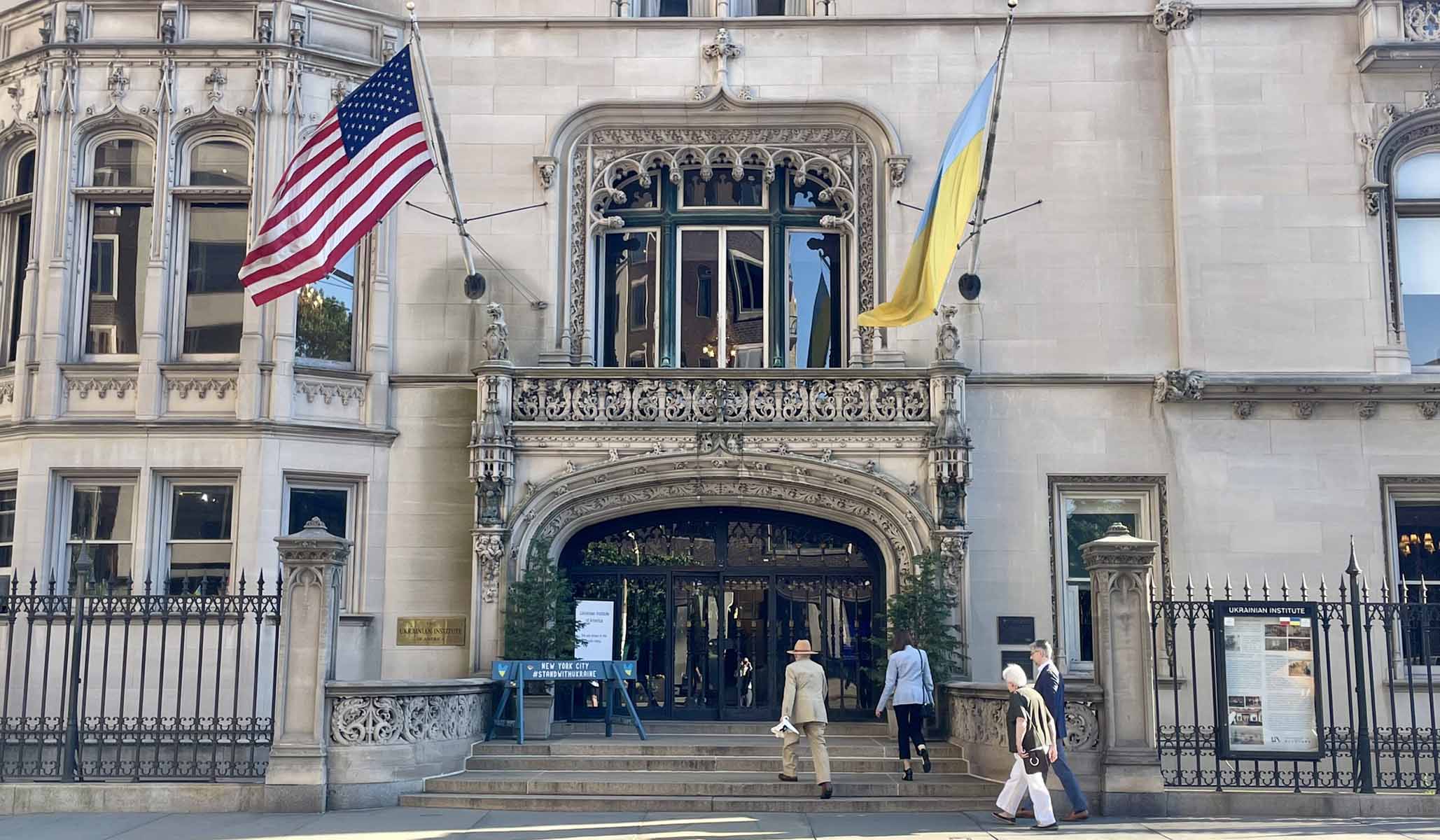
 The Ukrainian Institute of America, Manhattan, N.Y., June 15, 2024 (Jay Nordlinger)
 The Ukrainian Institute of America, Manhattan, N.Y., June 15, 2024 (Jay Nordlinger)
Yesterday, I wrote about Adrian Karatnycky and his new book, Battleground Ukraine: From Independence to the War with Russia. He and I recorded a podcast, a Q&A. Last night, we had another discussion, this one before an audience at the Ukrainian Institute of America, in Manhattan, N.Y. I had been there once before: 25 years ago, in 1999.
That was a memorable evening. Bill Buckley asked me to go with him to an event honoring Robert Conquest, the great British historian and man of letters. Bob was one of the very few people who could get Bill out for something like that.
Bob had just published his book Reflections on a Ravaged Century. Why was the event held at the Ukrainian Institute? Robert Conquest meant, and means, a lot to the Ukrainians. In 1986, he published his groundbreaking book The Harvest of Sorrow, about the terror-famine inflicted on Ukraine by the Kremlin. This had been an event largely swept under the rug by Western academics, journalists, and others. Bob called this “an intellectual and moral disgrace on a massive scale.” Ukrainians were, and are, incredibly grateful to Bob for telling this story — for researching and writing about this genocidal chapter in their history.
He was singular, Robert Conquest. Indeed, that was the title of an appreciation I wrote of him when he passed away in 2015: “The Singular Robert Conquest.”
Yesterday, I did a little Googling to see whether I could find anything on that event in 1999 — that event at the Ukrainian Institute. Lo, I found a write-up in an issue of The Ukrainian Weekly. The heading over the write-up: “The vindication of a Cold Warrior.”
The event was co-sponsored by Freedom House, whose president was Adrian Karatnycky, who gave opening remarks:
“Dr. Conquest is one of the lions of the Cold War. While Holocaust studies has its Elie Wiesels, its Simon Wiesenthals, its Lucy Dawidowiczes, in the story of Soviet atrocities there is only one great Western name — that of Robert Conquest. While the views of the Holocaust deniers were rightfully banished to the fringes of academic and political discourse long ago, Dr. Conquest labored in a difficult time in which much of academia seemed more preoccupied with ‘downsizing’ the true scale of Stalin’s and Lenin’s crimes.”
Oh, yes.
Incidentally, Bill Buckley had Bob Conquest on Firing Line, to discuss Ukraine and the terror-famine: see it here.
Fast forward to March 2022 — not long after Putin launched his full-scale invasion of Ukraine. I had a post titled “A Friend of Ukraine, and Truth, and Freedom.” That post began,
Yes.
More from my post:
Speaking of Kateryna and Viktor Yushchenko: You know what the leading story of that 1999 issue of The Ukrainian Weekly was? “Verkhovna Rada overwhelmingly approves reformer Viktor Yushchenko as prime minister.” (The Verkhovna Rada is the Ukrainian parliament.) There are some choice tidbits in that article — such as this:
Communists, we will always have with us, although sometimes they call themselves other things.
Kateryna Yushchenko was born in Chicago, to émigrés. She worked in the Reagan White House. I sometimes have trouble explaining to young people what the Republican Party and the conservative movement were like. The accent was on freedom, and opposition to tyranny. The spirit was Reagan, Buckley, Conquest — so different from what was to come (Trump, Vance, Orbán).
Ukraine would have been a big cause, after Putin’s full-scale invasion. It would have been regarded as the No. 1 freedom cause in the world. (I wrote a piece about this in September 2022: “Ukraine and the Right.”) Ukrainian soldiers would have been celebrated as heroes, giving their all, sacrificing everything, for their country and its freedom.
There was such a soldier at the Ukrainian Institute of America last night. He had a prosthetic leg. He spoke movingly — movingly and realistically about the straits that Ukraine is in. He is Senior Lieutenant Mykola Melnyk.
David Axe wrote about him in Forbes last November. His article begins,
They come from all walks of life, Ukrainian soldiers, putting everything else aside to work toward the one big thing. We are so lucky, those of us who can simply get on with our careers, secure in a free country.
Last night, I quoted Oleksandra Matviichuk, the Ukrainian human-rights lawyer who serves as the executive director of the Kyiv-based Center for Civil Liberties, which shared the Nobel Peace Prize in 2022. She frequently finds she has to say something like this: “It is not merely that we are fighting for our territories, though those territories are rightfully and legitimately ours. We are fighting for the people in those territories — because we know what Russian occupation is, and we know that no one should have to live under it, least of all our countrymen and our loved ones.”
In his own remarks, responding to those words, Mykola Melnyk quoted Taras Shevchenko, the national bard of Ukraine — something about one’s obligation to the living, the dead, and the yet to be born.
As I understand it, Melnyk has been recuperating at a hospital on Staten Island, here in New York. An article from last September says,
I admire these people — the Ukrainians, under siege. Losing their lives, losing their limbs. Defending their homeland. I admire the Americans and other foreigners who are helping them. I am not a neutral. I am on a side (as I explained in an essay last year). I hope Israel crushes Hamas. I hope Ukraine repels the invader. I hope the Ukrainians keep their country and remain free, so they can get on with the lives they deserve.