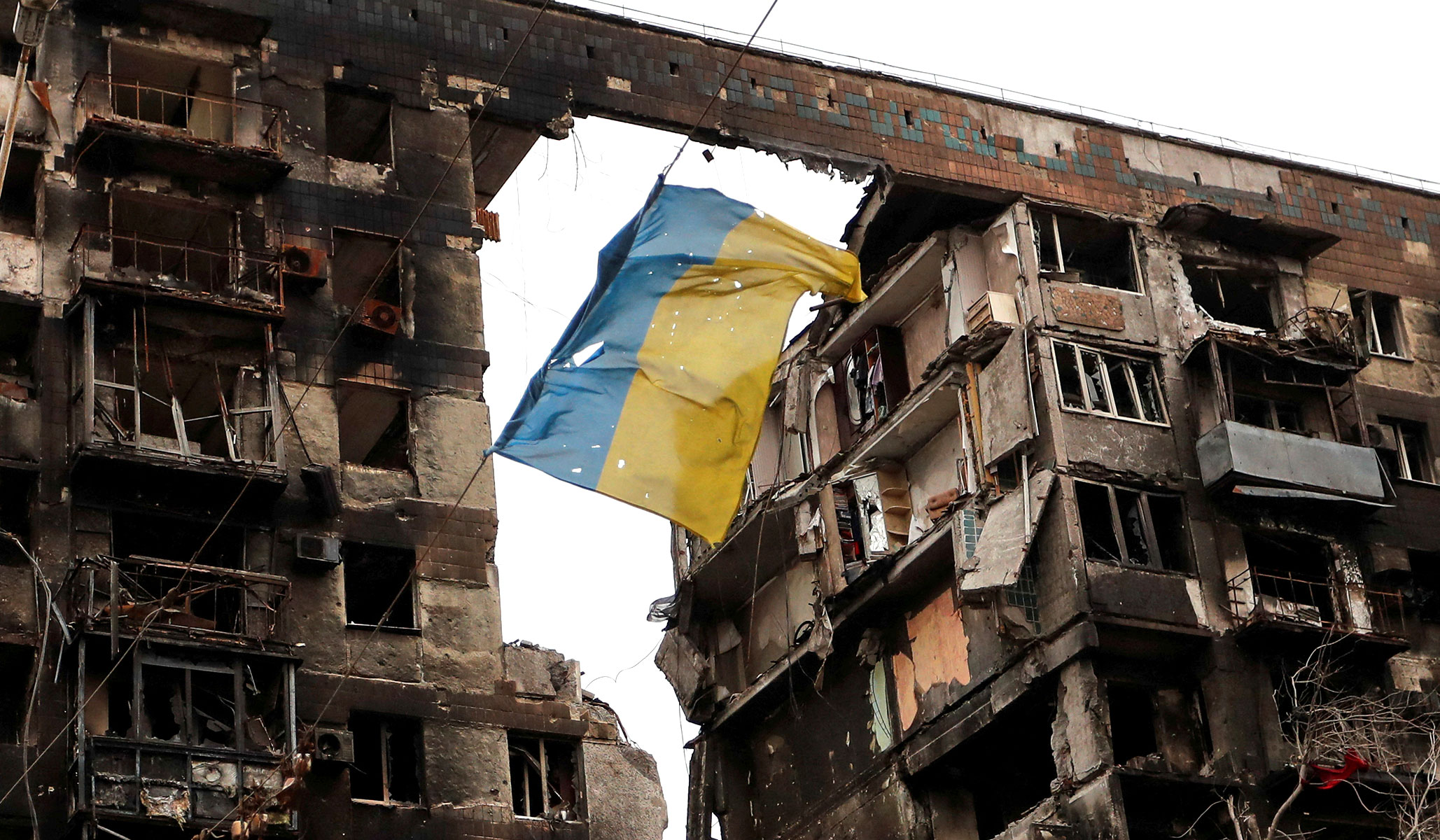
 A tattered Ukrainian flag hangs on a wire in front a bombed-out apartment building in Mariupol, Ukraine, April 14, 2022. (Alexander Ermochenko / Reuters)
 A tattered Ukrainian flag hangs on a wire in front a bombed-out apartment building in Mariupol, Ukraine, April 14, 2022. (Alexander Ermochenko / Reuters)
Editor’s Note: What follows is an expanded version of a piece that appears in the January issue of National Review.
When the times call for it, old books come up. “Old” is a relative term, of course. There’s Homer and there’s Robert Penn Warren. In 1946, Warren published his novel All the King’s Men. It is about Huey Long and the workings of populism. (Warren dubs his Long character “Willie Stark.”) Five or six years ago, a political-science professor, a conservative, told me, “I’ve begun assigning that book to my students. It helps them understand the times we are living in. Frankly, it’s all there. That book is uncanny.”
After Russia’s full-scale assault on Ukraine, I kept running into people who were reading Life and Fate. This is the novel by Vasily Grossman, which he wrote in the late 1950s. It’s about Russia, Ukraine, war, terror, identity — lots of things. Grossman’s government, in Moscow, would not permit the book’s publication. The author died in 1964. His book was smuggled out and published in the West in 1980.
For several months in 2022 and 2023, Life and Fate sat on my bedside table. I picked it up now and then, reading a page or two. But I would put it down, unwilling to bear it. The news out of Ukraine, day after day, was unbearable enough.
Today, North Korean troops are making war alongside Russians in Ukraine. Russian forces are killing Ukrainians with Iranian drones. China is collaborating with Russia in the making of weapons. The worst dictatorships in the world are in alliance: those in Russia, China, Iran, North Korea, Cuba, Venezuela . . . The free and democratic world is in the crosshairs. Ukraine and Israel are front lines, obviously. Is Taiwan next? Anyone caring to glance up will see that the skies are dark.
In recent years, I have heard mention of The World of Yesterday — repeated mention. I am talking about the memoirs of Stefan Zweig, published in 1942. The book is an autobiography, of course, but, equally important, or more important, it is also an account of Europe from the late 19th century until 1939 — September of that year.
Zweig may not be a household name today, but he was one of the most famous writers in the world. By some accounts, he was the most widely translated living writer. What did he write? Practically everything. Poems, plays, and novels. Biographies, histories, and essays. Zweig was both brilliant and humane. Virtually coined for him was the term “humane letters.”
He had European civilization within him. He knew his literary and artistic forebears, and he knew his literary and artistic contemporaries, personally. Hofmannsthal, Rilke, and Mann. Joyce, Shaw, and Wells. Pirandello, Valéry, and Gorky. Those are just a few writers. Among composers, we could list Strauss, Busoni, Bartók, and Ravel.
In The World of Yesterday, Zweig writes,
A further passage:
Yes. Consider the following:
Problems of those days, writes Zweig, were “Lilliputian” compared with later problems.
Zweig grew up in a “golden age of security,” as he terms it. This sense of security was imparted to widening circles of people, not just the comfortably off or advantageously born. Even the Jews, such as Zweig and his family, felt secure. “For Jews,” the author writes,
Vienna was a great, open, liberal city. The “genius of Vienna,” writes Zweig, was that “it harmonized all national and linguistic opposites in itself.” Nowhere, he says, “was it easier to be a European.”
That was then. “Our world of security was a castle in the air.”
Zweig and his generation would know horror after horror: economic collapse, epidemics, exile (if death by violence could be escaped). They saw the growth of hideous isms: Bolshevism in Russia, Fascism in Italy, National Socialism in Germany, and brutal nationalisms all over. Everything turned to ash.
Stefan Zweig was successful early. He had a book of poems published when he was 19. The composer Max Reger asked to set six of them to music. That same year, Zweig submitted an essay to Theodor Herzl at the Neue Freie Presse. Herzl immediately agreed to publish it. Remembers Zweig, “It was like Napoleon presenting a young sergeant with the cross of the Légion d’honneur on the battlefield.”
Zweig and his friends traveled throughout Europe, with Paris being a particular favorite. “Chinese and Scandinavians, Spaniards and Greeks, Brazilians and Canadians, we all felt at home on the banks of the Seine.” People had their national prides, of course. But there was also something like a human pride. “When Blériot made the first cross-Channel flight in an aeroplane, we rejoiced in Vienna as if he were a hero of our own nation.”
(Louis Blériot was a Frenchman, and he made this historic flight in 1909.)
Zweig also traveled farther afield — to the Subcontinent, for example:
That “most of all” is interesting. Zweig had a positive loathing of class and race distinctions.
He also traveled to the United States, wanting to “compare my rather vague idea of the New World with the reality.” An elaboration:
You may chuckle at this:
Zweig strolled around Manhattan for two or three days. Then he hit on an idea — an experiment. What if he were a nearly penniless immigrant, just arrived? Having no friends, relatives, or connections? What if he needed a job quickly, in order to put something in his stomach? Zweig writes,
There was this, too:
Elsewhere in his book, Zweig writes,
August 1914 did not come as a total shock. There were rumblings, including loud ones. On the street, Zweig met Bertha von Suttner, the famous peace activist and writer. (It was she who inspired Alfred Nobel to include a peace prize among the prizes he would will.) Zweig tells the story:
She died on June 21; the archduke and Sophie were assassinated a week later. Unsurprisingly, Zweig has a striking passage about that horrible event:
This is one of the themes of Zweig’s various books, and of many books — one of the themes of history: Civilization is so fragile; it can be shattered in a second, as barbarisms come to the fore.
It was an exceptionally beautiful summer in Europe, that summer of 1914. People commented on it, and not just in retrospect. They commented on it at the time. Zweig took a vacation in Belgium. He writes,
Would Germany really invade this peaceful little neutral country? Would German soldiers brutalize these people? Yes.
In Vienna, there was much patriotism, or “patriotism” — a war fever. The more boobish poets kept rhyming Krieg and Sieg (“war” and “victory”) and Not and Tod (“need” and “death”). “The more wildly you raved, the more of a hearing you got,” writes Zweig.
Nationalisms were horrific and murderous, but they also had their silly side, their comic side — a darkly comic side, maybe we can say: “Shakespeare was exiled from German theaters, Mozart and Wagner from French and British concert halls, German professors explained that Dante had really been of Germanic birth, the French claimed Beethoven as a Belgian . . .”
As the years ground on, the chest-thumping fever subsided and the reality of the war set in. A white-haired priest, who had administered many last rites, said to Zweig, “I am 67 years old. I have seen a great deal. But I never thought humanity capable of such crimes.”
Think of such crimes in our own time: in Bucha, for example, or Mariupol or Kharkiv; in Israel, on October 7, 2023.
After the war, Zweig settled in Salzburg — little, provincial Salzburg, a quiet place in which to work. He is vivid on the aftermath of the war (as on everything else): “For the first time I saw, in the yellow, dangerous eyes of the starving, what famine really looks like.”
Eventually, life stabilized. But Zweig had glimpses of the world soon to come. He saw Blackshirts in St. Mark’s Square, maneuvering smartly and singing the “Giovinezza.” He saw Brownshirts in a border town with Austria, maneuvering even more smartly, and alarmingly, though not singing. Proud boys all.
“I cannot remember,” writes Zweig,
Hitler got power in January 1933, and four weeks later there was the Reichstag fire. “All at once, the rule of law in Germany was over,” writes Zweig.
Zweig recalls a conversation he once had with his publisher in Leningrad. Zweig asked him why he had not left the country after the Bolshevik Revolution, when there was a chance to do so. The man replied, “Oh, well, who’d have thought at the time that a republic consisting of workers’ councils and the army would last more than two weeks?”
Hitler was a gradualist, in a sense — someone who tested how far he could go. The answer turned out to be: as far as he wanted (short of conquering the whole of Europe). Zweig is characteristically perceptive on the subject:
In an interesting turn of events, Zweig became a personal annoyance to Hitler. He posed a problem for him. The arena was opera, an arena very important to Hitler. Here is the story, in brief.
Strauss asked Zweig to collaborate on an opera with him — to suggest a libretto, and then write it. Zweig proposed a treatment of The Silent Woman, Ben Jonson’s comedy. Strauss liked the idea, and both men went ahead. Die schweigsame Frau was soon ready.
Hitler adored Strauss, of course (as did everyone else, as does everyone else, now). But the new opera’s librettist was a Jew. How to rule? Hitler dithered. He allowed the opera’s premiere, which took place in Dresden. But he canceled the show after three performances.
In Salzburg, Zweig lived on the Kapuzinerberg. With the naked eye, he could see Hitler’s place, across the border in Berchtesgaden. On these two peaks, within sight of each other, stood two opposites: an embodiment of European civilization and its eager destroyer.
“More and more clearly,” writes Zweig, “I began to detect a certain insecurity in people’s behavior as they started to waver. Your own small personal experiences of life are always more persuasive than anything else.” Yes. One day, on the street in Salzburg, Zweig noticed something telltale.
An old friend of his avoided greeting him. The next day, to make up for it, the friend called on Zweig at home. The truth was plain: It was becoming dangerous to be friendly in public with Jews — even world-famous ones. Zweig went into exile, in England.
He found that the English were in a state of denial, which was natural, given the world war that they and everyone else had only recently been through.
That is all too familiar to me, where Russia and Ukraine are concerned.
As for the “naivety” of the British, writes Zweig, “I observed it with the burning eyes of a man who, at home, had seen the faces of the storm troopers at close quarters and had heard them chanting: ‘Germany is ours today, tomorrow the whole world.’”
Zweig was a man of great liberality, with a universal outlook, but he also had his “identities,” along with everyone else: as a European, as a Jew — and also as an Austrian.
His friends back home could hardly believe that Hitler would invade Austria. France and Britain would not allow it to happen, they thought, and neither would Mussolini’s Italy. Zweig has a pointed line about these fellow Austrians of his: “They believed in the League of Nations and the peace treaties just as the sick believe in medicine with a pretty label.”
With the Anschluss came atrocities, as Hitler’s boys had their way with the helpless. “All the sick, perverted fantasies they had thought up over many nights of sadistic imaginings were now put into practice in broad daylight.” Zweig records a few examples. These passages are hard to read. Around the world, people were shocked by the atrocities. Such things were not supposed to happen in the 20th century, with airplanes whizzing about, and dread diseases at last being overcome. When the shock wore off, numbness set in. Zweig repeatedly uses the word “inured.” The inurement was worse than the shock.
I am all too familiar with this, too. Newspapers can barely bestir themselves to report on the latest inhumanity in Ukraine — the latest bombing of a school, say. And people are often peeved to hear about it. Why don’t the Ukrainians just give in and end the war? Why won’t they make peace? (Ukrainians, among others, know that “peace” under Russian occupation can be even worse than war.)
Much later than Zweig — indeed, after the Anschluss — Sigmund Freud left Austria for London. Zweig went to see the venerable doctor, then 81. As a “humane man,” writes Zweig, Freud was “deeply distressed” by the outbreak of savagery, but, as a “thinker,” he was “not at all surprised.” “He had always been considered a pessimist, he said, because he denied the supremacy of culture over our instinctive drives.”
Zweig ends his book on September 3, 1939, when Britain and France declared war on Germany, which two days before had invaded Poland. Zweig and his wife, Lotte, left England for the United States in 1940. Then they went to Brazil, their final place of exile.
In February 1942, Zweig put his manuscript, his memoirs, in the mail. The next day, he and Lotte committed a double suicide.
The book could not be published in Austro-Germany, of course — Zweig, like all other Jews, celebrated or not, was banned. It was published in Stockholm.
At one point in his book, Zweig uses the word “relapse”: “the unimaginable relapse of mankind into what was believed to be long-forgotten barbarism.” In 2018, Robert Kagan published a book called “The Jungle Grows Back.” I have never known a title to capture so perfectly a book’s thesis. When I mentioned this to the author, he said something like, “It’s true. You almost didn’t need to write a book to go with the title.” His subtitle is “America and Our Imperiled World.” He writes, “The liberal world order is like a garden, ever under siege from the forces of history, the jungle whose vines and weeds constantly threaten to overwhelm it.”
After World War II, Manchuria and Spain were seen as preludes to it. Are we, could we be, witnessing preludes today? This is a “night thought,” to borrow a phrase from David Pryce-Jones.
Last year, I had a conversation with Eliot A. Cohen, the political scientist who specializes in strategy. He mentioned a book by the late historian Zara Steiner about the 1930s: The Triumph of the Dark. Future historians may write of the current period as another “triumph of the dark,” said Cohen — but “it doesn’t have to be that way.”
How so? “It’s on us,” Cohen explained. Human beings have choices. Individuals make a difference. Their character, our character, matters. Human action, or inaction, matters.
There’s another book by a Viennese Jew, born two months before Zweig: Human Action (Mises). Maybe we can say that tyranny and depravity are part of human nature, but so is righteous opposition to them. Which side will prevail? And for how long?