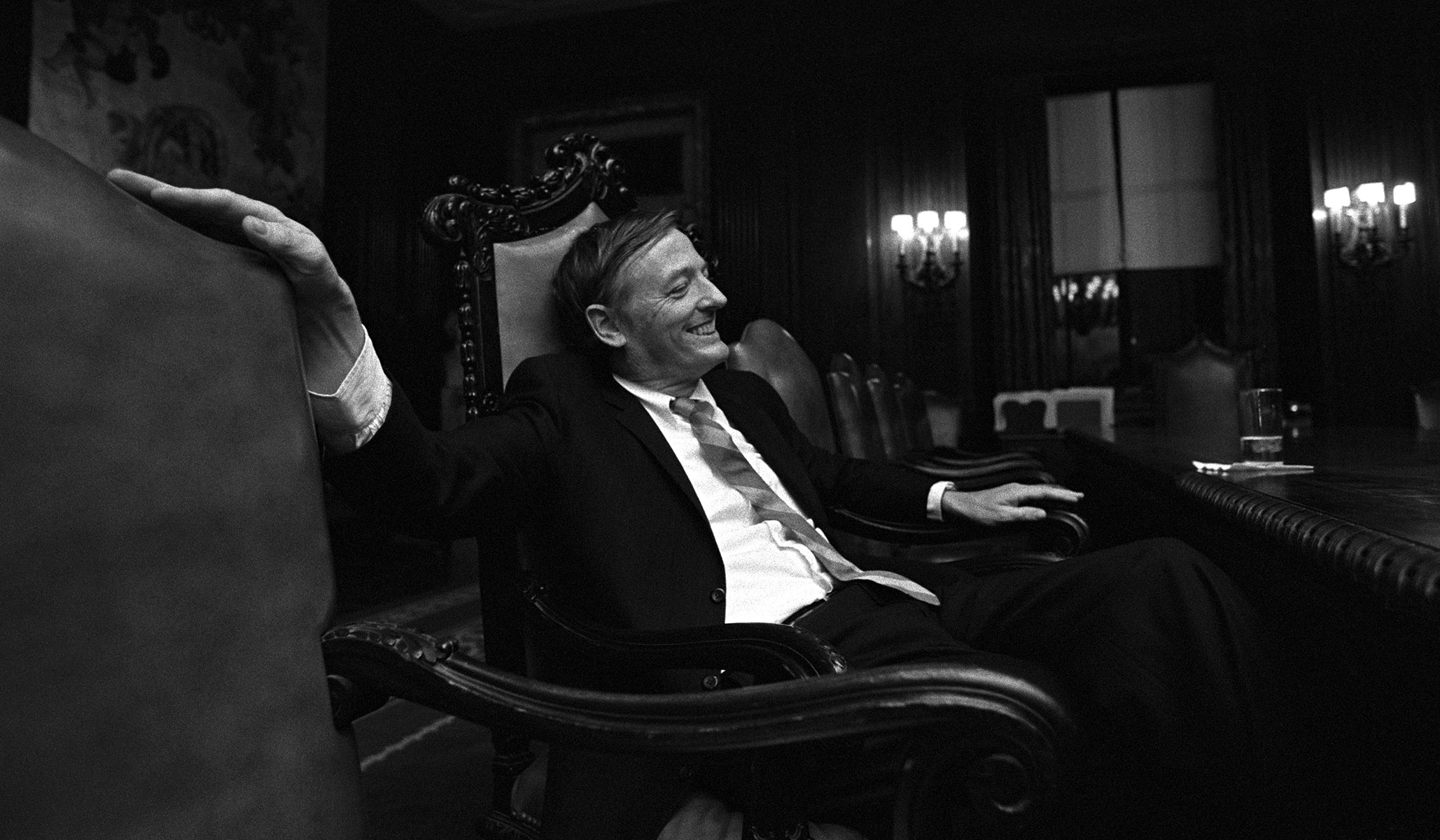
 William F. Buckley Jr. at the New York Public Library Dinner, October 24, 1972
(Fairchild Archive / Penske Media via Getty Images)
William F. Buckley Jr. at the New York Public Library Dinner, October 24, 1972
(Fairchild Archive / Penske Media via Getty Images) William F. Buckley Jr. at the New York Public Library Dinner, October 24, 1972
(Fairchild Archive / Penske Media via Getty Images)
Editor’s Note: The below is an expanded version of a piece published in the February issue of National Review.
All politics and no play makes Jack a dull boy. William F. Buckley Jr. was never dull. He ruled dullness out of himself, and he disliked it in others, though he was patient with it (most of the time) (some of the time). He often said that his greatest fear was to be bored. If conversation stalled, he might hit you with, “Say something provocative! Say something controversial!”
He liked politics — politics is an important part of life — and he knew a lot about it. But he had no time for the 24-hour ideologue, the 24-hour politico — the kind of person who is never “off.” It is so wearying to live that way: both for the one who is politics-consumed and for the people around him.
WFB engaged in political activism — he ran for mayor of New York (and got a great book out of it) — but, chiefly, he was a writer: of columns, essays, and books, all in a tremendous variety. He wrote four sailing journals. He wrote a children’s book. He wrote a novel about Elvis (and he had an Elvis impersonator at the book launch).
He described himself as a “performing writer.” That’s the term he used when people criticized him for writing a whole book about a single week in his life. The audacity! The arrogance! WFB replied, in essence, “Yeah? Well, if you were a performing writer, you could do it too — and I would read you with pleasure.”
(Bill did this twice, by the way: wrote two separate books about two separate weeks in his life. Great reads, of course.)
He was a “great artist.” That’s how he described Murray Kempton, his fellow journalist in New York. (It was Kempton, incidentally, who made the collegian George F. Will want to be a columnist.) Kempton was basically a liberal, but WFB published him in National Review, wanting such an artist, such a performer, to be before NR readers. This did not sit well with some at the magazine — but it was WFB’s (the magazine, that is).
To mark National Review’s 15th anniversary, in 1970, WFB and his confrères commissioned three essays: from a liberal point of view, a conservative point of view, and a left-wing point of view. This last essay was written by Eugene D. Genovese, the historian. (Eight years later, he would be elected the first Marxist president of the Organization of American Historians.) Late in his life, Genovese told me that James Burnham, our illustrious senior editor, paid him one of the highest compliments he had ever received. After receiving Genovese’s piece, Burnham said, “It’s good. It’s very good. It’s much too good for my taste.”
(Genovese, in the course of time, would become a pronounced conservative.)
There was plenty of politics in NR, but WFB also stuffed the magazine with articles about music, theater, art, ballet, language — the delights of civilization. One regular column, by Nika Hazelton, was called “Delectations.”
WFB had many cross-political friendships. He went sailing with Walter Cronkite. He went skiing with John Kenneth Galbraith. He also went skiing with Milton Friedman, an opposite number to “JKG” (as WFB styled Galbraith). JKG was a social-democratic economist; Friedman was a classical-liberal economist. The former was 6'9"; the latter was 5'0. WFB would quip, “Economic wisdom is not measured in height.”
He and Galbraith had a wonderful teasing relationship. Once, Galbraith blurbed a novel for his friend: “Mr. Buckley has a great talent for fiction, as readers of his columns know.” One of the things Buckley prized about Galbraith was the economist’s excellence of English. “Syntactically pure,” is how WFB described him.
While Bill was a mad sailor and a keen skier, he did not have much use for sports generally. In 1994, when Bill was almost 70, Ira Glasser took him to his first Major League Baseball game. (Glasser was the head of the ACLU.) It was Opening Day at Shea Stadium, where the New York Mets played. Glasser insisted that he and WFB take the subway out to the park. WFB had not been on a subway train since he ran for mayor, in 1965. (That appearance must have been ceremonial.)
Bill went home from Shea by his usual method: limo.
A few years later, Glasser took WFB to a Yankee game. (That was the end of WFB’s baseball career, so to speak.) I know one story from that outing. After an inning or so, WFB went to get a beer. The young woman behind the counter asked for ID. Blinking at her, WFB said, “I’m 74 years old.”
The limo had a partition. That’s because, Bill said, “Jerry likes to listen to the ballgame.” Jerry Garvey was his longtime driver. WFB did not care to listen to the ballgame — but he was not going to deprive Jerry of it.
WFB attended his fair share of shows and plays — Broadway and off-Broadway. I think Pat (Mrs. Buckley) attended more. Once, in their home, I met Kitty Carlisle Hart, who was then about 90. Someone said to me later, “Do you realize that you shook the hand of someone to whom George Gershwin proposed marriage?”
Toward the end of his life, WFB attended a play about Jack Kerouac, which included WFB himself as a character. It was interesting to glance at Bill as he watched an actor play a younger him. Later, backstage, we met the actor.
He seldom went to the movies, at least when I knew him. But, in 2006, someone urged him to see The Lives of Others, Florian Henckel von Donnersmarck’s movie about East Germany. Afterward, he said it was possibly the best movie he had ever seen.
With some regularity, he watched television. The Sopranos, Band of Brothers — I watched several episodes of those series with him. Years before, he had loved All in the Family, the sitcom starring Carroll O’Connor as Archie Bunker. It was shown on Saturday night at 8 o’clock. You had to be in front of your television then; no VCRs and such.
One Saturday, he was miffed at having to miss the show. He had accepted an invitation to a dinner party at Nelson and Happy Rockefeller’s. As it happened, he was seated next to . . . Carroll O’Connor. Which saved the evening.
He painted — particularly when he and Pat had their annual sojourn in Switzerland. WFB showed his paintings to Marc Chagall, who had come to visit. Chagall expressed pity for the paint. Everyone’s a critic.
In Switzerland, the Buckleys were friendly with other “seasonal” residents, including David Niven and Roger Moore. I love what Bill said about Niven: “If ever there was a man who winked at the homely girl, it was David.”
‘Music is dearer to me than speech.” WFB did not write that, but he could have. Those words were written by Vikram Seth, the great Anglo-Indian novelist. WFB was an exceptionally musical writer. And, all through his life, he was engaged with music itself.
His boyhood hero was Toscanini. He lurked in the lobby of the Savoy Hotel in London, hoping to catch a glimpse of the great maestro. Later in life, he knew Toscanini’s daughter Wanda — married to Vladimir Horowitz. It was Horowitz, by the way, who sought out WFB, not vice versa.
(Once, I asked Bill, “How did you happen to know Herbert Hoover?” He said, almost shyly, “Well, he was a bit of a fan.”)
WFB’s lodestar in music was JSB. In 1985, WFB wrote the following: “Three hundred years ago on March 21, Johann Sebastian Bach was born. The event is as though God had decided to clear His throat to remind the world of His existence.” WFB further wrote,
WFB hosted his TV show Firing Line from 1966 to 1999. Its “theme music” was the last movement of Bach’s Brandenburg Concerto No. 2. One evening, I was at a New York Philharmonic concert at which this concerto was played. When the orchestra finished, the friend next to me leaned over and said, “You remember the definition of an intellectual: ‘someone who can hear the William Tell Overture without thinking of the Lone Ranger.’ Well, I find it impossible to hear the last movement of that concerto without thinking of William F. Buckley Jr.”
When WFB graduated from college, his father made him a gift of a clavichord (forerunner of the harpsichord). Ralph Kirkpatrick, the renowned harpsichordist, came over to Bill’s to try it out. Many years later, Bill recalled that experience in an essay for the New York Times:
WFB also encountered Ralph Kirkpatrick’s teacher, the legendary Wanda Landowska. She asked Bill whether he had heard her new recording of The Well-Tempered Clavier. Yes, indeed, said Bill. The grand lady closed her eyes and said, “Magnificent, no?”
Bill himself performed in public — starting when he was in his 60s. At the harpsichord, he played Bach concertos with orchestras in Phoenix, Raleigh, New Haven, and elsewhere. (The one in New Haven was that of his alma mater, Yale.)
His teacher was Fernando Valenti, also a good friend of his. Valenti had been a student of Kirkpatrick’s. For about ten years running, Valenti played a recital at National Review’s annual Christmas party. A harpsichord recital at a Christmas party, or any party? That was WFB, and his magazine.
He had many friends in and around music. When he introduced me to Schuyler Chapin, I knew the name but could not quite remember why. I asked, “Do you have to do with music?” WFB interjected, “He is music.” Chapin held many jobs in his distinguished life. One of them was tour manager for Jascha Heifetz. Another was general manager of the Metropolitan Opera. Also, he wrote a book about his friend Leonard Bernstein. And married a Steinway — that is, a woman of the piano-manufacturing family.
WFB said that Schuyler Chapin was one of the best conversationalists he ever knew. He could never bore you. His repertoire was inexhaustible, and he executed it marvelously. (I was a privileged listener from time to time.)
Alicia de Larrocha, the great Spanish pianist, was a musician who meant a lot to me, and WFB had a story about her (naturally). One day, he and Fernando Valenti were having lunch with her. “Where are you going next, Alicia?” one of the them asked. “New Arizona,” she said. No, they explained, there was “Arizona” and “New Mexico,” but not “New Arizona.” The pianist was unconvinced, saying, “My contract says ‘New Arizona.’”
WFB loved the story about Clemenceau and Paderewski. He told it once when introducing me at an event — an event at which we were going to talk about music. The great pianist, remember, became prime minister of Poland in January 1919. And he represented his country at the Paris Peace Conference. In due course, he introduced himself to Clemenceau.
“What was your name again?” said the Frenchman. “Paderewski,” answered the Pole. “Any relation to the pianist?” asked Clemenceau. “I am the pianist,” said Paderewski. Clemenceau blinked. “And now you’re in politics?” he said. “You could say that,” Paderewski answered. Clemenceau then said: “What a comedown.”
The Buckleys hosted many recitals in their home(s). Here is a report from the New York Times, published on October 4, 1983:
The report goes on to say,
The Times account concludes like this:
Not all of them were lovely, needless to say. But many, many were.
Rosalyn Tureck made recordings in the Buckleys’ homes. WFB had her as a guest on Firing Line, more than once. Another guest was Yehudi Menuhin, the great violinist. (“What’s on Yehudi Menuhin’s Mind?,” that episode was called.) All politics and no play makes Jack a dull boy.
One night, a guest at an editorial dinner was Sharon Isbin, the classical guitarist. WFB said, “I understand you’re the greatest guitarist in the world.” Isbin said, “Oh, come on. There’s no ‘greatest guitarist.’ That would be like saying there’s a ‘greatest writer.’” WFB grinned that grin and said, “Well . . .”
He liked jazz too, plenty. One favorite was Dick Wellstood, the pianist. I also met Peter Duchin at the Buckleys’. He is a pianist and band leader, like his father, Eddy Duchin, before him.
While I’m in storytelling mode, let me mention Mr. T (the television star, known for his mohawk and medallion and the catchphrase “I pity da fool”). One night, WFB and I had a pre-opera dinner at the Mexican place across from Lincoln Center. As Bill walked to our table, he passed Mr. T, who was leaving. They brushed shoulders, each oblivious to the other. “Two icons,” I thought, “passing in the night.”
WFB’s work shed in Connecticut was crammed with books and magazines and papers, but there was also an organ in there. One Fourth of July, I heard him practicing diligently on it. The music: Ives’s Variations on “America.” Sometimes, we would just listen to music in that shed — recorded music. On one occasion, we listened to Simone Dinnerstein’s new recording of the Goldberg Variations.
Later, he asked her to play the work in his (Manhattan) home, which she did. And he wrote about her, and Bach, for Gramophone magazine.
There was joie de vivre in Bill (to go with tristesse). He gulped down life, wanted to devour a great many aspects of it. He traveled incessantly, writing of his adventures. He loved high culture. He recorded episodes of Firing Line in the Sistine Chapel. (The guest list: Princess Grace, Malcolm Muggeridge, Charlton Heston, and David Niven.)
Critics called him “effete,” “elitist,” and worse. What he was, was himself — his wonderful, warm, wide-ranging self. He referred to caviar as “cav,” true. But he also loved Kentucky Fried Chicken. One New Year’s Eve, the household staff had the night off and we drove to KFC to pick up chicken. You never saw a happier eater than he.
Another time, he was going to have lunch at his usual place, Paone’s, in Murray Hill (Manhattan). He called me from the car, saying, “Let’s do something offbeat.” We went to a barbecue place I knew, with a jazz club attached. He loved it. The manager insisted on showing him the jazz club, down in the basement, after lunch. I could tell that Bill was daunted by the stairs, at that stage. But he refused to say anything, and let himself be led down the stairs, and then back up.
I sometimes think of Bill’s words: “do something offbeat.” I really should. And usually don’t.
He dealt with the gravest subjects, political and otherwise. But he also loved amusement. He would head an e-mail “Pour t’amuser” — “To amuse you.” (A reader told me that he had canceled his subscription to NR, earlier in his life, “after too much untranslated French.”) WFB was just big. That’s how I often answer when people ask, “What was Bill Buckley like?” If I want to say something quick, I say, “He was big: big of heart, big of mind, big of appetite --- appetite for life.” Big, and glorious.