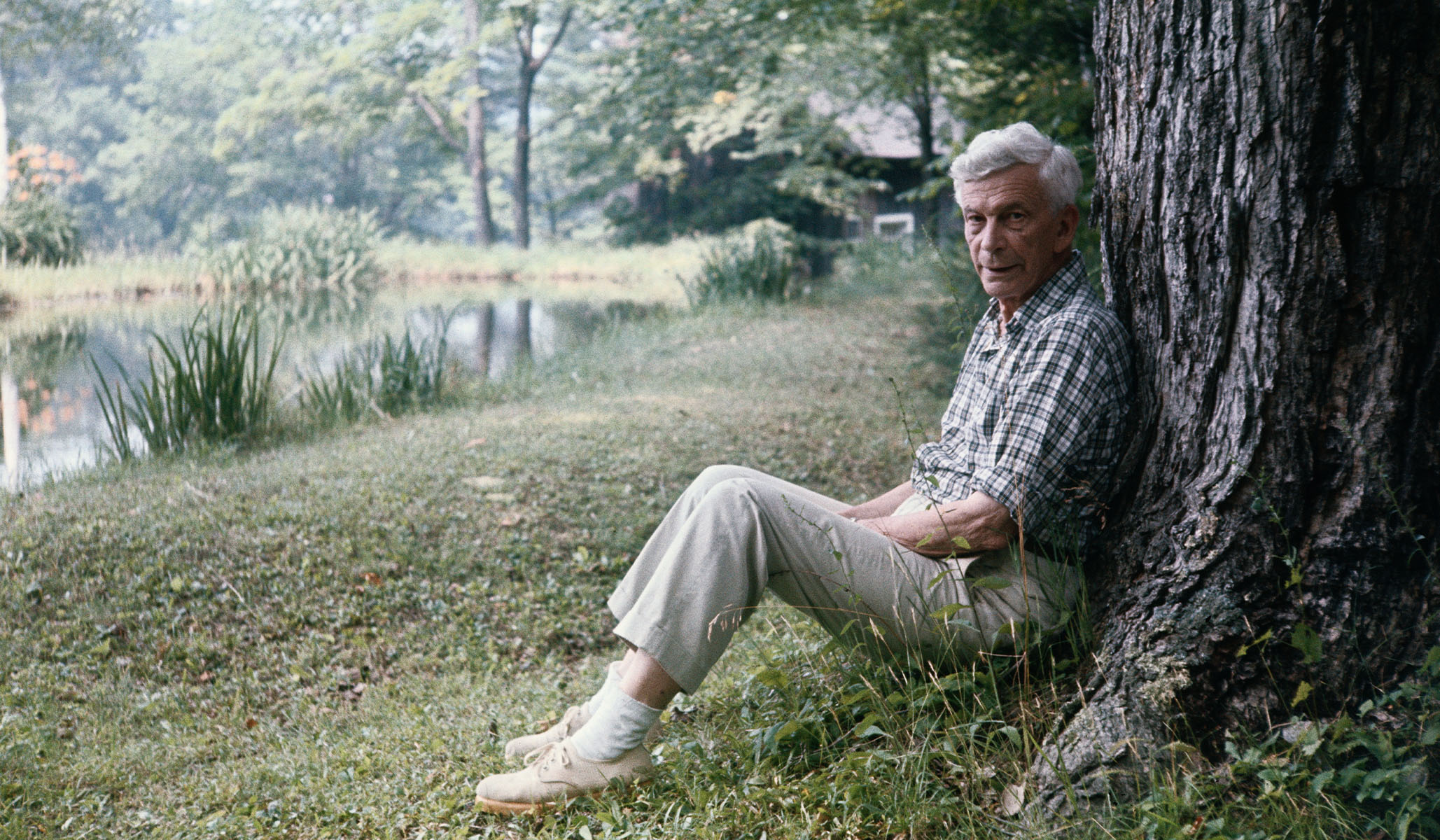
 Mark Van Doren at his farm in Cornwall, Conn., July 17, 1969 (Bettmann / Contributor via Getty Images)
 Mark Van Doren at his farm in Cornwall, Conn., July 17, 1969 (Bettmann / Contributor via Getty Images)
A phrase from Mario Vargas Llosa comes to mind: “those of us who did not attend his classes and yet feel ourselves to be his students.” He is writing of Isaiah Berlin and the many who are indebted to him — whether they ever met Berlin, in the flesh, or not. You will find Vargas Llosa’s discussion of Berlin, and other influences on him, in his book The Call of the Tribe.
(I reviewed that book in November 2022, here.)
Can you be a student of someone you have never laid eyes on? Sure, in a way. You may wish to sign up with Mark Van Doren, the great professor of English who lived from 1894 to 1972. In 1938, he wrote Shakespeare, which can be had in an edition from NYRB. The foreword is by David Lehman, a poet and critic born in 1948.
Among Van Doren’s students, in the flesh, were Lionel Trilling, Thomas Merton, Whittaker Chambers, Allen Ginsberg, Norman Podhoretz, John Berryman, Jack Kerouac, Meyer Schapiro, John Hollander, and Jeffrey Hart.
Bill Clinton styled himself “The Man from Hope” (for he was born in Hope, Ark.), and Van Doren was another. He was born in Hope, Ill. (a dot on the map in Vermilion County). He studied at the University of Illinois and then at Columbia, in New York. He would make his career at Columbia, teaching.
Another professor of English, Charles W. Everett, wrote the following about him:
Van Doren was known by a wider public, too. As David Lehman tells us in the foreword I have mentioned, Van Doren edited an anthology of poetry that sold so well, he was able to buy for his family a house on Bleecker Street, in the Village. Lehman further offers this: Van Doren was “one of the experts discussing great literature on Invitation to Learning, a half-hour radio show that aired on Tuesday evenings starting in 1941.”
That show was a hit. Do you think something like it would be possible today? Would the public want it?
Thomas Merton wrote that, in Professor Van Doren’s classes, “literature was treated, not as history, not as sociology, not as economics, not as a series of case studies in psychoanalysis, but, mirabile dictu, simply as literature.” Van Doren loved literature, and was a great exponent of it. A scholar, to be sure: but also a poet, a novelist, and so forth.
Merton, as you know, became a Trappist monk. He and Van Doren were friends for life, though the teacher outlived the student, as Merton died in 1968, at 53.
I will again quote David Lehman, in a passage that tells us something about the character of Van Doren:
These included Trilling and Schapiro.
His Shakespeare book is dedicated to Raymond Weaver, his colleague at Columbia, with whom he shared an office. Weaver, says Lehman, had been “nagging” Van Doren to “collect his thoughts on Shakespeare and turn them into a book.” In the summer of ’38, at the Van Dorens’ farmhouse in Cornwall, Conn., he did it.
It was on the farm, says Lehman, “that Van Doren got to do nearly all his writing; his dedication to his students and his classes left little surplus time during the academic year.” I think of Mahler — who composed for about six weeks in the summer, out in the country. Otherwise, his conducting duties engulfed him.
To his Shakespeare, Van Doren wrote an introduction. It begins,
He goes on to say,
That is a key point. Here’s more:
Yes, yes, yes. You know, I feel exactly the same way about Bach and most other great composers. (Beethoven, I have some personal interest in. I mean, I am interested in him as a man. Most of the others, however, I find in their music, solely, and that is enough — more than enough.)
Back to Bach. I, and others, have frequently said about him that he contains all of music — all the music that came before him, all the music of his own time, and all the music that would ever, or could ever, come after him. Van Doren says of Shakespeare that every kind of poetry and every kind of prose is found in him — moreover, at their best.
More, from our professor, Van Doren:
Forgive one more analogy to music: Wagner has some of this power, too (in fact, a lot of it).
When Shakespeare writes poetry, says Van Doren, it is seldom for its own sake. He did not regard poetry as the most precious thing in the world. Nope, the world was more precious — the world itself. “What he dealt in,” says Van Doren, “was existence, and his dealings were responsible, high-hearted, and humane.”
I don’t think I had heard that word “high-hearted.” It means, according to Merriam-Webster, “full of courage or nobility”; also “full of gaiety.”
Says Van Doren,
I have quoted a lot, and I should not detain you forever. Van Doren begins his book with a chapter on the poems, then has a chapter on each of the plays. I will quote just a little from two of the chapters: on Othello and Antony and Cleopatra. (Those are two of the plays I have a decent knowledge of, and two of the plays I value most.)
Listen to what Van Doren says about one of the characters. “Nothing,” he says,
More about Iago:
Perfect (and applicable to many).
When I was young, I was sort of embarrassed that Antony and Cleopatra was my favorite play, pretty much. Your favorite play is supposed to be Hamlet or King Lear or Macbeth — you know, one of the gravest and deepest. I had to smile when I read that Antony and Cleopatra was the favorite play of a venerable Shakespeare scholar, Samuel Schoenbaum (1927–96).
In A&C, writes Van Doren, Shakespeare
If you know the play, you realize: “That is perfect.” So is this (the last of the passages I will quote):
You bet your . . .
For years, I have said (along with many others), “Reading A. C. Bradley is the next best thing to reading Shakespeare himself — and sometimes as good.” (Bradley was the Oxford don who lived from 1851 to 1935.) I can say the same of Mark Van Doren. John Updike said that, when dealing with any Shakespeare play, he consulted Van Doren’s book.I have come away from Van Doren’s Shakespeare thinking not so much about the greatness of Van Doren as about the greatness of Shakespeare. Van Doren is an appreciator, and he makes you appreciate, too. I love to quote Robert Graves — who said (in essence), “The thing about Shakespeare is, he really is good.”
What a pleasure, what a privilege, to sit in Professor Van Doren’s classroom, remotely, so to speak.
If you would like to receive Impromptus by e-mail — links to new columns — write to [email protected].