 (Image by Eric Sailer)
 (Image by Eric Sailer)
Editor’s Note: The below is a version of a piece that appears in the current issue of National Review.
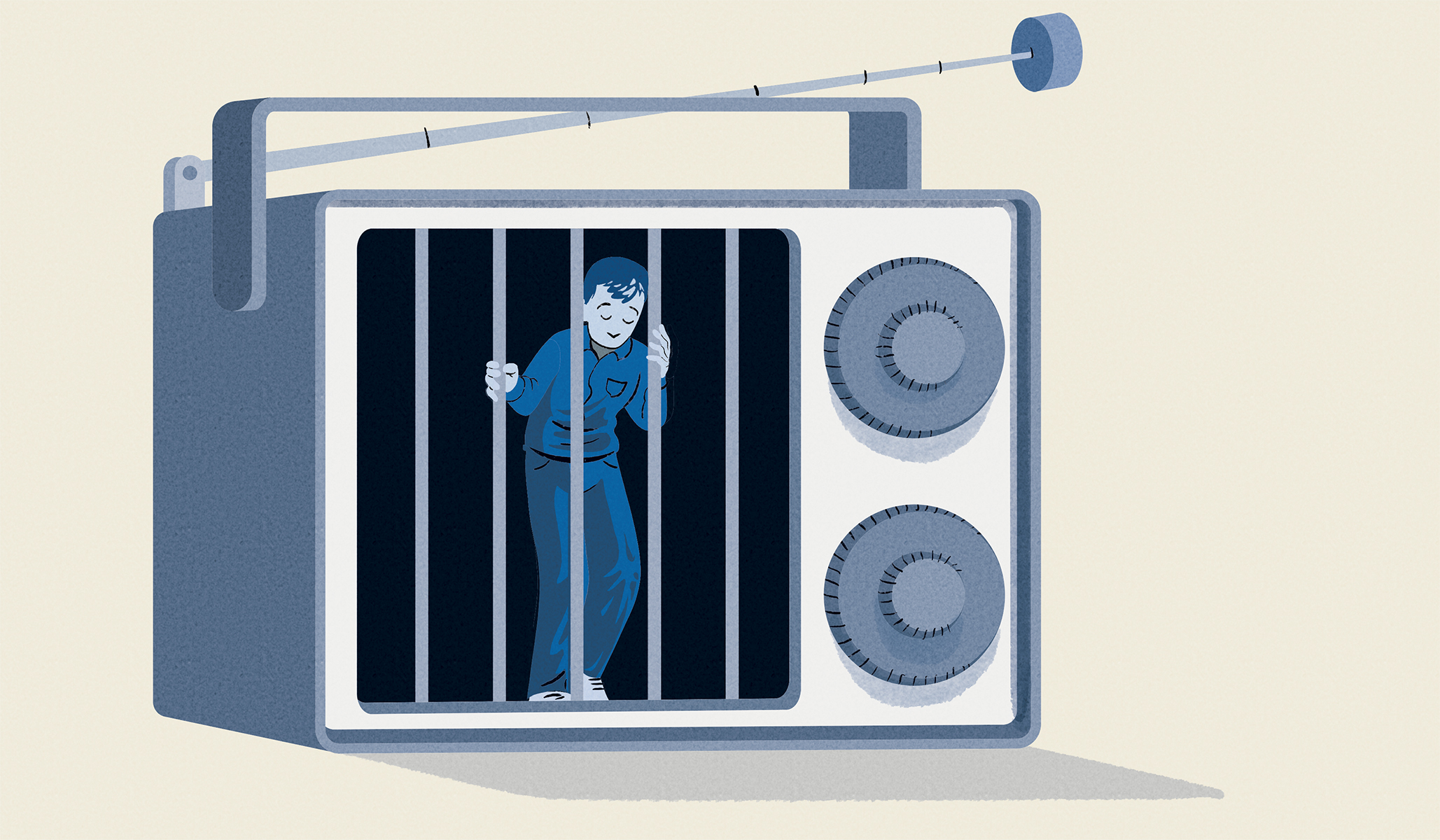
One Friday night — March 14 — President Trump essentially shut off the radios: RFE/RL (our combination of Radio Free Europe and Radio Liberty); Radio Free Asia; the Voice of America; Radio Martí (which broadcasts to Cuba); and so forth. Can he do that? Does the president have the power to silence the radios, all by himself? This proposition is now being tested in court.
Some of us regard the radios as jewels in the American crown, whatever their flaws and problems. Trump and his administration have a very different view. The White House put out a statement saying that “taxpayers are no longer on the hook for radical propaganda.”
On X, Ian Miles Cheong echoed that theme. The radios, he said, “produced and disseminated far-left propaganda.” Cheong is a “social-media influencer” from Malaysia who has contributed to RT, the Kremlin propaganda network. Why does his statement matter? Besides the fact that he has 1.2 million followers on X, his statement was reposted by Tulsi Gabbard, who is our director of national intelligence.
Elon Musk, the owner of X and a senior adviser to Trump, posted, “Yes, shut them down,” meaning the radios. “Nobody listens to them anymore,” he said. “It’s just radical left crazy people talking to themselves while torching $1B/year of US taxpayer money.”
This statement was quoted by the Global Times in an editorial. GT is a publication of the Chinese Communist Party. Exulting, the editorial said, “The so-called beacon of freedom, VOA, has now been discarded by its own government like a dirty rag.”
A former editor-in-chief of GT, Hu Xijin, put out a statement of his own: “Voice of America has been paralyzed! And so has Radio Free Asia, which is just as malicious toward China. How truly gratifying!”
In Russia, the state media were equally exultant. Vladimir Kara-Murza had a wry comment, when news came that Trump had shut down the radios. (Kara-Murza is a Russian democracy leader and a former political prisoner.) “One more champagne bottle opened in the Kremlin. They must be running out by now.”
A “news” site of the Cuban dictatorship, Cubadebate, celebrated the end of Radio Martí: “the most expensive, failed, and corrupt communications project in the history of the United States.” (Radio Martí’s annual budget was about $13 million, by the way.)
Our radios are lifelines to people under dictatorship, starved for information, or fed a diet of lies. This is a term people frequently use when talking about the radios: “lifelines” — to Cubans, Iranians, Tibetans, Uyghurs, and many others.
Taken together, the radios broadcast to approximately 100 countries in 63 languages. They reach some 420 million. The total cost is $950 million — a small amount in our overall federal budget ($7 trillion), delivering much “bang for the buck.”
When we say “radios,” we are using a catch-all term, and an old-fashioned one: The radios have expanded into television, Instagram, YouTube, and everything else that is modern.
But they indeed started out as radios. They meant a lot to Václav Havel, the Czech dissident and political prisoner, who would become president of his country. RFE/RL was located in Munich. After the Cold War, Havel invited the agency to come to Prague, for one Czech crown a year. We took him up on it (and are still there).
In Poland, another dissident and political prisoner became president: Lech Wałęsa. He was once asked what the radios had meant to the cause of Polish democracy. His answer: “Would there be an earth without the sun?”
Anatoly Shcharansky was a dissident and political prisoner in the Soviet Union. Today, he is Natan Sharansky, in Israel. He remembers how his father listened to the American radios, though the Soviet government did its best to jam them. You had to be careful, Sharansky tells me: If the neighbors heard you listening, it could be big trouble for you.
From the radios, the family learned about the outside world — but they also learned about what was happening inside the Soviet Union, Sharansky emphasizes. You could not get that from state media.
“It is very important to support independence of thought,” he says. Alternative media — truthful and reliable media — are important to independence of thought. “If a person is disconnected from the outside world,” says Sharansky, “his independence of thought dries up.”
After Russia’s initial invasion of Ukraine in 2014, RFE/RL created Current Time, a 24/7 TV network in Russian. Vitaly Mansky, a prominent Russian filmmaker, said this about the network: “It is the only television in the world that tells us, in Russian, the truth about the current state of affairs.”
RFE/RL’s Kyiv bureau has had about 100 employees, doing excellent work — in straitened circumstances, of course. One member of the bureau, Vira Hyrych, was killed in a Russian strike in April 2022.
Stanislav Aseyev once worked for RFE/RL. He was held prisoner by Russian agents for two and a half years in eastern Ukraine. Finally, he was released in a prisoner swap. On March 16 this year, he wrote,
Myroslava Gongadze is the Eastern Europe chief at the Voice of America. A native of Ukraine, she is an inspiring figure to people in that country, and to their well-wishers. She is a dogged journalist. So was her husband, Georgiy Gongadze. In 2000, he was murdered by a post-Soviet Ukrainian regime that was all too Soviet. The Gongadzes’ twin daughters, Nana and Salome, are young Ukrainian-American women who work in the general field of democracy, freedom, and human rights.
In Belarus, there were mass demonstrations, pro-democracy, in the summer of 2017. Protesters stood outside state-media headquarters in Minsk, chanting a defiant chant: “Radio Svaboda! Radio Svaboda!” That is the Belarusian way of saying “Radio Liberty.”
Our radios may be silly to some Americans, but they are greatly important to other people.
Sviatlana Tsikhanouskaya is the leading figure of the Belarusian opposition. She is in exile. Her husband, Sergei Tikhanovsky, is a political prisoner. On March 16, Tsikhanouskaya wrote, “For us, nations living under tyranny, RFE/RL and the VOA are symbols of the free world — voices of truth.” She also pointed out that her countryman Ihar Losik was in prison for working for RFE/RL.
Losik is now 32. He began at RFE/RL in 2015 as a Václav Havel journalism fellow. The dictatorship arrested him in 2020 and sentenced him to 15 years.
Nine other journalists around the world are in prison for working for RFE/RL. In Azerbaijan, Farid Mehralizada. In Russian-occupied Crimea, Vladyslav Yesypenko. In Russia itself, Nika Novak. In Burma, Sithu Aung Myint. And in Vietnam, five people: Pham Chi Dung, Truong Duy Nhat, Nguyen Tuong Thuy, Nguyen Lan Thang, and Nguyen Vu Binh.
As you know, it is risky not only to work for American radios, it can also be risky to listen to them. In December 2017, Radio Free Asia reported the following:
A component of RFE/RL is Radio Farda, which broadcasts to Iran. (“Farda” means “tomorrow” in Persian.) This radio, like the others, is staffed by exiles, eager to provide accurate information to people back home. Some 6.5 million Iranians tune in to Radio Farda every week.
On March 17, an Iranian dissident in exile, Sardar Pashaei, sent me a note, saying,
(An update: Leila Pashaei has been released from prison on bail and is awaiting trial.)
Steve Capus is the president of RFE/RL — and “I don’t want to be the last,” he says. He is bewildered by the attack on the radios. Such attacks habitually come from America’s enemies, not from the White House. Capus is from Bucks County, Pa. The first president he ever voted for was Ronald Reagan. He believes in the radios’ mission, unapologetically. He believes they are in the U.S. interest. We press our case, he says, against the assorted and tireless foes of freedom.
RFE/RL’s budget is $142 million — and “this is a fraction,” says Capus, “of what the Chinese and the Russians and the Iranians are spending in the so-called information space.”
Jeffrey Gedmin was the president of RFE/RL — twice — and now he is the president of another of the radios, MBN, which stands for “Middle East Broadcasting Networks.” In a memo to staff, he said, “MBN operates in a region where America’s enemies invest aggressively in fake news and disinformation. MBN matters. American surrender cannot be an option.”
The president of Radio Free Asia, Bay Fang, said this, when the ax fell on the radios: “The termination of RFA’s grant is a reward to dictators and despots, including the Chinese Communist Party, who would like nothing better than to have their influence go unchecked in the information space.”
Ms. Fang and others have emphasized two points about RFA. (1) The agency has been crucial in reporting on the persecution of the Uyghurs. This reporting played a role in the decision of the State Department to designate that persecution a genocide. (2) RFA has looked deep into the origins of the coronavirus.
Is it any wonder that Beijing is celebrating RFA’s demise?
A number of European officials have voiced support for the radios, including Jan Lipavský. He is the Czech foreign minister. “From Belarus to Iran, from Russia to Afghanistan,” he wrote, “RFE/RL and the Voice of America are among the few independent sources for people living in darkness. Their silencing would be a loss not only for them but for all of us who believe in democracy.” Lipavský is a Czech in the Havel tradition. He has also had an idea. Maybe the European Union can fund RFE/RL, seeing that the United States is unwilling to?
Edward Lucas, the British writer who concentrates on security issues, thought this was a good idea. “RFE/RL is a ready-made project: the information-warfare equivalent of a fully commissioned, crewed, and equipped aircraft carrier.”
Kaja Kallas was the prime minister of Estonia and is now an EU official. Like many another Eastern European, she knows the worth of the radios. “It is sad to hear that the U.S. is withdrawing its funding,” she said. “Now the question for us is, can we come in with our own funding and fill the void that the U.S. is leaving?”
That is a question that applies to the radios and a lot more.