National Review | APRIL 21, 2025
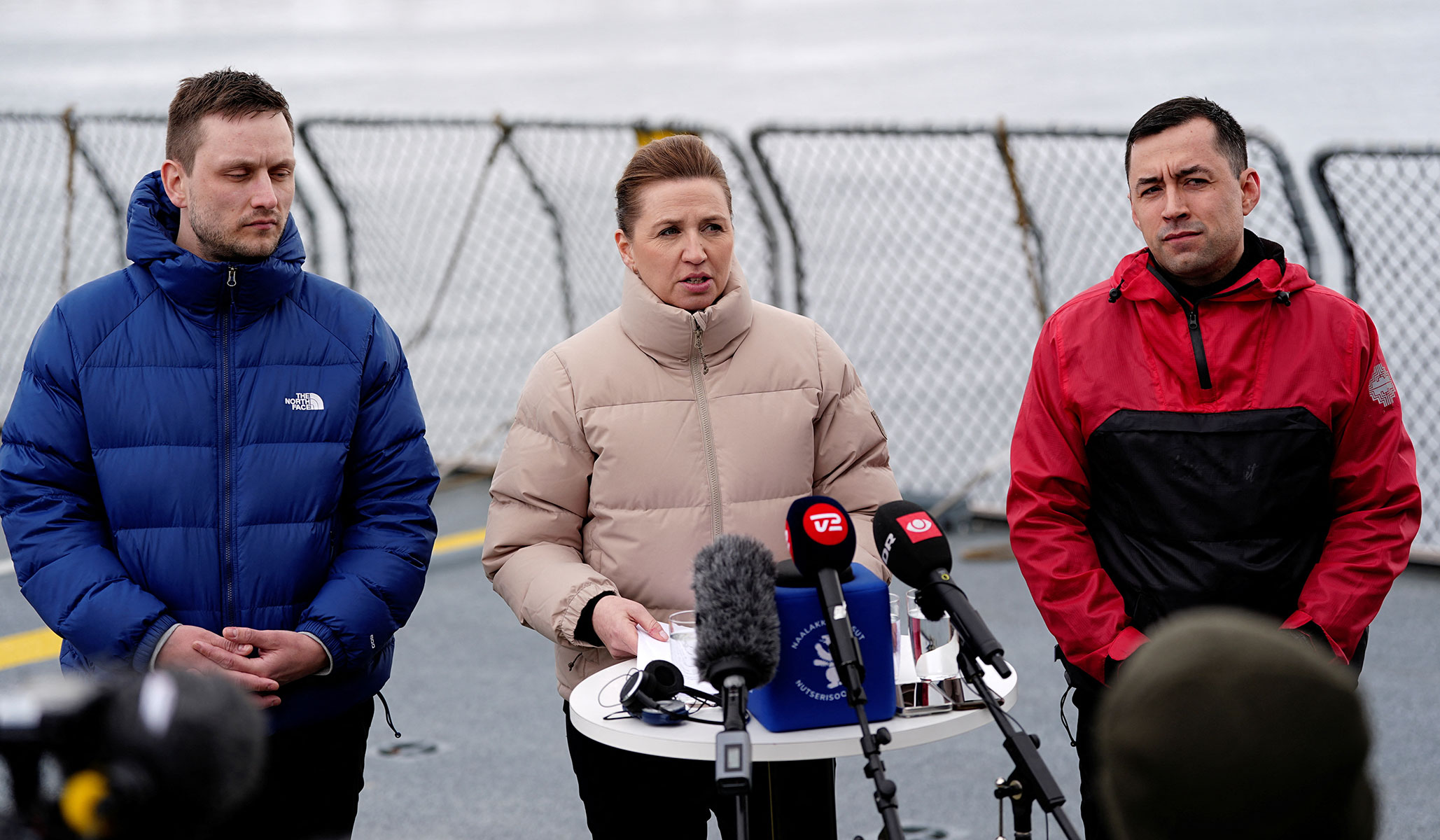 Denmark’s prime minister Mette Frederiksen (center) with Greenland’s acting head of government Múte Bourup Egede (right) and newly elected head of government Jens-Frederik Nielsen at a press conference aboard the Danish Navy inspection ship Vaedderen in Nuuk, Greenland, April 3, 2025 (Ritzau Scanpix / Mads Claus Rasmussen via Reuters)
A report from an allied capital in a strange time
Jay Nordlinger
Editor’s Note: The below article is an expanded version of one that appears in the current issue of National Review.
Copenhagen
Recent weeks have been good for Jolly Cola — a Danish soft drink. Many Danes are boycotting American products, and there is no product that says “America” more than Coca-Cola. In this country, Coke partners with Carlsberg, the Danish brewer — but never mind: The symbolism’s the thing. On the bottles and cans of Jolly Cola, there is a slogan: “A real Danish original — since 1959.”
In addition to boycotting products, Danes are canceling their trips to America. Hundreds have even demonstrated outside the U.S. embassy here. “Back Off, U.S.A,” read a sign. Another sported an old standby: “Yankee, Go Home.”
This is very, very unusual. Denmark has long been a pro-American country, and the Yanks and the Danes have long been close allies. Suddenly, everything is different. There is shock and hurt in this country, especially among people who have been the most America-admiring.
Several people have related to me their lifelong love affairs with America. Per Stig Møller remembers singing a song as a child, right after the war. It celebrated Uncle Sam, with his glorious tall hat.
Møller had an initial career as a literary scholar, then spent many years as a politician, and is now back to writing. He was Denmark’s foreign minister from 2001 to 2010.
The last few months have been jolting. In came the second Trump administration. The U.S. radically changed posture on Russia’s invasion of Ukraine. Denmark is robustly pro-Ukraine and anti-Putin. In April, there was President Trump’s launch of a worldwide trade war, which he dubbed “Liberation Day.” Since then, the war has been “paused.”
A war of this type, says Peter Kurrild-Klitgaard, is “based on completely absurd calculations and ignorant of 250 years of economic thought.” Mr. Kurrild-Klitgaard is a professor of political science at the University of Copenhagen. We will hear more from him, and Mr. Møller, and others, in due course.
Not least on the Danish mind — far from least — have been Washington’s threats to this country over Greenland. In his first term, Trump mused about buying the territory. The Danes said it was not for sale. This term around, Trump has spoken in belligerent tones. Here is a sampling of his statements:
“The ownership and control of Greenland is an absolutely necessity.” “We have to have Greenland. It’s not a question of, ‘Do you think we can do without it?’ We can’t.” “We’ll get Greenland. Yeah, 100 percent.”
More than once, Trump has explicitly refused to rule out the use of military force in his getting of Greenland. Military force against Denmark — a founding member of NATO.
Greenland is an autonomous territory of Denmark, and so are the Faroe Islands. They are part of the Kingdom of Denmark, or “the Danish Realm.” These territories are interesting stories on their own, quite apart from U.S.-Danish relations.
Two weeks before Trump was sworn in for the second time, his son Don Jr. went to Greenland, passing out MAGA hats. “Make Greenland great again!” he cracked. A Greenlandic parliamentarian, Pipaluk Lynge, had a crack of his own. He told Politico, “We know how they treat the Inuit in Alaska. Make that great before trying to invade us.”
(Almost 90 percent of Greenland’s population is composed of Inuit people.)
In March, the wife of Vice President JD Vance, Usha, was scheduled to pay a visit to Greenland. Chief on her itinerary was the national dogsled race. (If you want to get local, Greenlanders call it “Avannaata Qimussersua.”) But it became clear that Mrs. Vance would not be welcome. There would be protests, resulting in a p.r. setback.
A new plan was formed: The Vances, JD and Usha, would go to the U.S. military installation in Greenland, Pituffik Space Base (formerly Thule Air Base). Accompanying them would be Trump’s national security adviser, Mike Waltz, and the energy secretary, Chris Wright.
In advance of their trip, Vice President Vance accused Denmark of “not being a good ally.” At Pituffik, he said, “Our message to Denmark is very simple: You have not done a good job by the people of Greenland. You have underinvested in the security architecture of this incredible, beautiful landmass and its incredible people.”
Talking about Greenlanders, but not to them, Vance further said, “We hope that they choose to partner with the United States, because we’re the only nation on earth that will respect their sovereignty and respect their security. Their security is very much our security.”
“The last part is correct,” Per Stig Møller remarks to me. About the rest, “he is lying.”
What’s more, Denmark is part of NATO, as we have noted, and all members of the alliance have obligations to one another. Needless to say, Greenlanders are in no position to defend themselves against Russia, China, or any other such aggressor. Their population is 57,000 — a little less than that of Pocatello, Idaho. Neither can Denmark defend the Greenlanders.
Denmark is not the least populous Scandinavian state — the Danes beat Norway by about half a million. Sweden is the most populous, with 10.5 million. Denmark is at 6.
Think of the Icelanders: Can they defend themselves? Can the Luxembourgers? Both Iceland and Luxembourg, like the United States, Denmark, and Norway, are founding members of NATO. Almost no member of the alliance, on its own, can defend itself. That’s the point of the alliance.
Vance and his party spent three hours in Greenland — on the base. Shortly after, the Danish prime minister, Mette Frederiksen, thought it wise to spend three days in Greenland. In the territory’s capital, Nuuk, she was flanked by Greenland’s outgoing prime minister, Múte Bourup Egede, and its incoming prime minister, Jens-Frederik Nielsen.
One effect of the Trump administration’s posture has been to bring the Greenlanders and the Danes closer together. Another has been to boost Frederiksen’s popularity, considerably, in Denmark. The Danes have “rallied ’round the flag.”
Speaking rhetorically to the United States, Frederiksen said,
When you ask us to spend more on our defense, we do. And when you ask of us to strengthen security in the Arctic, you’re pushing against an open door. But when you demand to take over a part of the Kingdom of Denmark’s territory; when we are met by pressure and threats from our closest ally — what are we to believe about the country that we have admired for so many years?
The prime minister also said, “You cannot annex another country, not even with an argument about international security.”
A touch of history: The United States has had a military presence in Greenland since 1941. At one time, the U.S. had 17 bases there, and 10,000 troops. Now the U.S. has just the one base, Pituffik, and 200 troops. Perhaps it is time for reinforcements — an Arctic surge, if you will?
Frederiksen spoke of an “open door.” If the U.S. wants to bolster security in Greenland, Denmark is all ears. “We are ready, day and night, to cooperate with the Americans,” said the prime minister. But any cooperation “must be based on the international rules of the game.”
In 1951, the United States and Denmark, cooperating, signed the Greenland Defense Agreement. It was updated in 2004 — in an agreement signed by Colin Powell, the U.S. secretary of state, and Per Stig Møller. A third signatory was Greenland’s deputy prime minister, Josef Motzfeldt. The agreement was signed in his home village, Igaliku, whose population was 40.
Møller tells me a story. En route to Greenland, he and his party had plane trouble. They were three hours late. When they finally arrived, Møller was greeted by Powell, who said, “Welcome to the 51st state of the United States of America.” He had had three hours alone with the Greenlanders, you see — and he was a charming man.
“It was just a joke,” says Møller. Today, when President Trump calls Canada the 51st state, repeatedly, is he joking? Is it a good joke?
Here in Copenhagen, and throughout Denmark, people are buzzing about the United States and this new predicament. Peter Ernstved Rasmussen is a leading defense journalist (and a veteran of the Danish military). Suddenly, his friends are interested in what he knows and asking him questions. Jonas Parello-Plesner reports the same thing. A former diplomat, he is the executive director of AoD, the Alliance of Democracies.
This organization was founded in 2017 by, among others, Anders Fogh Rasmussen. (There are many Rasmussens in this country — though not as many as Nielsens, Jensens, and Hansens.) He was prime minister from 2001 to 2009, and thereafter the secretary-general of NATO: from 2009 to 2014.
In late February, Rasmussen gave an interview to TVP, the Polish broadcasting service. The interview was conducted in English. Just before its conclusion, the interviewer, Adam Jasser, said, “Can I ask you a personal question, at the very end? Do you feel bitter about the way America has treated Denmark, one of its staunchest allies in Europe?” Rasmussen answered,
To speak very honestly about it, I find it shameless the way the American president and also the vice president have articulated their desires to acquire Greenland. During my whole life, since childhood, I have admired the United States. I admired President Reagan. As prime minister, I worked closely with then–President Bush. I’m so disappointed to see the new course of America.
In our own interview, Per Stig Møller — who was foreign minister under Rasmussen (two Rasmussens, actually) — goes through the history of Danish-U.S. military cooperation: in the Balkans, in Afghanistan, in Iraq, in Libya, and elsewhere. Denmark had 9,500 troops in Afghanistan; 43 Danes were killed. After the United States, no coalition member suffered more losses per capita.
Above, I cited Peter Kurrild-Klitgaard, the political scientist at the University of Copenhagen. He is also a newspaper columnist. Kurrild-Klitgaard is an expert on America and a great admirer of it. At the door of his home, he greets me wearing a Federalist Society tie, with its profiles of James Madison.
Kurrild-Klitgaard has been a visiting professor in America on several occasions. One of his stints was at George Mason, in Virginia. He first went to America in 1987, when he was twenty. “I remember getting off the plane at JFK and feeling like I was ten feet tall. The opportunity, the dynamism, the energy” — America! He was a graduate student at Columbia University. He remembers going down into the subway station at 116th Street and Broadway. At the newsstand there, he would ask for National Review — which took a little daring.
He was a member of the Philadelphia Society. He was vice president of the Mount Pelerin Society. On his Twitter page, or X page, there is a photo showing three men together: William F. Buckley Jr., Barry Goldwater, and Ronald Reagan. In the back-and-forth of Danish politics, he has always defended America, and he has particularly defended Republican presidents, who have been special targets of criticism.
And now? People like him, he says, have undergone “a dramatic shift.” They are jolted and jilted. Fervent Atlanticists are now thinking about European solidarity.
If America is on a “new course,” as Anders Fogh Rasmussen says, Denmark is on a new course, too. The government is spending more on defense than it has in more than 50 years. Denmark is rearming, furiously. This course has the approval of the entire parliament: parties left, right, and center. There is an almost eerie unity in the country, certainly on this question.
Peter Ernstved Rasmussen, the defense journalist, makes a funny, and telling, remark: In the past, when voters were asked, “What issues are most important to you?,” defense was way down at the bottom. “It competed with cultural stuff to stay out of last place,” says Rasmussen. Today, defense is near the top.
And high time, Rasmussen says. Last year, he wrote a book called “Defenseless.” Denmark and other European countries had been lazy and irresponsible about defense for too long. Now, they are awake.
This awakening started in February 2022, when Russia launched its full-scale invasion of Ukraine. Three years later, a new administration in Washington made clear that supporting Ukraine was no longer a priority, to put it mildly. The defense of Europe in general was no longer a priority either.
In 2020, Pete Hegseth published a book called “American Crusade.” One sentence reads, “The defense of Europe is not our problem: been there, done that, twice.” The author further described NATO as a “relic.” Today, he is the U.S. secretary of defense.
Speaking to the parliament in Copenhagen, Prime Minister Frederiksen said, “We must upgrade massively to protect Denmark. And we must rearm massively to avoid war.” The country, she said, was facing “the most dangerous situation in our lifetime,” a situation “worse than during the Cold War.” Russia, she said, is “threatening all of Europe now,” and “I don’t think they’re going to stop in Ukraine.”
Russia, or the Soviet Union, occupied part of Denmark in living memory: the island of Bornholm, for a year — 1945 to 1946. One of Peter Kurrild-Klitgaard’s grandfathers came from Bornholm.
Denmark aids Ukraine on the “Danish model.” What is that? Copenhagen purchases arms from Ukrainian manufacturers, to give to the Ukrainians. That helps keep Ukrainians, first, armed, and second, employed.
The Nordic countries are now in close military cooperation, as Peter Ernstved Rasmussen points out. Finland and Sweden were not in NATO — until Russia’s full-scale invasion of Ukraine. Denmark, Norway, and Iceland already were. Now that tier — the northern tier — are all lined up.
In Denmark, people are suddenly joining the Home Guard, a branch of the military. The new recruits include men in middle age — even late middle age — who are alarmed and wanting to do something. The atmosphere in Denmark has undergone a profound change in the last two or three months.
“De Gaulle knew what he was doing,” I have heard more than once in this country. Generations ago, that French president decided that his country needed a separate nuclear force — a force separate from the Americans’. He would not trust his country’s defense to NATO, led by the United States. You would be hard pressed today to find a Dane, or other European, who feels sure that America, under its current leadership, would defend Europe against further violence from Putin’s Russia.
In addition to hearing about de Gaulle, I have heard about divorce. Suddenly, after 80 years of alliance, Denmark and the United States are “divorced.” Or it is more like a separation? This is a question posed by Jonas Parello-Plesner, of the Alliance of Democracies. The breach could be repaired, perhaps as soon as the next U.S. administration. Even if it is, however, trust has been eroded, says Parello-Plesner. And trust is not easy to regain.
There is a feeling, Parello-Plesner continues, that we have entered a new world order — which is an old world order: one in which might makes right, and big countries simply step on smaller countries. “We used to feel that there was a U.S. guarantee against the kind of law of the jungle that we would see from Putin or Xi Jinping.” There can be no such confidence any longer.
Evidently, “we’re back to ‘spheres of influence,’” says Kurrild-Klitgaard. Under this dispensation, Putin would take Ukraine, Xi Jinping would take Taiwan — Trump would take Greenland?
Talking with NBC’s Kristen Welker, Trump reiterated that he would not rule out military force in the acquisition of Greenland. When she asked him what message this would send to Putin, among others, he answered, “I don’t care.”
In Russia, Aleksandr Dugin is a philosopher and bard of Putinism (with many fans in the United States). He weighed in on X, saying,
The Prime Minister of Denmark believes that Ukraine is better off fighting than accepting a peace settlement under Trump’s policies. So it would be fair take Greenland out of her. She is murderer.
President Trump and Vice President Vance have both spoken of cards: Ukraine “doesn’t have the cards,” Canada “doesn’t have the cards.” Does Denmark? The U.S. military could seize Greenland in about five minutes. Some have asked a terrible question — a question that would seem comical in different times: Could Denmark invoke Article 5 against the United States?
This is the NATO provision saying that an attack on one is an attack on all. It has been invoked only once — on 9/11.
Today, Danes bring up another provision, less known: Article 4. It reads, “The Parties will consult together whenever, in the opinion of any of them, the territorial integrity, political independence or security of any of the Parties is threatened.”
On Fox News, Vance said that Trump “doesn’t care about what the Europeans scream at us.” The Danes I have met are not screaming. They are sad and stunned. Professor Kurrild-Klitgaard says that the administration’s behavior has “left a deep wound in a lot of Danes.” Many who have cheered for America all their lives feel “a deep betrayal.”
He adds, “Of course, countries should be free to reconsider their alliances and all that, but the combination of Greenland, Ukraine, and then the trade policies — it’s just too much.”
Though I should be the one asking the questions, Møller, the ex–foreign minister, has a question for me: “Do you think Trump will take Greenland by force?” I would like to say, “No, of course not. We are a civilized country.” But, like Trump himself, I cannot rule it out. While at Pituffik Space Base, Vance said, “The president said we have to have Greenland.” And “we just can’t ignore the president’s desires.”
Two days before coming here, I heard a talk by William McRaven, the retired admiral who commanded our special operations. He is best known for being in charge of the raid that killed bin Laden. He was speaking in New York to a gathering of the Renew Democracy Initiative, an organization chaired by Garry Kasparov, the chess champion who is now a full-time human-rights and democracy champion.
We Americans, McRaven said, have always thought of ourselves as the good guys. We have made mistakes, of course. We are not saints or angels. But on the whole, we are the good guys, standing against the darkness of the world.
To think it might be otherwise — with respect to Ukraine, Denmark, and other arenas — is incredibly bitter.