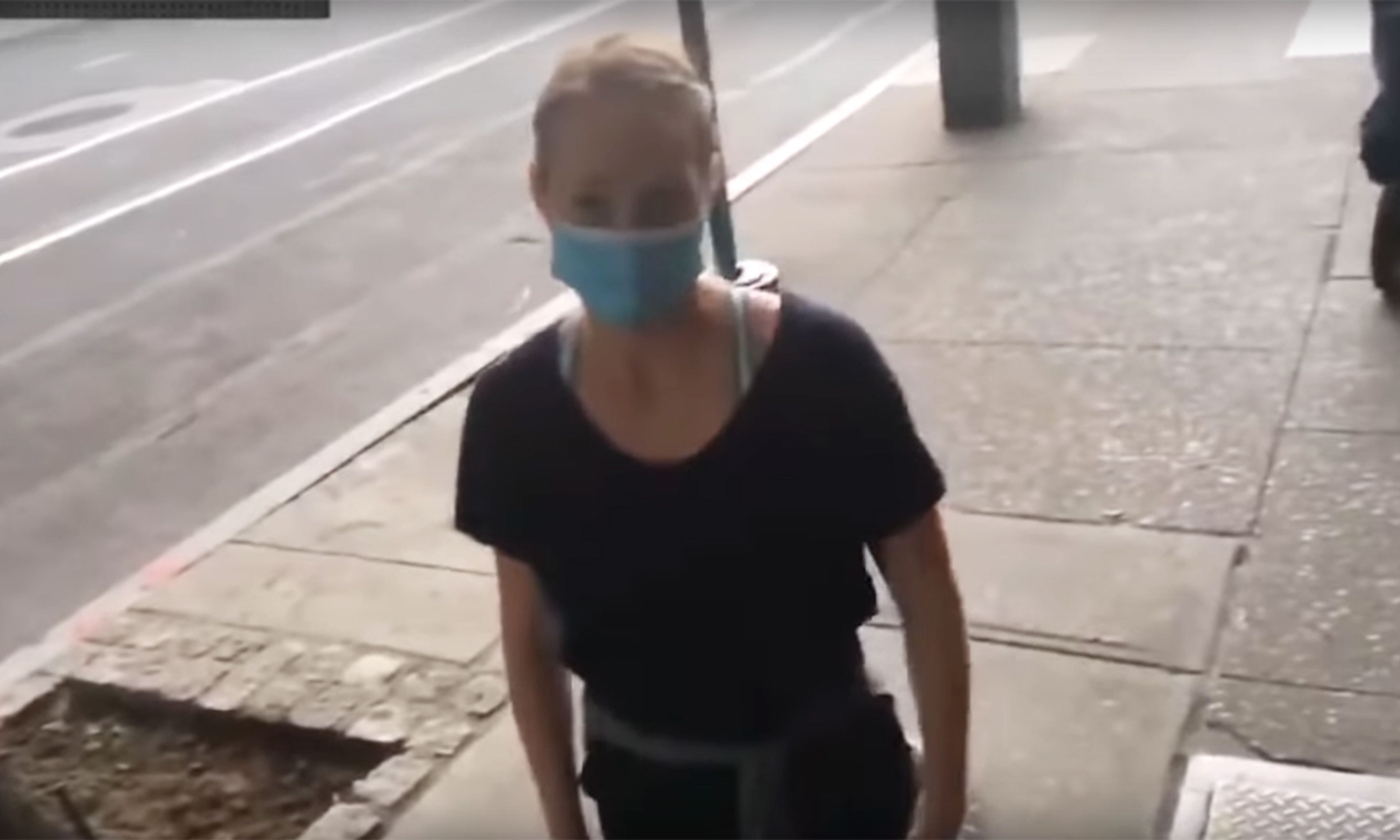
During the height of the George Floyd protests, a YouTuber known as Smooth Sanchez released a livestream of himself strutting through the streets of New York City and interacting with random pedestrians. Some portions of the uncut, nearly two-hour video do not make for great entertainment; however, shorter clips of Sanchez’s dramatic interactions with white people quickly went viral on social media.
A typical encounter of this sort runs as follows: Sanchez approaches a white woman (why he seems to have singled out females is unclear) and falsely identifies himself as a representative of Black Lives Matter. Next, he claims that his BLM manager has instructed him to find white people on the street for his livestream and to bring them to their knees in a show of solidarity with George Floyd. Once the subject is kneeling — an easy thing for Sanchez to bring about in many consecutive encounters— the YouTuber asks her to apologize for her white privilege (an action secured five times) or even to admit to being complicit in crimes against minorities by virtue of being white (secured twice). Finally, Sanchez thanks his unwitting dupe and goes on his way. If, at any point, a white target refuses to follow Sanchez’s directions, he shames her by calling her a bigoted racist or a white supremacist. The fear of this reproach, however, is not likely to be a significant motivating factor; the women on film are all anonymous, and most are unidentifiable due to their masks. If all of this weren’t enough, Sanchez calls George Floyd “George Foreman” throughout the video just for fun. Many subjects daren’t correct him.
The backlash to Sanchez from the conservative wing was severe. Viewers spammed his upload with dislikes and claimed that he was “racist against whites” and a “bully.” Even Tucker Carlson played a clip from Sanchez’s video, as an example of the “mob seeking the total humiliation of its enemies.” What these critics comically failed to realize was that Sanchez was not a sincere social justice warrior; rather, as he revealed on Twitter, he had made the video to troll people.
Indeed, the unquestioning faith displayed by some in the video is astonishing. Almost no one wonders whether the unknown camera-wielder can be trusted. No one questions Sanchez’s allegiance to Black Lives Matter, nor does anyone find the premise of kneeling and begging pardon for her race on a livestream unsettling. (Incidentally, though Sanchez intends the kneelers in his video to be met with mockery, some white people have been kneeling and apologizing for their white privilege unprompted in an albeit well-intentioned attempt at racial solidarity.) Finally, the notion that whiteness — rather than the action of individuals — is responsible for the death of George Floyd goes largely unchecked among Sanchez’s Caucasian targets.
It feels as though many of those whom Sanchez films have transcended the material plane and reached a level of mystical elevation in their political fervor. To them, the woke genuflection of repentance is like unto a kneeling prayer, the renunciation of one’s identity unto devout asceticism, the obeisance of the supposed minister of Black Lives Matter unto humility before divine authority.
But this fervor is nothing new; it is astutely captured in Aurel Kolnai’s essay “The Humanitarian Versus the Religious Attitude,” appended at the end of Daniel Mahoney’s exceptionally written The Idol of Our Age. The 20th-century philosopher thus characterizes the phenomenon: “The modern civilization of Western mankind . . . has revealed a trend of evolution towards a society in which, practically speaking, religion as a determining factor of private and public life is to yield its place to a nonreligious, immanentistic, secular moral orientation which may best be described succinctly as “humanitarian.”
Kolnai’s remarks make a great deal of sense; perceiving the abnegation with which Sanchez’s targets launch themselves into the flames of political correctness, one is hard pressed to conceive of any motivating factor but this sort of “immanentistic, secular moral orientation”— a “civil religion,” as Rousseau envisioned. But what are the relevant properties of this “humanitarian” system of belief? Kolnai theorizes:
The humanitarian attitude may . . . find expression in a kind of hyper-moralism. . . . An intensified, systematized and particularized moral strain may be substituted for the vanishing mystical substance of religion; with faith proper growing more doubtful, reduced and threadbare, a crampedly “impeccable” life may serve to demonstrate one’s “effective” belief in whatever is “truly essential” in religion.
In like manner, those in Sanchez’s video seem to have taken important virtues — pity for the oppressed and righteous anger toward their oppressors — and to have committed to exercising them as essential even at the expense of dignity and truth. While one could easily protest the injustice of Floyd’s death without deprecating oneself and erroneously confessing that one is complicit in the killing, that would remove the badge of being “impeccable” with respect to the essential virtues. After all, the purported Black Lives Matter livestreamer, with all his authority, has laid bare the precise terms on which one must currently engage with the virtues, and so to object to these terms would seem to be to object to them.
Though Smooth Sanchez provides valuable fodder for conversation, he should not be mistaken for a serious individual. This is a man who, after all, has openly recorded himself harassing strangers, laughing at women for being lesbians when they reject his advances, and yelling “pigs” to police standing on the street. He has likely given little thought to politics or political philosophy, or in any case values the shock factor above all else. But by simply walking around for two hours and filming what he sees in New York City, Sanchez points to a stunning Kolnaiesque hyper-moralism among his subjects, their piousness beyond what most parishioners could match.





Comments