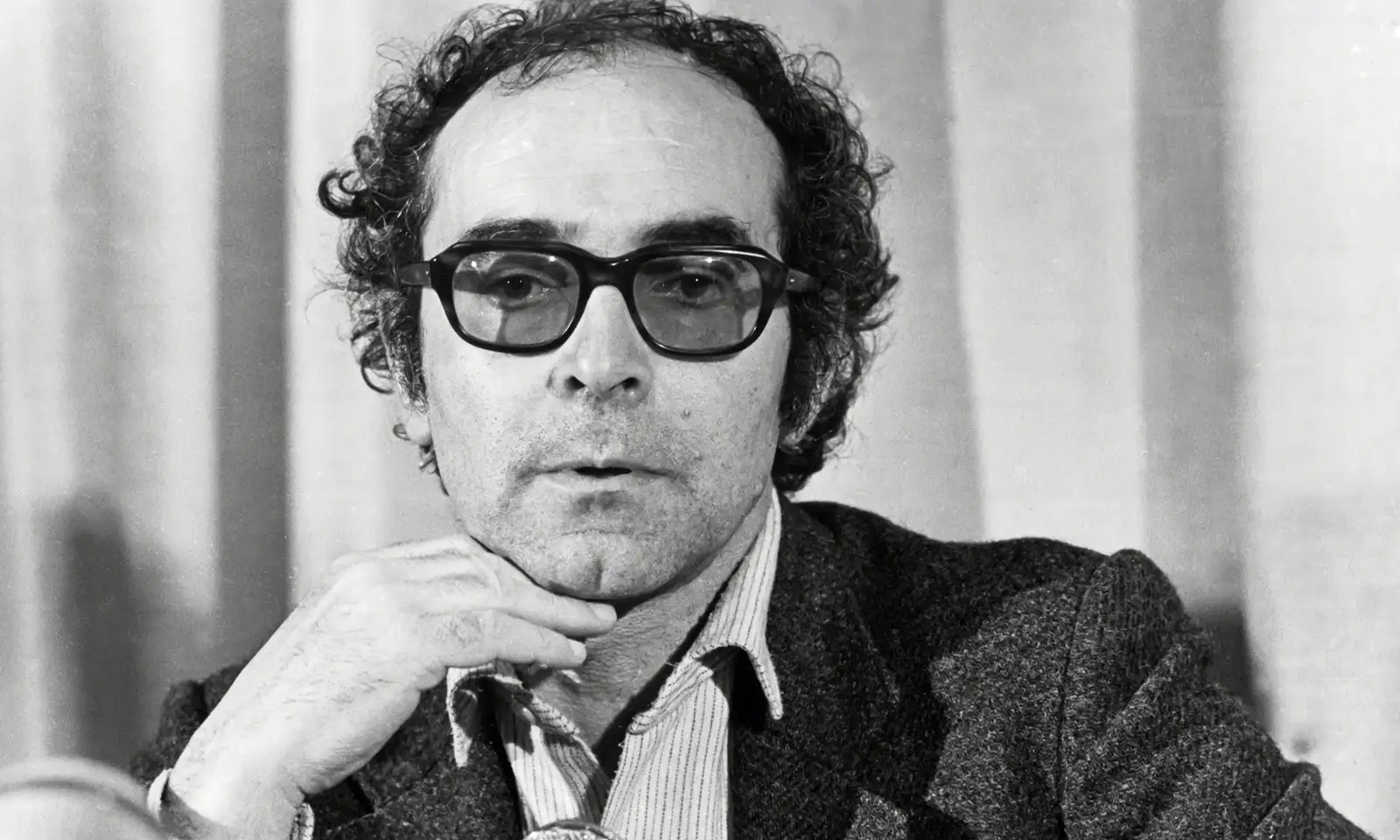
On my 2022 ballot for Sight and Sound’s Greatest Films of All Time decadal poll is À bout de souffle (Breathless). Its appearance on my list, submitted July 31, acknowledges my recent realization that, of the many breakthroughs customarily accorded Breathless, the film’s essential greatness is its defiance — in fact, correction — of contemporary sexual politics. The 1960 movie was Jean-Luc Godard’s debut feature and is still revolutionary. Not just technically innovative (Godard’s jump-cut editing and cinematographer Raoul Coutard’s hand-held camera), the troubled fable is cinema’s sexual-binary masterwork. Its genius director has passed, but Breathless and his other films will last for as long as there are movies.
The male–female relationship at the heart of the crime story (Jean-Paul Belmondo’s Parisian hood Michel falls in love with Jean Seberg’s Patricia, an expatriate American) is cinema’s essential love story. Hollywood geeks might sentimentalize Casablanca, but Breathless goes deeper. That depth — simultaneously exploring film form and cultural, social illusions about human relations — is why Godard has re-revolutionized film around the world every year since Breathless was first released.
No matter the change in political fashion (now separating homosexuals from heterosexuals and confusing their commonality), the Belmondo–Seberg ideal remains. Breathless recognized the fact of romance and yet mocked romanticism — totally, tenderly, tragically.
My new appreciation for À bout de souffle came with teaching it alongside Godard’s debut short Charlotte et son Jules (Charlotte and Her Boyfriend, 1958) — the original story of man–woman magnetism minus the Hollywood genre trappings. Godard observed intimacy and tension, as did August Strindberg’s The Stronger, through the realization of one lover who is desperately, frantically drawn to a powerful, irresistible other. All Godard’s senses converged into a personal confession. No one who sees it can deny or resist it.
I tell my students, “You may not know the name Godard, but you owe the way you look at and understand media to him.” Every Godard film pushes you to reconsider what you thought you knew about the world and cinema. His inquiry into society, intelligence, history, politics, art — that’s what changed movies and media culture. Even Quentin Tarantino’s facetious cinephilia (naming his production company after Godard’s 1964 crime flick Bande à part) depended on Godard’s innovations even while disgracing them. The juvenilia and shallow sophistication now exploited by contemporary Hollywood derived from filmmaking methods that Godard advanced.
But there’s more to the Cahiers du Cinéma critic who became a filmmaker. Godard transcended his early innovations, growing to transform movies into visual, spiritual poetry — the exquisite Oh, Woe Is Me, Detective, Hail Mary, Nouvelle Vague, and Histoire(s) du cinéma. These later films explored cultural history, making cinema that was persistently new.
It belittles Godard’s achievement to emphasize his “radical politics.” Such films as Le Petit Soldat, A Married Woman, Alphaville, Les Carabiniers, Masculine Feminine, Made in U.S.A., La Chinoise, Weekend, The Rolling Stones: Sympathy for the Devil, For Ever Mozart, and In Praise of Love saw past political fashion despite the Left’s attempt to claim his timely flirtation with radicalism as the same as their own. Even the Dziga Vertov Group experiments (politically minded films made by Godard in collaboration with other directors; they named their group after the pioneering Soviet-era filmmaker) showed Godard’s constant questioning of everybody’s political orthodoxy.
It was the honor of my chairmanship of the New York Film Critics Circle to propose giving its first-ever career-achievement award to Godard in 1994 and then to receive his personal response. Though unable to attend, he vouchsafed his sincerest thoughts and regrets (from “preventing M. Spielberg from rebuilding Auschwitz” to not “shooting Contempt [Le Mépris] with Sinatra and Novak”) and signed it “Faithfully yours.” I treasure that fax.
Godard, still a mysterious name. Ross Cacavalle, who programmed Detroit’s arthouses, the Studio Theaters, introduced him to me and a classroom of high-school students, joking: “His name is Godard and some people consider him the god of movies.” This was the era when rock musician Brian Eno’s name was scrawled on campus walls (“Eno is God”). I never thought of Godard with religious reverence but enjoyed his beautiful, difficult movies for being devout, connecting all things and all things cinema.
My first Godard experience was a dubbed, late-night TV broadcast of Alphaville. I found myself leaning forward, grasping at its vagrant relation to American B-movies and puzzled by its romanticism. It all came together in the mind and heart of an American kid who hadn’t yet been to Europe or the Sorbonne. But movies were part of my entrée to the world, and Godard made that introduction matter. I even subjected a first date to a double bill of Breathless and Bande à part. We eventually broke up, but Godard and I never did. Godard’s films concretized the way movies express our feelings, desires, spirituality, political awareness, humor, and sense of beauty.





Comments
On “Why Jean-Luc Godard Matters”