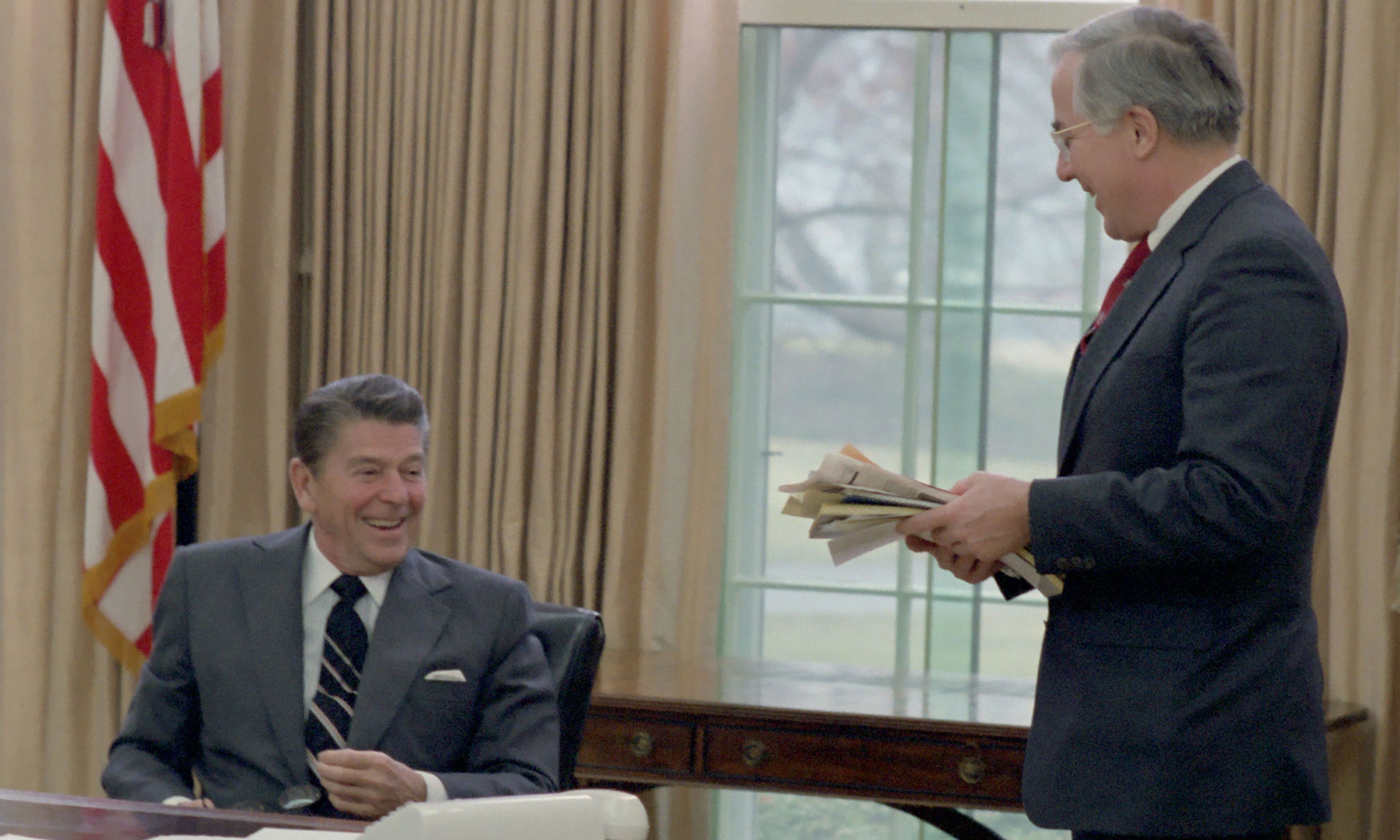
Formally speaking, Dick Allen was always known as “Richard V. Allen.” What did the “V” stand for? “Vincent.” (Quick aside: What did the “Q” in “James Q. Wilson” stand for? “Quinn.”) Dick Allen was a fixture in conservative foreign-policy circles for a half-century. He passed away, at 88, earlier this month.
He was born on New Year’s Day in New Jersey (1936). He went to Notre Dame. He worked in the Nixon White House. He became an adviser to ex-governor Ronald Reagan, and in 1977 they had an exchange, soon to be famous. It went something like this:
Allen: “Governor, what is your aim in the Cold War?”
Reagan: “Well, Dick, my idea is: we win, they lose.”
Allen was part of a stalwart group of Reaganauts. That’s a term he coined, by the way. As he once explained,
In the 1980 campaign, political and press adversaries were assailing Reagan as dangerous and unpredictable, suggesting he’d blow up the world. They used the term “Reaganites” to describe us. I thought that “Reaganite” sounded too much like “dynamite,” so I created the term “Reaganaut,” as in “astronaut,” as the acceptable substitute, and we insisted on the term.
I always thought that “Reaganaut” went with “Argonaut.” But anyway . . .
After the 1980 election, Allen served as Reagan’s first national-security adviser. He left in a cloud of scandal. Was the cloud justified? I have my doubts. In any event, for details on this, see the New York Times’s obituary of Allen, here.
In his later years, Dick Allen was a knowledgeable and convivial guest on National Review cruises. He had particular expertise on Korea — the two of them, North and South.
Some years ago, I wrote a history of the Nobel Peace Prize, Peace, They Say. The 2000 laureate was Kim Dae-jung, the president of South Korea, who had been a dissident, incredibly brave. Many times, he had narrowly escaped death.
An excerpt from my book may interest you:
In 1980, after an uprising in his home base of Kwangju, the government charged Kim with sedition and conspiracy. The sentence (once more) was death. The Carter administration, in its last days, seemed powerless to save him. Carter’s leverage with the South Koreans had approached nil. The Carter team appealed to the incoming Reagan administration to do something for Kim. Reagan agreed. His soon-to-be national security adviser, Richard V. Allen, delivered a message to Seoul: “If you kill him, you will be struck as though by a lightning bolt from the heavens.” The execution was stayed.
South Korea’s strongman, Chun Doo-hwan, was one of the first visitors to the Reagan White House. He visited on February 2, 1981, less than two weeks after the president was sworn in. Reagan took a great deal of criticism for this visit: it appeared that he was coddling dictators. But the visit had been a price of sparing Kim. Reagan, just taking the criticism, never said a word.
One of the people blasting Reagan for his alleged coddling of dictators, and his alleged indifference to human rights, was Kim himself. Years later, Allen told him the story of what had happened, at the end of 1980 and the beginning of 1981. This was indeed a revelation.
• Regular readers are familiar with Masih Alinejad, the journalist and human-rights activist from Iran. She has lived in America since 2014. She is a U.S. citizen. She spends a lot of time in safehouses, as she is a target of the Iranian regime. Courageous and irrepressible, Masih is.
I first wrote about her in 2021: “A Free Spirit.” We have podcasted on several occasions.
On November 8, the Department of Justice revealed a murder plot against Masih — another one. This is the third such plot in three years. Can men and women such as Masih Alinejad be kept alive? I hope our law-enforcement people do all they can, and I am grateful for them.
I also know this: The rise of that dictatorship in Tehran was a curse on all mankind, starting with the Iranians. It has been 45 years now. The dictatorship’s fall will be a relief and a boon. May it come before too much longer.
• “Chinese officials bundled British journalists out of a G20 meeting between Prime Minister Keir Starmer and Chinese President Xi Jinping Monday.” So reports Sam Blewett for Politico. He continues, “Reporters were aggressively ushered out of the bilateral in Rio de Janeiro as Starmer raised human rights . . .”
Specifically, Starmer brought up the case of Jimmy Lai, the Hong Kong political prisoner. That’s when Chinese “officials” got aggressive.
China’s dictatorship, like all of them, is a bully.
• Couple of weeks ago, John Thune (R., S.D.) was elected majority leader in the Senate. Among those competing for the job was John Cornyn, of Texas. The election is by secret ballot. Afterward, Cornyn quoted Lamar Alexander, the former senator from Tennessee. Alexander once ran for a leadership position (whip). As he told it, “I wrote 27 thank-you notes for 24 votes.”
This gave me a memory of November 1984. I was an intern in the office of Senator Bob Dole, of Kansas. He was running for majority leader. An aide asked him, “Do you have the votes?” Dole answered, “I have the pledges. Not sure I have the votes.” (He won, in the end.)
• Let’s have a language item. As I have complained in the past, people are saying “more so” when they mean “more” or something else. This has grown up like a weed. I’m not sure why. This article about Steph Curry says, “. . . is Steph the greatest offensive player since Michael Jordan? Even more so than LeBron James?”
I would have suggested, “Even greater than LeBron James?”
• Speaking of whom: This month, he had four straight triple-doubles, at age 39. I’m not sure there has been anything else like it. James will be 40 before the year is out.
• Let’s get back to language, but stick to sports. Caitlin Clark, the basketball sensation, played in a golf pro-am. According to this article, she “shanked” a tee shot into the gallery. But the accompanying video shows she did not shank the ball; she smothered or roped it left.
(Shanks are shots off the hosel and, for a righthanded golfer, they go right.)
(I have friends who, when they shank the ball or someone else does, say, “Shank you very much.”)
• The Daily Utah Chronicle is a newspaper at the University of Utah, in Salt Lake City. The headline over a recent article says, “Is College a Place for Politics? Yes and No, National Review Editor Says.” I don’t know who the guy in the picture is. I like to think of myself as a Jude Law type (just kidding).
• Let’s have some music, in the form of reviews. I will jot a little list.
Maxim Vengerov, violin, playing Mozart.
The New York Philharmonic, conducted by Santtu-Matias Rouvali, with Miah Persson, soprano soloist.
The Belcea and Ébène quartets, combining, for octets (Mendelssohn and Enescu).
The Berlin Philharmonic, under Kirill Petrenko, in Bruckner.
The New York Philharmonic, conducted by Paavo Järvi, with Yefim Bronfman, piano soloist.
The Royal Concertgebouw Orchestra, under Klaus Mäkelä.
Is that enough?
• I thought this was pretty clever — something different:

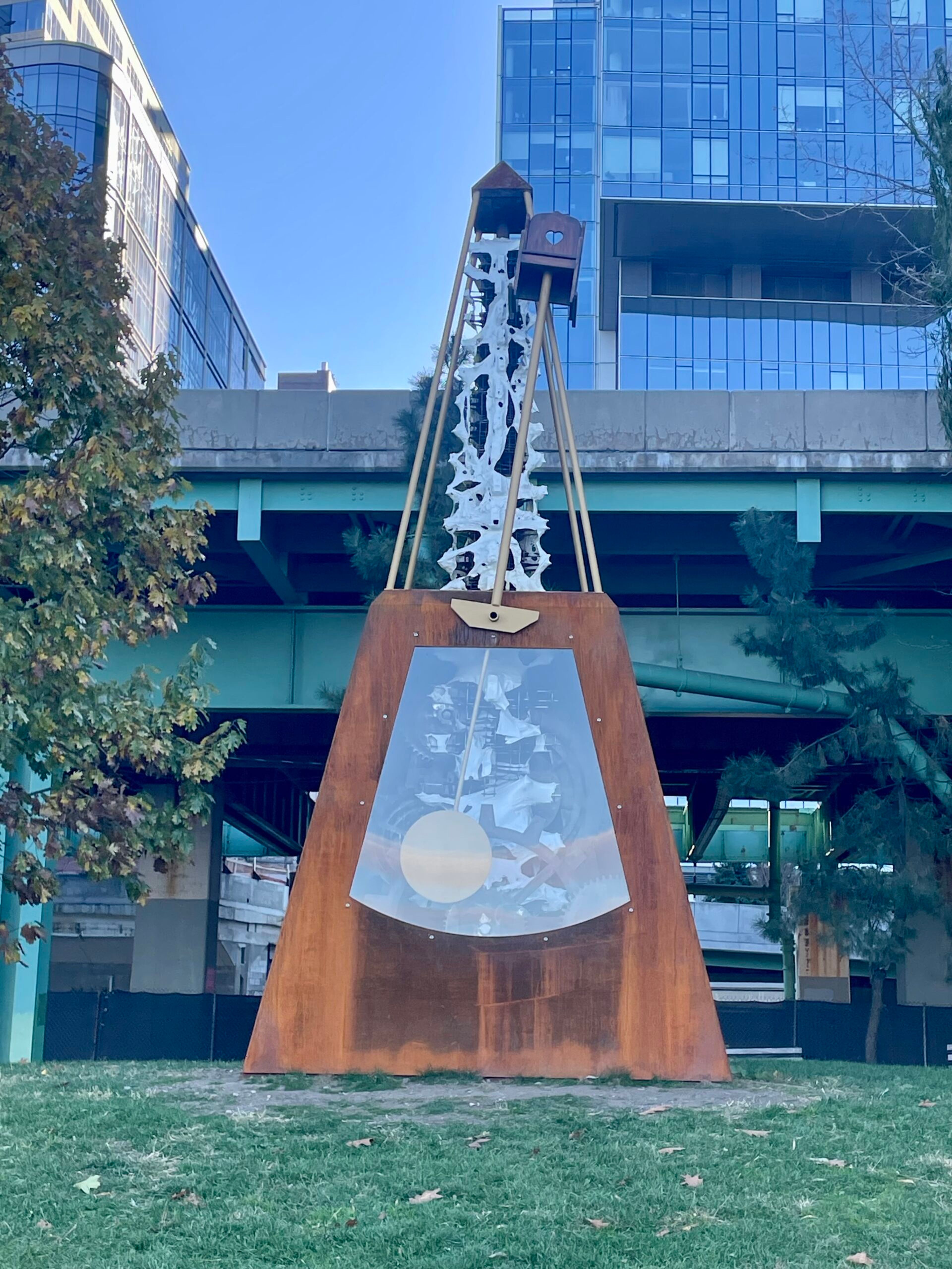
• In New York, a metronome, out of nowhere:
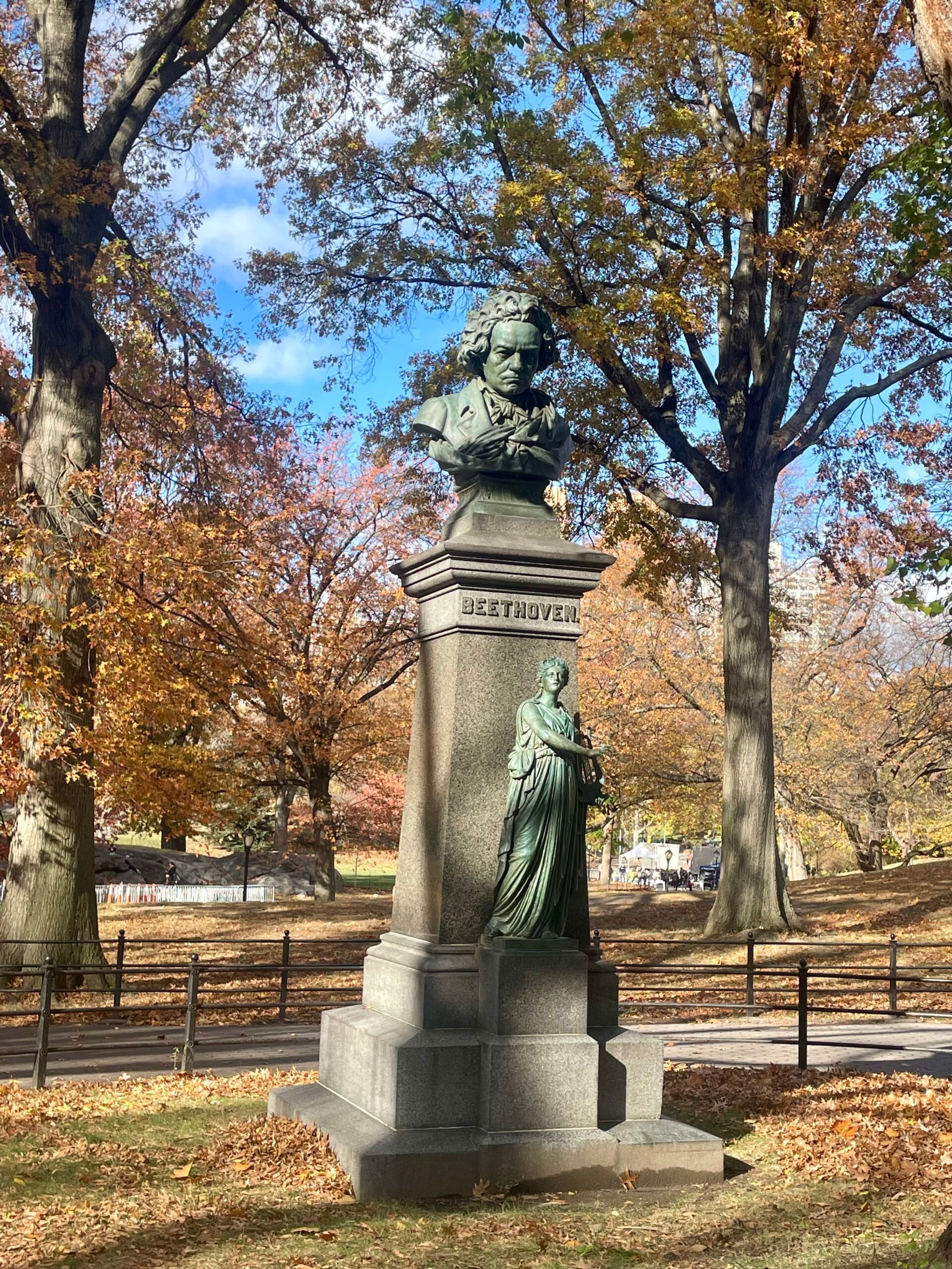
• If we say “spring has sprung,” do we also say that “fall has fallen”? It has in Central Park, as you can see:

Beethoven is defiant — of fall and of anything else that could darken the life of man:
If you would like to receive Impromptus by e-mail — links to new columns — write to [email protected].






Comments