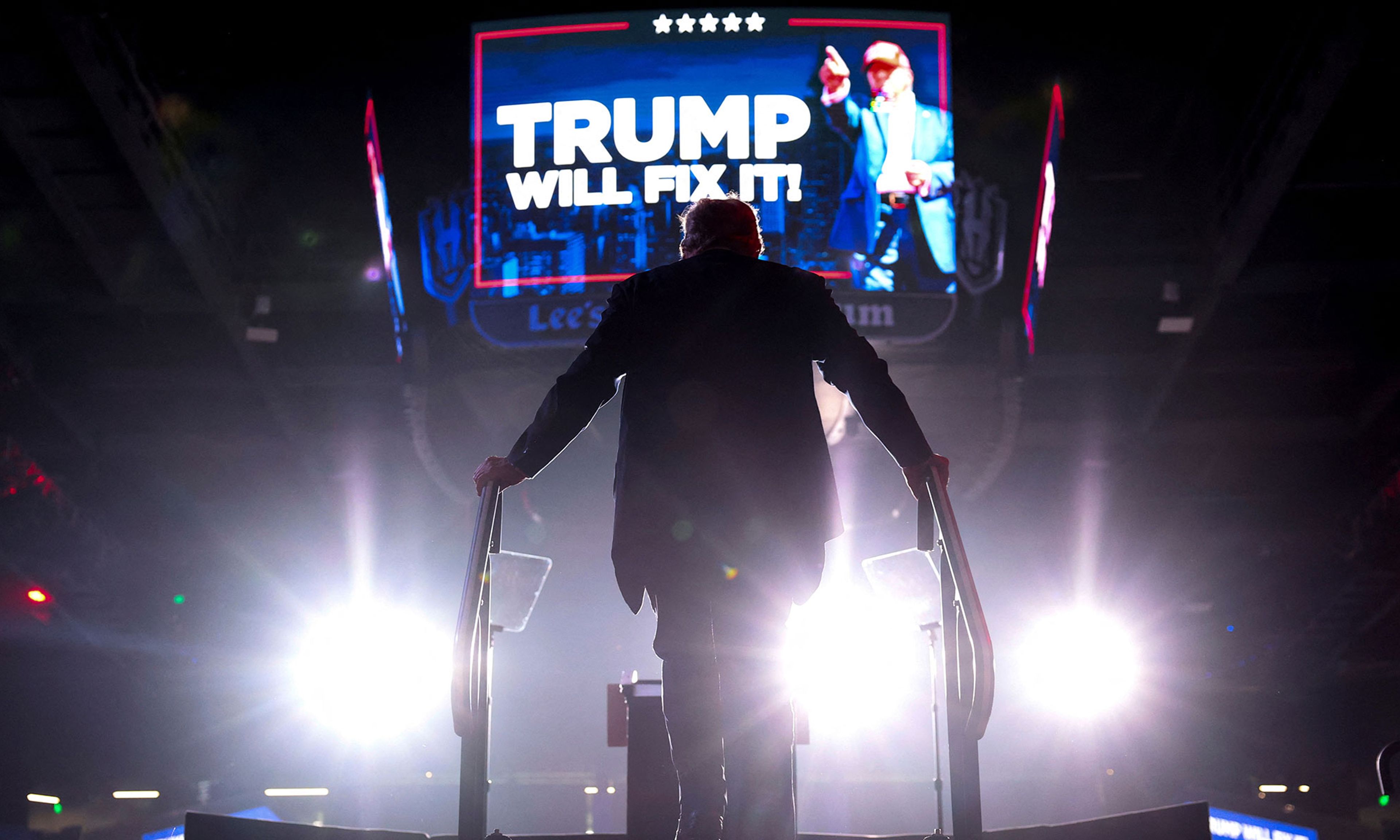
Many people expected Donald Trump to win his pursuit for presidential reelection. Many more thought he might, but weren’t quite sure. But I doubt that anyone really believed in their innermost parts that the Electoral College and popular-vote results would be this overwhelming for Donald Trump. In addition to the presidential results, the Senate map and a wide array of other races point to a wave across the country that was lacking in 2022, and is worthy of objective analysis to best understand the state of American politics and culture.
I don’t have a lot to add to the political commentary that many with far more political chops and savvy will have to offer today. I hesitate to propose a non-falsifiable theory of the case, but I suspect history will conclude that the two people who could not beat Donald Trump in 2024 were the two the Democrats tried to run: first the infirm incumbent president, Joe Biden; and then the appointed replacement, Kamala Harris.
Their party can do its own autopsy about the decision to hide Joe Biden’s cognitive decline until a nationally televised debate shined a light on it four months before the election. They can discuss whether skipping a primary was a good idea. And obviously, they can determine for themselves whether the candidate they selected was the right choice in this environment: Biden’s “border czar” when one of the biggest campaign issues was justified furor over failed border policy; the actual No. 2 in the administration when one of the biggest campaign issues was angst over the incumbent economy; a far-left progressive who just decided to say she no longer held to her radical positions, without so much as a tweet explaining her reversal. These were all acts of political malpractice, but no one really knows what they could have done differently. All I can say is that the answer to that question must surely be: something.
I prefer also to skip over the standard postmortem commentary on how much of the campaign (and closing parts of the campaign) went. In hindsight, the lawfare the Left used to destroy Trump made a martyr out of him, and breathed new life into his political fortunes. It was obviously farcical to believe that a joke a comedian told with nine days to go in the race was a real needle-mover in the election. I won’t pile on Ann Selzer and her Iowa poll because I don’t doubt that she believed it, and plenty of people far meaner than I have already taken their turn.
The “Trump is a fascist” line of attack will end up being regarded as a political failure, but again, I do not know what else her campaign could have done. Asked Kamala Harris to go talk about the economy? Laid out the Biden-Harris success in the Afghanistan withdrawal? Allowed her to do unscripted interviews? They had a few angles and they tried them, never realizing that those who were prone to believe the idiocy of Trump being Hitler were likely already in their camp (unless you believe there were large amount of persuadable voters out there who were in the “Trump IS Hitler, but I’m voting for him anyway” camp).
And if I may, as someone who has been objectively, rationally, and fairly critical of Donald Trump for nine years: Trump Derangement Syndrome is not when one criticizes Trump. It is when one reverts to incoherent hyperbole often borrowed from the same slanderous playbook used against such gentlemanly statesmen as Mitt Romney and George W. Bush. If everyone is Hitler, no one is Hitler. Critics of MAGA, or of conservatives, or of any political opponent, must do better. All of Hitler is objectionable; not all that is objectionable is Hitler. This shouldn’t be so hard.
I believed Donald Trump was making a campaign error to fight Harris’s vacuous, empty, anti-intellectual platitudes about the economy with a comparable lack of depth and seriousness. But he had an embedded advantage that she did not: the actual 2017 Trump tax cuts, an actual first-term energy policy, and an actual record on deregulation. Some on his team (including his own vice president) did not lean into the occasional inner-Reagan of Trump’s economic ideology as I would like, but to Trump’s credit, he stood his ground on his first-term priorities of supply-side tax cuts, deregulation, and energy independence. His chatter about tariffs was mostly incoherent. (Per Trump: They are expected to raise a lot of money and bring back manufacturing to the country. But last time I checked, if they are crushing imports to help U.S. domestic activity, they are not generating revenue; and if they are generating revenue, they are not promoting domestic activity; but we’ll let this play out.)
I do not believe those of us who hold to a Reaganite vision for economic freedom and prosperity have accomplished all we could want for the next four years. In fact, I think the effort to win key arguments will need to be more intense now than it was in his first term. But the economic opportunity in a second Trump term is in philosophy (he still intuitively believes in incentives and markets more than candidate Harris), and personnel (though I am sure he will have some in his administration I am wary of, he will have enough supply-siders and free-marketeers to do good work).
Plenty of other things can and will be said about the campaign, the prospects of Trump’s second term, and the overall state of our deeply divided country. I want to pray for Trump to try to be a healing and uniting force, but I have prayed for too many miracles already this month. I do not believe Trump can, or will, unite this country. I do, however, hope and pray that he will promote a philosophy of economic growth, earnestly seek an aspirational society, and end the anti-meritocracy that has become a hallmark of progressivism, and that he will do this by appointing personnel who have the chops and the worldview to do it. Personnel is policy. I pray we can say this as a good thing in the weeks to come, and not as foreshadowing of concern.





Comments