
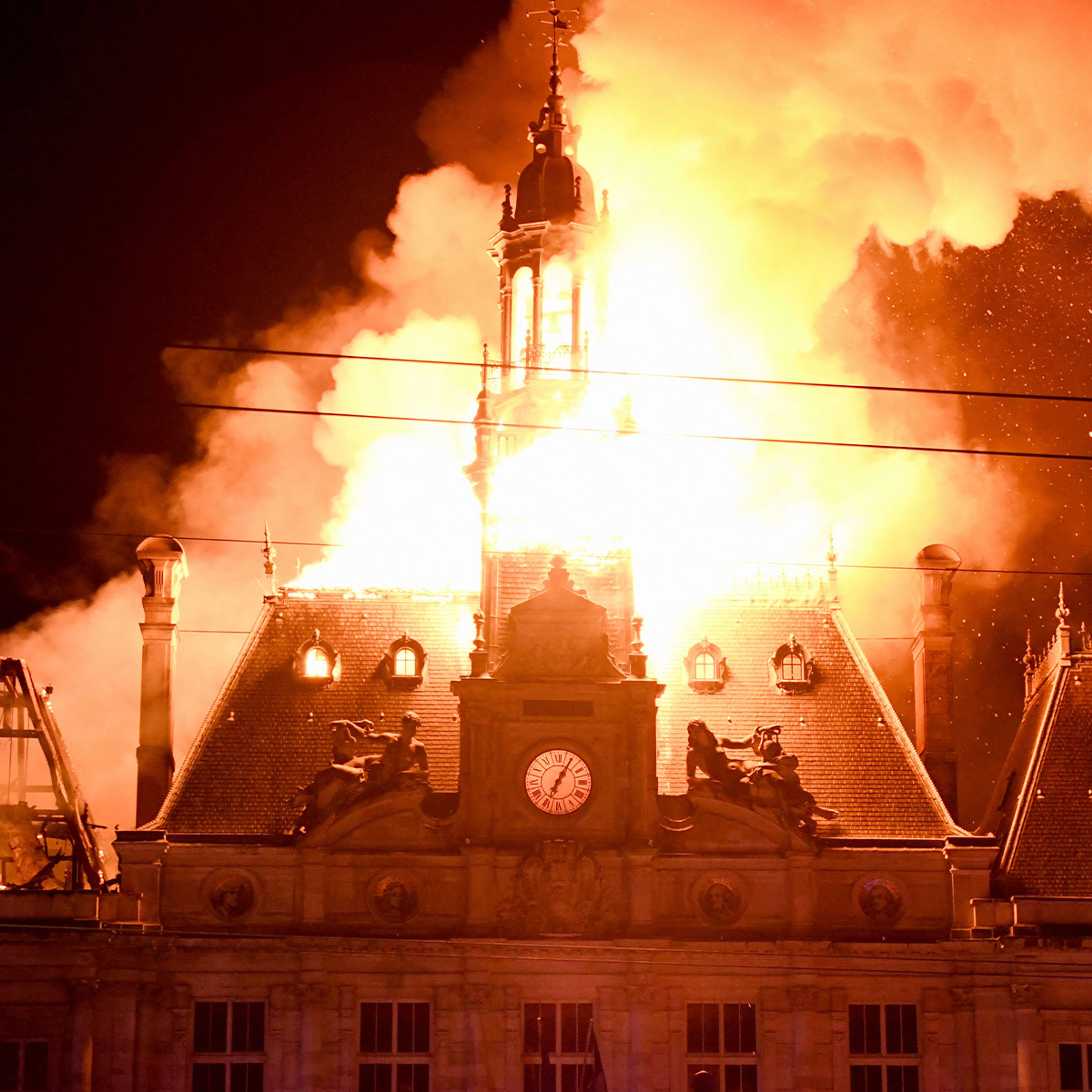
The restoration of Notre-Dame de Paris was a cause for rejoicing — not just in France but in all the world. It was sickening to see the cathedral burn, back in April 2019. It was commensurately heartening to see it reopen this month.
This was no small effort, to restore the cathedral. In an article, Seth Doane of CBS News quotes the man in charge of the effort, Philippe Jost. (He succeeded General Jean-Louis Georgelin, who died in a hiking accident last year.) Restoration was “a national challenge,” said Jost. And a challenge “unifies people.”
Workmen were asked to do things that no one had done in 150 years. How did they make that happen, generations back? Can we do it now? “We were not sure workers would be able,” said Jost. But they were.
In his article, Doane says,
Around 2,000 people helped rebuild, from a foundry in Normandy that re-tuned the bells which rang out again this weekend, to those scouring forests for centuries-old oak, to find a thousand pieces of French oak to rebuild the spire.
Part of the job of a spire is to inspire, I would think. The one in the center of Paris does.
Allow me a personal memory. It was first semester, freshman year of college. I had been to Paris the summer before. In a class on the French short story, I had occasion to mention that I had seen the plaque in the ground outside Notre-Dame, marking “le centre de Paris.” My prof, with a twinkle in his eye, said, “De l’univers, mon ami. De l’univers.”
Vive la France, a bulwark of civilization.
• In the past three years, I have taken note of Ritchie Boys. Who were Ritchie Boys? Young men trained at Camp Ritchie, in Maryland. They were refugees from Europe, many of them Jewish. They were trained to return to the continent they had fled and gather intelligence for their new country, in World War II.
Maximilian Lerner died in 2022. He was 98. Guy Stern died in 2023. He was 101. For their obits in the New York Times — by Richard Sandomir — go here and here. This is the obit of Victor Brombert, who died a few weeks ago at the same age as Stern: 101. Alex Traub’s write-up is stunning — like his subject’s life.
Brombert was born in Berlin in 1923. “The family arrived in New York in 1941, in the cargo hold of a banana freighter amid some 1,200 other dysentery-plagued refugees.” (I have quoted Traub, of course.)
In the war, as a Ritchie Boy, Brombert was at D-Day. And the Liberation of Paris. And the Battle of the Bulge. He was amazed — amazed — to survive the war.
Afterward, he went to college: Yale. And went on to graduate school, also at Yale. He would become a professor of comparative literature, first at his alma mater, then at Princeton. Not until late in his life did he talk about the war.
The hundreds of students he had taught over the years were shocked to find out, and deeply impressed. One of those students was Ramesh Ponnuru, the editor of National Review.
Usually, heroes are forced into their heroism, as I pointed out in an article yesterday about Ukraine. The Ritchie Boys were. But, oh, did they deliver, and so did all the rest.
• In the last few days, some Trumpers have taunted me on social media, sending me images of their man as a king: a glamorous, majestic king. There may be something in the water.
Kash Patel has written three children’s books depicting Trump as a king. Here is the cover of one of them:

Thus do MAGA parents teach their tots, I suppose. A phrase comes to mind: “Make the Republican Party republican again.”
Never have I believed that Americans would tolerate a monarch or dictator. That’s what people in other countries do. These days, I’m not so sure. We may not be as exceptional as we claim.
By the way, as you know, Kash Patel is set to become the director of the FBI. Think of that. The author of The Plot Against the King: 2,000 Mules.
• “CEOs Want Trump to Change Course on Tariffs. He Isn’t Budging.” Thus reads a headline in the Wall Street Journal (over this article). The subheading reads, “Companies mount a campaign to soften the president-elect’s trade policies, but Trump’s team tells consultants he is serious.”
It would take a heart of stone not to laugh. “Promises made, promises kept,” baby.
• In his Washington Post column, the above-mentioned Ramesh Ponnuru wrote about trade (here). He wrote in particular about reciprocity. This sounds good in trade: “Hey, you tax us, we tax you!” But in practice?
My longstanding belief is this: Nations ought to do what’s in their interest — whether it results in a “balance” or “imbalance.” This is elementary, or ought to be.
I remember when I was in college. (There I go again.) In arguments about trade, people would say, “But France . . .!” and I would say, “Let France be France. If the government there wants its people to pay more, fine. But we Americans should do what’s in our own interest.”
Maybe I should run for office. (Don’t worry: The Republic is safe from me.)
• Safe from Mitt Romney too, I’m sorry to say. He is retiring from politics. He is nominally still a Republican, but he is essentially partyless, like others of us. A fish out of water. Great fish, in my opinion.
(I wrote about Romney – “a personal appreciation” – in 2023, here.)
• A report from the Associated Press begins as follows:
Fifty years later, a man who grew up in suburban Detroit tried to return a very overdue baseball book to his boyhood library.
The answer: You can keep it — and no fine.
This is the problem with America: no consequences for law-breaking.
• Stick with my home state, where the Michigan State Spartans played the Oakland University Golden Grizzlies (in basketball). The two head coaches were matchers.
• Let’s have a little music — in the form of my “New York chronicle” for The New Criterion: here. Various composers, performers, and issues come up.
• Maybe a quick photo — of Manhattan on a quiet and unseasonably warm evening:

• At this point in my column, I don’t bring up weighty issues — certainly not grave ones. I will make an exception this time. Readers of my column, and listeners to my Q&A podcast, are familiar with Yaroslav Trofimov. For that matter, so are readers of the Wall Street Journal — Trofimov is the paper’s chief foreign-affairs correspondent.
Last Saturday, he had an essay on a very weighty, grave subject: “Has World War III Already Begun?” The subheading of that essay is, “An axis of autocracies led by Russia, China, Iran and North Korea is challenging the democratic world order.”
Many of us have been thinking about the same subject. Last month, I published an essay that included these lines:
After World War II, Manchuria and Spain were seen as preludes to it. Are we, could we be, witnessing preludes today? This is a “night thought,” to borrow a phrase from David Pryce-Jones.
Trofimov, in his own essay, writes, “The spectacular collapse of Assad’s tyranny in Syria showcased just how interconnected different theaters of conflict have become.”
Like many others in my business, and out of it, I am critical of decision-makers in the democracies. At the same time, I don’t envy them. But I think history — repeating/rhyming — should guide.
Enough. Later on.
If you would like to receive Impromptus by e-mail — links to new columns — write to [email protected].





Comments