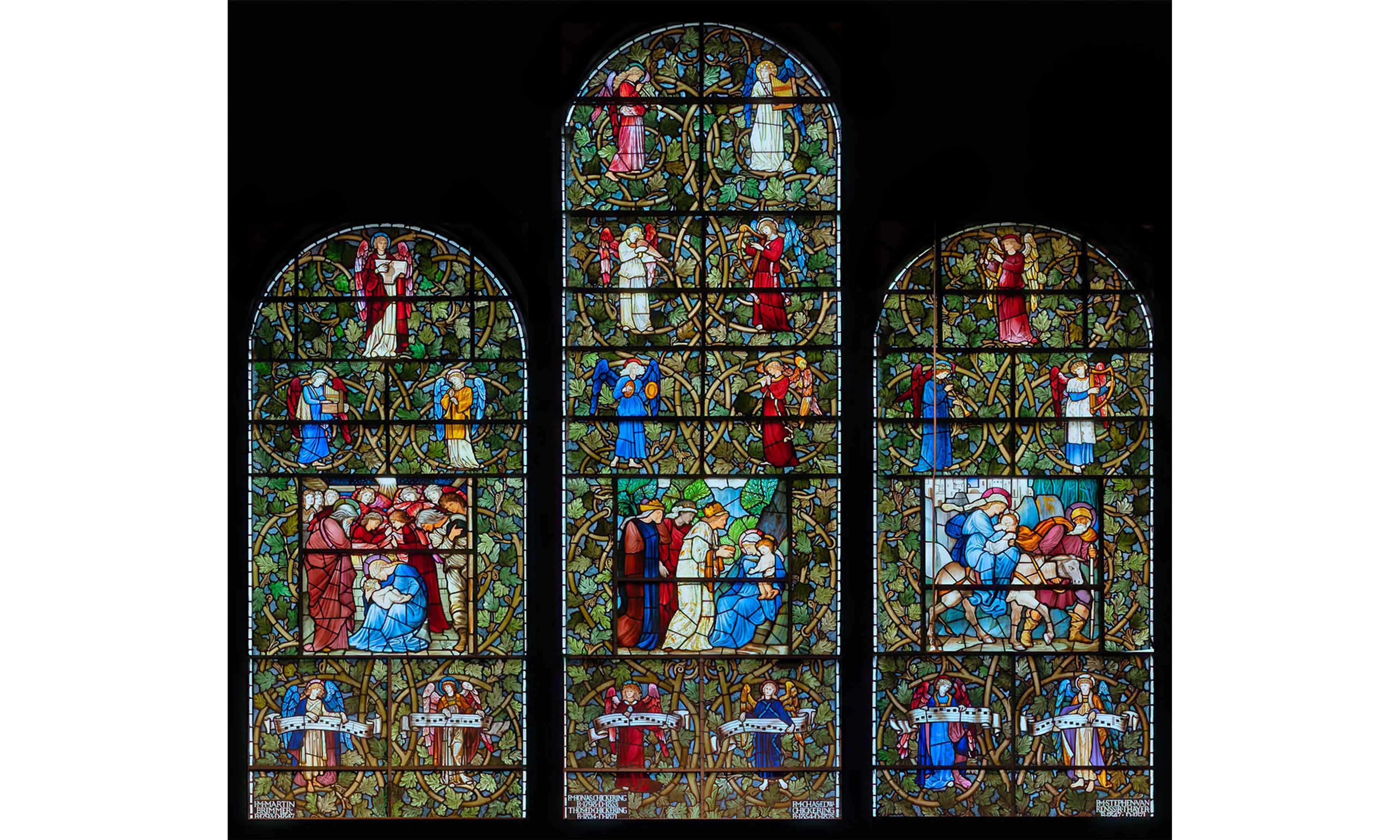
Much as Christmas shopping, for me, is a year-round practice, I hunt and gather Christmas stories starting in January. I love writing about stained glass and tend to visit churches, museums, and auction houses where stellar, five-star, unsung stained glass is to be seen. This year, I saw some exquisite church stained glass windows treating the Nativity. That’s the central story of Christmas starting, broadly speaking, with the Annunciation — Mary receives news from the angel Gabriel that she will be the mother of God — and ending with Jesus’s birth in a barn and adorations from local shepherds and then from faraway wise men, possibly royals or high priests. John La Farge (1835-1910) called stained glass “painting in air,” his material colored light. Let’s look at some stellar stained glass.
I’m not a Pre-Raphaelite scholar but know Edward Burne-Jones’s biggest hits like The Golden Stairs from 1880 and know Burne-Jones (1833-1898) is, as Pre-Raphaelites go, the most mannered and la-di-da of the Victorian artists who loved Raphael’s dignity and detail but loved more the fancy colors, refinement, and froth of Filippo Lippi, Fra Angelico, and Botticelli. I knew he designed stained glass with William Morris but didn’t know any of it came to the United States, to Trinity Church in Boston. I visited earlier this year to do some archival work on John La Farge (1835-1910), who bests Tiffany in stained glass, discovered the Burne-Jones Nativity windows, three of them side by side, and felt like a clodhopper for not knowing about them.





Comments