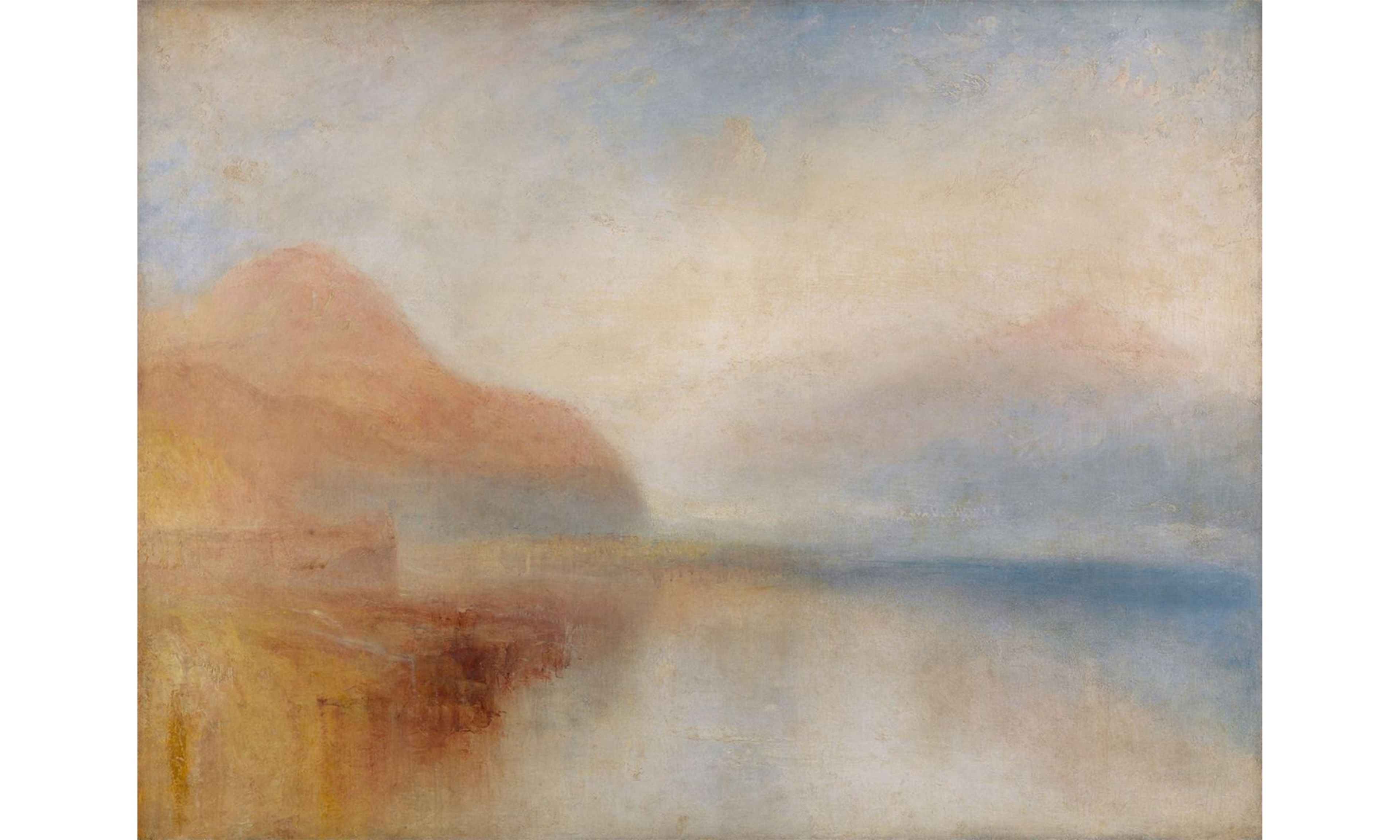
Earlier this month I was in New Haven to visit the Yale Center for British Art, newly reopened after an extraordinarily long period of pandemic lockdown — nearly two years — and, then, nearly three years to replace the roof and lighting. Regarding Tracey Emin’s feminist art now on display in the renovated museum, I noted that “one painting of her is enough” — less is more. But when it comes to J.M.W. Turner (1775–1851), more is to be rewarded, given his sublime idiosyncrasy and a way with color and mist that’s boundless. J.M.W. Turner: Romance and Reality, the art center’s other premiere exhibition, is well worth a trip to New Haven. It’s a premiere in that, coming to its 50th anniversary in 2027, the Yale Center for British Art (or BAC) has never shown all 75 of its works by Turner at the same time. And April 23, a few short days from now, is the 250th anniversary of Turner’s birth. Yale owns the biggest and best collection of work by Turner outside of London, assembled by the BAC’s patron, Paul Mellon.
Romance and Reality is a good title for Turner, who is a star among the English Romantics, but “reality” links him to Whistler and Monet, each an icon for the art of real life. Turner descends aesthetically from the William and Mary era of ship-battle painters but also to gauzy, breezy Gainsborough and the stately works by Reynolds. The son of a London barber and wig maker, Turner was a prodigy. By 20, he was exhibiting at the Royal Academy, earning a living as a watercolorist with a fresh, anti-systematic approach. He was at the top of the British art establishment for 50 years, and not for his convention. By the 1840s, paintings such Squally Weather, a ship-in-a-storm scene, put us in the wettest and thickest of things. He was closer to an abstract painter than anyone before 1945, a hundred years later.

Comments