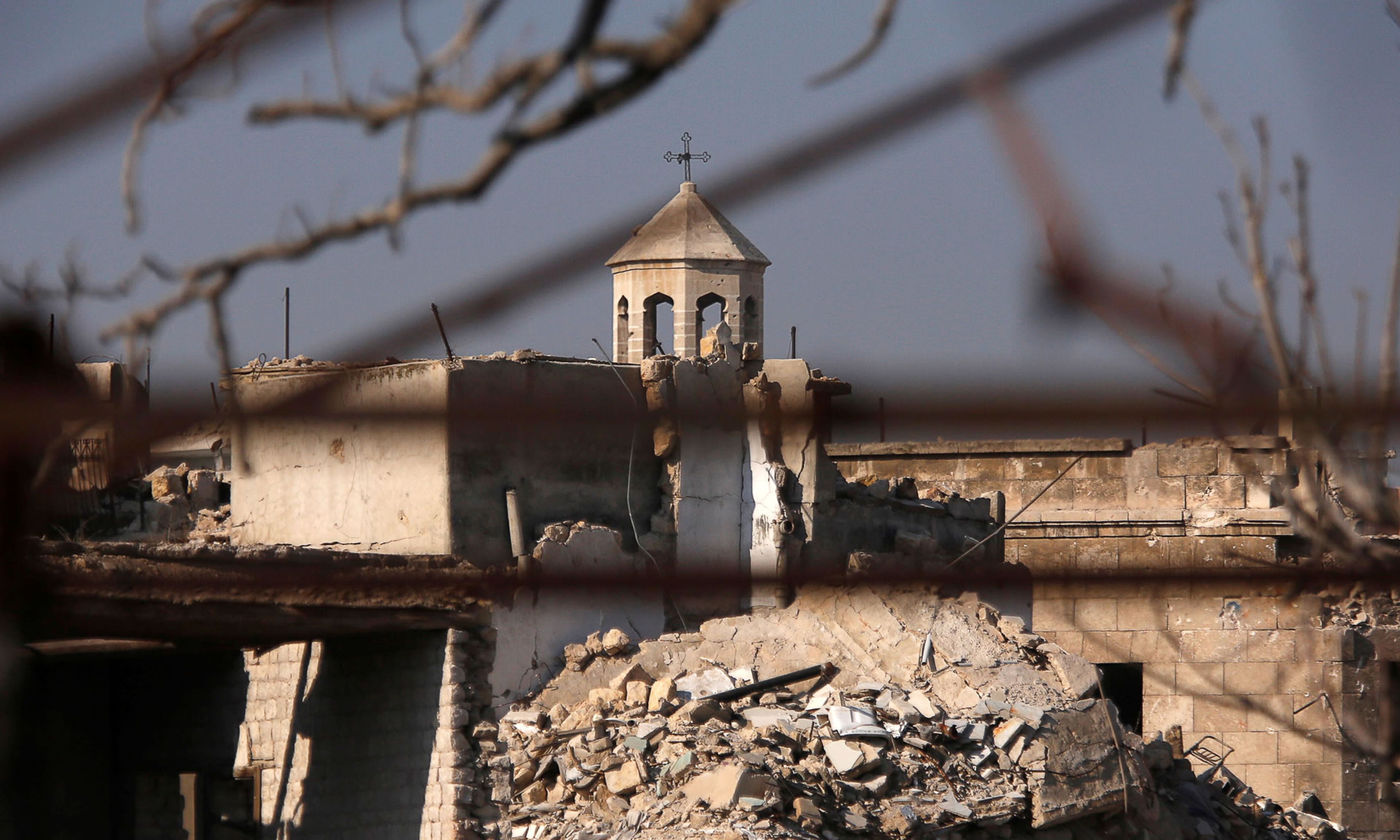
‘Aleppo Awaits You” isn’t the ultimate exit strategy for anyone tired of politics in the United States, the ultimate tactic for distancing oneself from the Confederacy. The father of the city, Archbishop Jean-Clément Jeanbart, in fact, doesn’t even want to talk to you about the terrible things happening in the world — unless you want to talk. “You have heard enough about the suffering in the world and the killing and the savagery and the mercenaries who send their money to buy arms, to send weapons to these people to destroy and kill,” he says early in our interview. “I do not talk about it.”
Somehow just being in the presence of the archbishop of Aleppo is enough of a reminder as far as he is concerned. I test-drove that with some people waiting in line for days after their flight from St. Louis to Newark had been cancelled. (The Knights of Columbus had just hosted Jeanbart for their annual convention, in St. Louis this year.) A normally crabby scene was suddenly a place of gratitude. “At least we have homes to go back to.”
But Syrian Christians do, too. It’s been crucial over the past few years to simply tell the truth about the genocide perpetrated by the so-called Islamic State — to do anything and everything to help the beleaguered victims often missed by international agencies, and also to insist that there be a future for a people who have been in this part of the world since Biblical times. Pentecost happened there, Jeanbart tells Westerners, who often have no idea.
The “most important” news Jeanbart came to St. Louis to tell is that “the larger cities are now freed.”
“I must say that what is going on in Syria now gives us hope that in few months, things will be much better. I hope so.”
The government, he says, “has been liberating the cities, and as long as ISIS and the opposition is in the countryside or in the desert or places where there are not many inhabitants, I think it will be much easier to finish them.” He implores governments around the world to stop financing ISIS, to stop sending mercenaries and weapons. “If it stops, I think that very soon we’ll have peace.”
He also explains why he’s been supportive of the government in Syria. “We felt that if the government collapsed, if Syria disintegrated, we would not have any more possibility of living there.” Christians in this area know all too well the likelihood of being “second class citizens” in their own country. They don’t fear Muslims, he notes, but a fundamentalist Muslim government in which Christians and other religious minorities may not have the same basic human rights as others under a constitution.
Each single human being has the right to be himself, to choose his religion, to have his belief. More than that we do not want. What we want is to be considered as citizens. Give us all the rights, give us human rights, give us. We have to — we want to have a full citizenship, with all the duties, but also all the rights.
In a letter penned at the beginning of July to his people, he outlined the Church-based medical care and schooling available in Aleppo. Describing a housing program, he writes:
“Build to Stay” continues its social and development efforts. More than 500 apartments in the city, damaged in the bombings, have already been restored; 98 of them are let out rent-free to help fathers who are heads of households to relaunch a small business or start a new one. . . . “Build to Stay,” which is having quite an impact, will substantially enlarge its operations once the war is over, and take part in the reconstruction of institutions that are most needed to make life less difficult and more pleasant for our dear faithful, who sadly have lost everything in this war.
This is a people with a future: That’s Jeanbart’s message to Christians who are worried they have no future in Syria.
The Church is also providing interest-free loans to young people wanting to start up small businesses. This is a people with a future: That’s his message to Christians who are worried they have no future in Syria.
Some people have lost their houses, others will sell them, but the program “will help anyone who wants to come back,” he says. “We will help them, pay their transportation, help them get resettled, and send their children to our schools with the help of scholarships. We will stand by to help.” Welcome to the reconstruction of our people. Spread the word. Good news, if we help — through prayer and the support of those who are helping like the Knights of Columbus. Beats obsessively watching what feels like a car crash — or train wreck — of domestic politics.
READ MORE:
From Raqqa, with a Christian Unit on the Front Lines of the Caliphate War





Comments