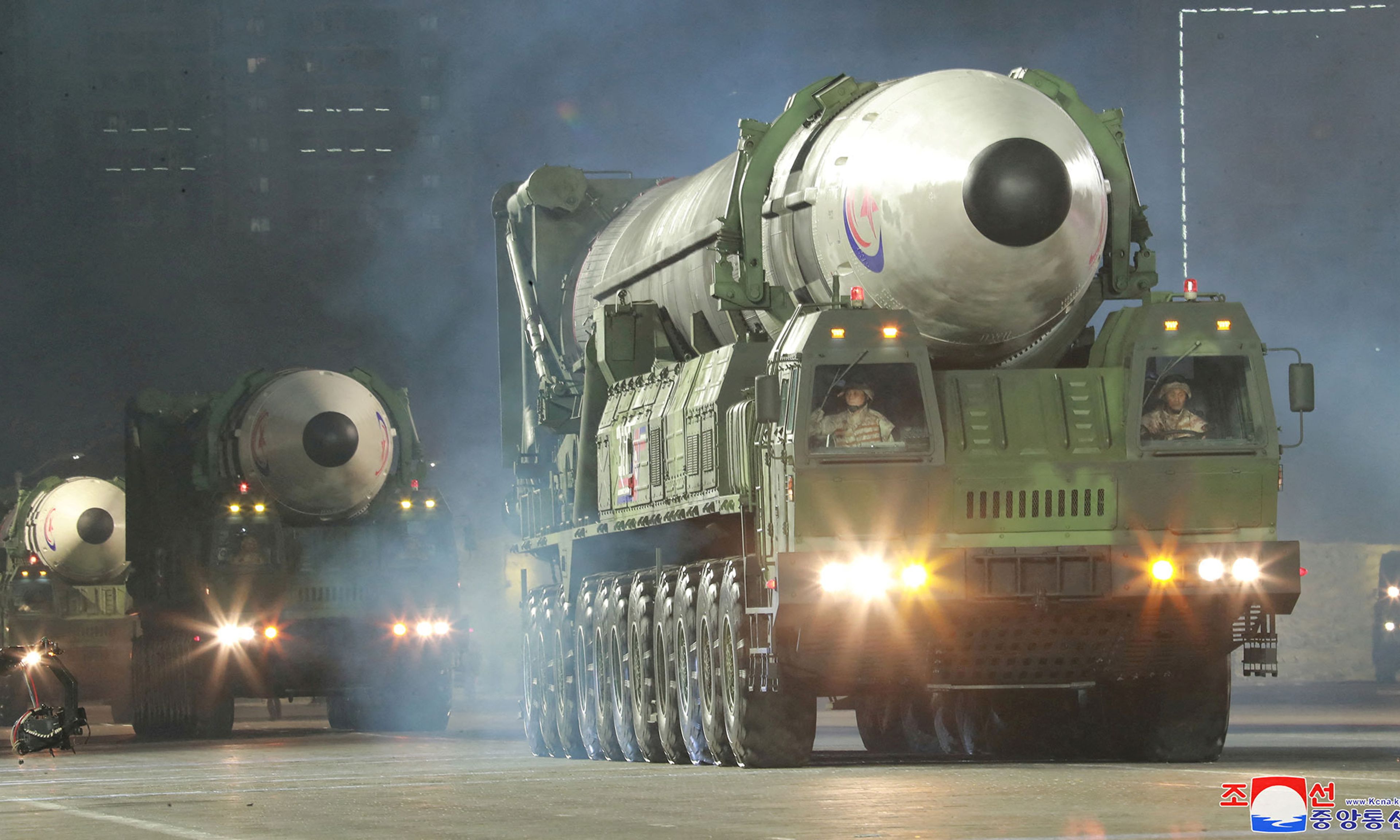
In his New Year’s Eve address, North Korea’s dictator, Kim Jong-un, called for an “exponential increase” in his country’s nuclear arsenal. This followed a year during which the North launched a record number of ballistic missiles of all ranges, including a new missile assessed to be capable of striking any city on the American homeland. Kim’s intention to expand his nuclear stockpile should not come as a surprise. The previous spring, he directed his weapons program to move forward “at the fastest possible speed” to support a new law calling for the preemptive use of nuclear weapons “automatically and immediately” if the Kim leadership is put in danger. Even earlier, the then–vice chairman of America’s joint chiefs, John Hyden, stated that North Korea “is building new missiles, new capabilities, new weapons as fast as anybody on the planet.”
While Kim’s announcements receive widespread attention, and while there is extensive concern expressed about his nuclear buildup, serious analysis of the political and military significance of the North’s growing arsenal is lacking. Five years ago, it was simply unthinkable for most observers that North Korea would possess a 100-weapon stockpile. That level is now easily in sight with every indication that the growth will continue to accelerate beyond that benchmark. At its current rate, the North’s stockpile could exceed 200 weapons by 2027, approaching those of France and Britain. But unlike France and Britain, the North’s numbers will continue to grow.



Comments