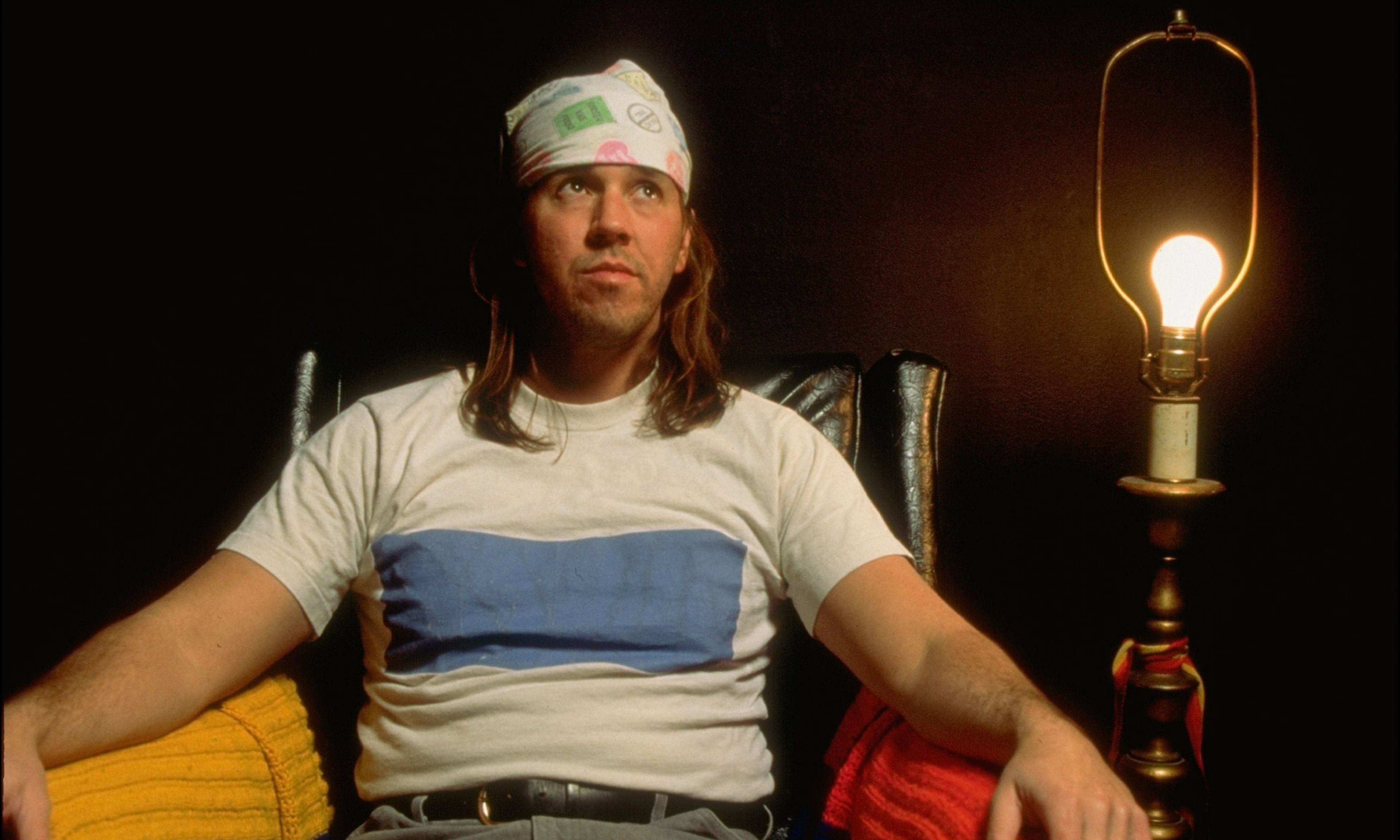
The recently deceased novelist, essayist, and journalist David Foster Wallace was a genius. And a big, showy one at that. His style, laden with his trademark footnotes, was that of a man whose brain was permanently stuck in overdrive — a mind so bright, an observer so exactingly acute as Wallace seemed to have no other option. He was going to struggle mightily to convey the whole of his experience and insight on any given topic, and lest anything slip through the cracks he would insert it on the bottom of the page where he hoped that there was still room, given his typically voluminous outpouring. They say brevity is the soul of wit, but Wallace’s agile mind was witty enough to rewrite the rules.
Wallace’s two collections of journalism and essays, A Supposedly Fun Thing I’ll Never Do Again and Consider the Lobster, remain his most accessible works. But most of his career came in the shadow of his magnum opus, the dystopian doorstop of a novel Infinite Jest. The book describes a future in which the U.S. has turned a huge section of its Northeast into a toxic-waste dump (where herds of feral hamsters roam) and declared that region part of Canada, angering our neighbors to the north to the point that there’s a terrorist group made up entirely of Quebecois assassins in wheelchairs frantically searching the country for an avant-garde film — the Infinite Jest of the title — they plan on using as a weapon. The film is said to be so compelling that all who see it want to do nothing but watch it until they waste away. Even more oddly, most of the book’s characters are either youths at a tennis academy or the occupants of a drug-rehab center.
The novel is about addiction, and about the whole of the American experience. It’s very, very funny and very, very sad and, according to the jacket copy, which for once is not exaggerating, is “one of those rare books that renew the very idea of what a novel can do.” But as is most often remarked upon, it is nearly a thousand pages long, not counting the additional 97 pages that contain the book’s 388 footnotes.
To say Wallace needed an editor is a not-altogether-unfounded criticism, but Infinite Jest is surprisingly readable. It’s true that its length is almost unmanageable; it’s overstuffed with textual games and knowing pop-culture references and, as such, appears to bear all the hallmarks of postmodern literary self-indulgence. And yet, the two most common assessments of Infinite Jest and, to some extent, of Wallace’s entire literary output — that it is self-indulgent and postmodern — are fundamentally wrong.
To put it plainly, Wallace was the postmodernist who wasn’t. What Wallace wrought in Infinite Jest and elsewhere wasn’t just brilliant writing in the vein of a previous generation of postmodernists (think Gaddis, Pynchon, Barth, DeLillo) so much as a response to them. Where a generation of writers before him saw America as a vast canvas for their expansive intellects and decried it as a hollow, satire-demanding place, Wallace almost never wrote without empathy for the world of flesh and blood and feelings and those who inhabit it.
As the critic A. O. Scott observed, Wallace’s early novella “Westward the Course of Empire Takes Its Way” (published in his first short-story collection, The Girl with Curious Hair) pulled off a neat trick. “It features authorial intrusions in the manner of John Barth; whimsical collages of wild fabulation and deadpan realism that recall Richard Brautigan, or maybe middle-period Kurt Vonnegut; and long, long sentences in the style of Donald Barthelme. The proceedings are shot through with an air of wild Pynchonian intrigue,” Scott wrote. The novella, set in a creative-writing workshop, adeptly mimicked nearly every major postmodern writer — solely for the purpose of exposing the limitations of their cleverness. (Wallace singles out Barth’s unbelievably self-referential book Lost in the Funhouse for an especially delightful skewering.)
Which is not to say that Wallace’s own displays of literary pyrotechnics were insincere. Wallace truly did believe in pushing the envelope of what language could do and how it could be employed. But in a very contradictory and un-postmodern fashion he was also acutely sensitive to the rules and limitations of language. He wrote a very credible and amusing essay for Harper’s on the debate over whether English usage rules should be prescriptive or bend and break as usage changes. And one of Infinite Jest’s many amusing asides concerns an organization known as the Militant Grammarians of Massachusetts, which, among other things, organizes boycotts of stores featuring signs that read “10 items or less.”
Wallace’s biggest indictment of postmodernism was that he never stopped raging against solipsism, literary or otherwise. Wallace, whose academic background leans heavily on math and philosophy, took the topic on directly in his now-classic commencement address at Kenyon College, where he said:
Think about it: There is no experience you’ve had that you were not at the absolute center of. The world as you experience it is right there in front of you, or behind you, to the left or right of you, on your TV, or your monitor, or whatever. Other people’s thoughts and feelings have to be communicated to you somehow, but your own are so immediate, urgent, real — you get the idea. . . . This [i.e., the act of trying not to be self-centered] is not a matter of virtue — it’s a matter of my choosing to do the work of somehow altering or getting free of my natural, hard-wired default-setting, which is to be deeply and literally self-centered, and to see and interpret everything through this lens of self. People who can adjust their natural default-setting this way are often described as being “well adjusted,” which I suggest to you is not an accidental term.
Wallace went on to note that once you become well-adjusted, you’ll realize that “the really important kind of freedom involves attention, and awareness, and discipline, and effort, and being able truly to care about other people and to sacrifice for them, over and over, in myriad petty little unsexy ways, every day.”
For better or for worse, the spirit that defines Wallace’s writing is that of someone striving to be self-aware — sometimes painfully, cringe-inducingly so. It thus becomes hard not to see his writing as something of a cri de coeur against many of his immediate literary forebears.
That’s how Wallace, whose writing normally oozed decency and compassion for all but the most contemptible subjects, came to write just about the only caustic thing of note in his entire career. It was a particularly savage and devastating review of John Updike’s Toward the End of Time, in which Wallace threw down the gauntlet against what he termed the “Great Male Narcissists” of postwar literature: Updike, Mailer, and Roth. Here Wallace finally made clear his feelings about the previous generation of literary masters: “When a solipsist dies, after all, everything goes with him. And no U.S. novelist has mapped the solipsist’s terrain better than John Updike, whose rise in the 60s and 70s established him as both chronicler and voice of probably the single most self-absorbed generation since Louis XIV.” Toward the End of Time, he continued, is a bad book, unbecomingly obsessed with sex and death. “[The narrator’s] unhappiness is obvious right from the book’s first page. But it never once occurs to him that the reason he’s so unhappy is that he’s an a**hole.”
Wallace’s anger at what he perceived as Updike’s narcissism reveals something about who Wallace was. For all the cranial firepower he possessed, he was actually a modest person. He was just Dave Wallace to most (his literary agent suggested he use his middle name, as there were a number of other David Wallaces already writing), the unfailingly courteous midwesterner who sent thousands of immaculate and mostly typewritten notes to his friends throughout his life. As literary titans go, he wasn’t pretentious: He liked dogs, he rather ashamedly chewed tobacco in nearly every social setting, and he almost never wore anything resembling formal attire. In his later years, he was enough of a literary rock star to inhabit an extremely well-endowed academic position created especially for him; yet he never took advantage of his success to retreat to writerly solitude and avoid sharing his gifts. Professor Wallace taught thousands over the years and was consistently rated an outstanding and thorough teacher, wildly popular with his students.
But to the extent that Wallace appeared to be “well-adjusted,” this was the result of a profound lifelong struggle. He dropped out of Harvard’s graduate philosophy program to wage a rumored battle with drug addiction and other psychological problems, and an anonymous and hyperliterate testimonial on the website of a drug-treatment center in Massachusetts is widely assumed to have been written by Wallace. If he hated solipsism, that hatred might well have been a result of hating the thing he feared the most — that he would give in to his own demons.
Which, in the end, is exactly what he did. David Foster Wallace committed the ultimate act of solipsism, hanging himself on Sept. 12, 2008, at age 46, leaving behind a lovely wife. However self-centered and sadly clichéd his demise, it seems unlikely that it will overshadow a literary voice so powerful that at times it felt as if Wallace could singlehandedly hold back the postmodern mudslide and be the moral conscience of American fiction. May he rest in peace.






Comments