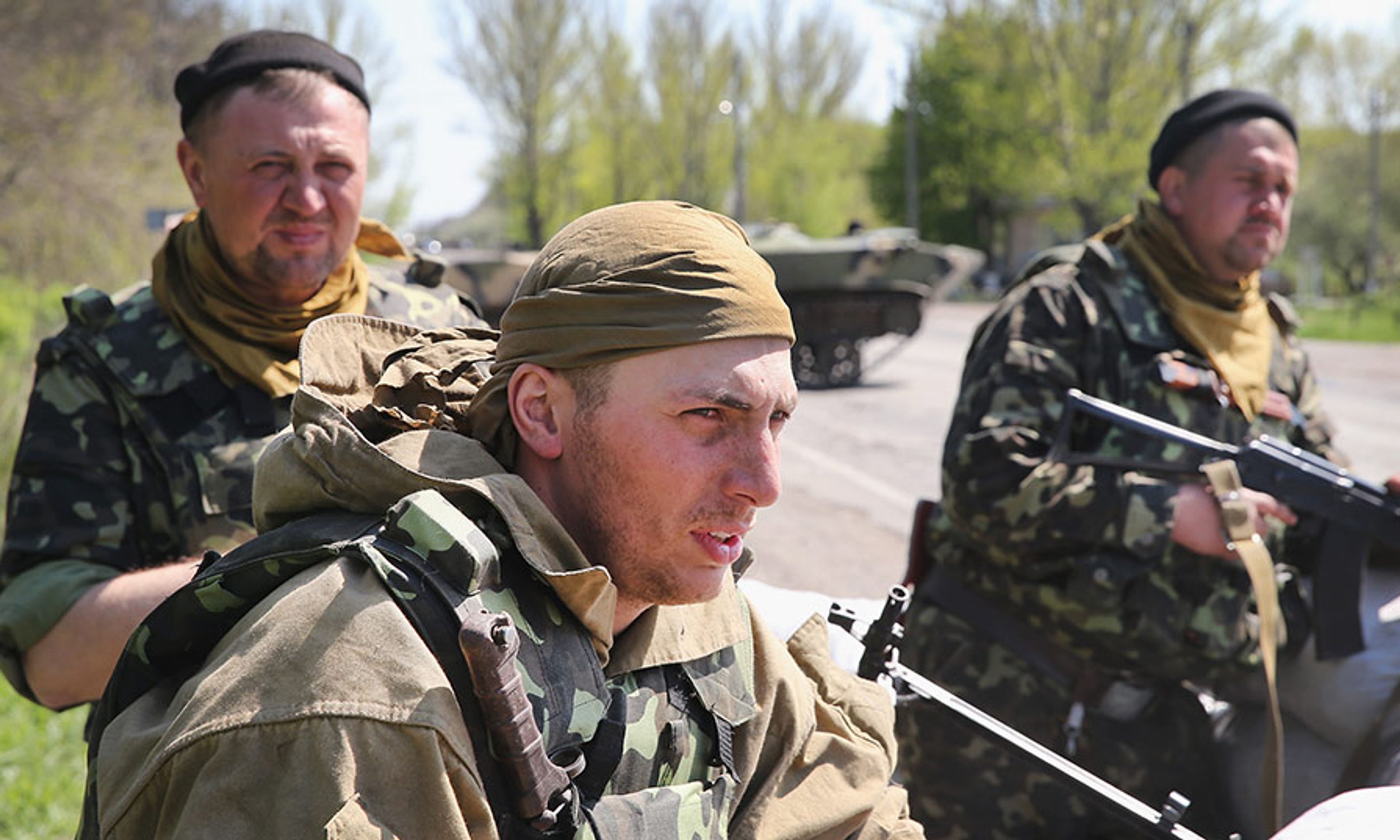
What could be described as “the fundamentals” of the Russo-Ukrainian crisis have now been in place and even stable for the better part of a year. Ukraine is governed from Kiev by a democratic government (originally the result of a street revolution but confirmed by free elections) that is nationalist internally and pro-Western internationally. Nine tenths of Ukraine is under the control of Kiev; the remaining tenth in eastern Ukraine is ruled by forces claiming to be “pro-Russian” Ukrainian insurgents but in reality composed of Russian military forces and allied mercenaries.
President Putin sent in these forces to stage an uprising against Kiev when Russophone Ukrainians and ethnic Russians failed to rise spontaneously against Kiev as he had plainly expected they would. Partly as a result of this aggression, however, popular opinion throughout Ukraine is now strongly nationalist and supports not only the Kiev authorities but also continuing resistance to Russia. And though fortunes on the battlefield change, mainly in response to the level of Russian intervention, the Kremlin is clearly aware that an invasion of the whole of Ukraine would carry heavy costs and unpredictable risks. So something like a military stalemate has prevailed between the two sides since the late summer of 2014.
In the last two months, however, developments external to the crisis itself have upset this balance and changed everyone’s calculations. The most important such development is the collapse in the price of oil and the growing belief that it will not return to the high levels of recent years. We should be cautious about such long-term predictions: Trough Oil may prove as temporary as Peak Oil. But since Russia has never diversified its economy, the Russian budget requires oil prices to be somewhat in excess of $100 a barrel in order to finance all the state’s needs from growing military spending and a glitzy international broadcasting blitz to the transfer payments that keep its subjects passive. The current oil market has thus created a massive financial crisis for Russia. Its currency has fallen; its reserves, too; and its savers and oligarchs are sending their money abroad. As Chrystia Freeland writes in the January issue of the magazine Prospect, this crisis is pushing Putin further down a path on which he had already embarked: switching from a stable authoritarian kleptocracy to a reckless nationalistic one.
Until recently, that hyper-nationalism was seen and heard mainly in the Kremlin’s propaganda machine, which was pumping out constant denunciations of the “fascists” in Kiev, and suchlike. In the last few weeks, however, the Kremlin’s actions have begun to match its words. Russian planes have been dogging the English coastline; frontier incidents have been staged in the Baltics; massive additions of men and equipment have been moved into Ukraine; and fresh attacks have been launched on Ukrainian positions in the East. This renewed aggression might perhaps represent a defiant assertion that Russian state policy toward Ukraine will be unaffected by the weakness of the economy but will go no further. Such an assertion might even be a smokescreen behind which a diplomatic retreat is being prepared. In Putin’s Russia, “nothing is true and everything is possible.” to quote the title of a recent book by Peter Pomerantsev. But unless something like that happens — and it seems unlikely — where is Russia heading and what might be the consequences?
Most analysts doubt that Putin will risk a full-scale invasion of Ukraine or even formally annex the “New Russia” statelet that his policy is creating in the east of the country. They suppose that Putin intends to create another frozen conflict in eastern Ukraine on Russia’s borders, both to destabilize Kiev and to give him unofficial control of the area around Donetsk and other key cities. It sounds suitably Machiavellian. But such a policy would hurt Russia at least as much as Ukraine.
As long as it lasted, it would prevent a diplomatic rapprochement between the West, notably Germany, and Russia and thus prolong Russia’s economic isolation in hard times. The West would meanwhile come to Ukraine’s aid financially. Over a longer period, two Ukraines would develop alongside each other — a more prosperous and democratic Western Ukraine increasingly integrated into the West economically, and a sluggish authoritarian rump Ukraine dependent on Russian markets and subsidies. The comparative careers of West and East Germany give us some idea of their respective futures.
Meanwhile, the continuing crisis would poison East–West relations. The West could not simply retreat without serious concessions from Moscow, since that would encourage further adventurism against the Baltics or Eastern Europe. And there would be a risk that the saber rattling we have recently seen from Russia would get out of hand and prompt crises on the lines of the recurrent Berlin crisis. That is not a future anyone, including Putin, should want. But we will get it if the West does not send unmistakable signals that Putin’s reckless gamble in Ukraine will not be allowed to succeed. And since NATO will not directly intervene with troops, the only way the West can do so is to supply Ukrainians doing the fighting with weapons so that they can better resist the Russian incursion and as a result raise its price to Putin and the Kremlin.
That conclusion was reached by, among others, National Review a year ago. This week it has been endorsed by the center-Left of the U.S. foreign-policy establishment (itself a largely center-left institution). A paper — ”Preserving Ukraine’s Independence, Resisting Russian Aggression” — issued under the joint auspices of the Brookings Institution, the Atlantic Council, and the Chicago Council on Global Affairs argues that the U.S. should supply the Ukrainian army with weapons along the lines and for the reasons argued above. There are the usual signs of legalistic fine-tuning in the document; it wants to ensure, for instance, that U.S. weapons don’t fall into the hands of Ukrainian volunteers who should anyway be quickly integrated into the regular Ukrainian army. Those aims are doubtless desirable, but they will be hard to ensure in the fog of war, and they shouldn’t be used as an excuse to keep the weapons safely in official stockpiles far from the front. But these cautions are a small price to pay for such distinguished signatures as those of Ivo Daalder, Strobe Talbott, James Stavridis, and Michele Flournoy — a genuinely impressive roster of national-security luminaries from the U.S. military, former administrations, and, in one case, the Obama administration.
That points to another significant aspect of the document. It can be read as a cry of frustration at the hesitation and inaction of the Obama administration more broadly than merely on Ukraine. President Obama’s policy on Ukraine has actually been better than most of his other policies on defense and foreign policy. It has placed the blame for the crisis firmly on Putin from the start and pushed the Europeans into going further on sanctions than most wished (though some, like Chancellor Angela Merkel, have since come round to the American view). But half-measures are its signature in foreign policy (leading from behind, moderate sanctions, wooing the Muslim Brotherhood), and it sticks with them long after they have failed. These policies are potentially even more dangerous in Iran, Syria, Iraq, and Afghanistan than in Ukraine. But they are bad enough in Ukraine, where even experts who are politically sympathetic to the president recognize that Obama has shrunk until now from the one step that would seriously obstruct Russian aggression and maybe reverse it: supplying the victims of that aggression with weapons to defend themselves.




Comments