Last week, I wrote about the first part of Jacopo Tintoretto’s massive retrospective, or career overview, in Venice. Shown at the Accademia, it ends as we like them to end: with fireworks, not sizzle. The Miracle of the Slave from 1548 was done for the Scuola Grande di San Marco, one of Venice’s fancy men’s clubs, so it was a substantial commission. It’s splashy and packed with drama. Tintoretto had proven himself a special-effects master with a novel talent for presenting the key moment with whatever it demanded — poignancy, flair, or an electric jolt. This week, I’m writing about the rest of the retrospective, held at the Doge’s Palace.
Insofar as “what’s a retrospective,” my scruples are loose. A proper overview should include the greatest works, but in Tintoretto’s case, many of them are still in the spaces for which Tintoretto painted them. His last big commission is in the Doge’s Palace, permanently installed in its grandest state rooms. They’re a walk away from the show. His biggest job, the decoration of the Scuola San Rocco, is in Venice, too, and a thing of splendor it is. It’s one of Europe’s best art experiences. There are about 30 churches in Venice with Tintoretto paintings, some 50 feet tall and immovable. You can visit them, but they’re not in the show.
The show at the Doge’s Palace is really an introduction to Tintoretto and an in-depth look at his working methods. There is a comprehensive group of portraits and mythological paintings. Otherwise, it’s a launching point. It’s very correct and worth seeing, though. Tintoretto studies are new and developing, so the scholarship is valuable. The first modern retrospective was only in 2007, at the Prado. Few of the best things are in the Venice show, but they’re all somewhere in Venice, and it’s Tintoretto, and that’s enough.
The Abduction of Helen from 1578 is in the show. It’s Tintoretto at the top of his game.
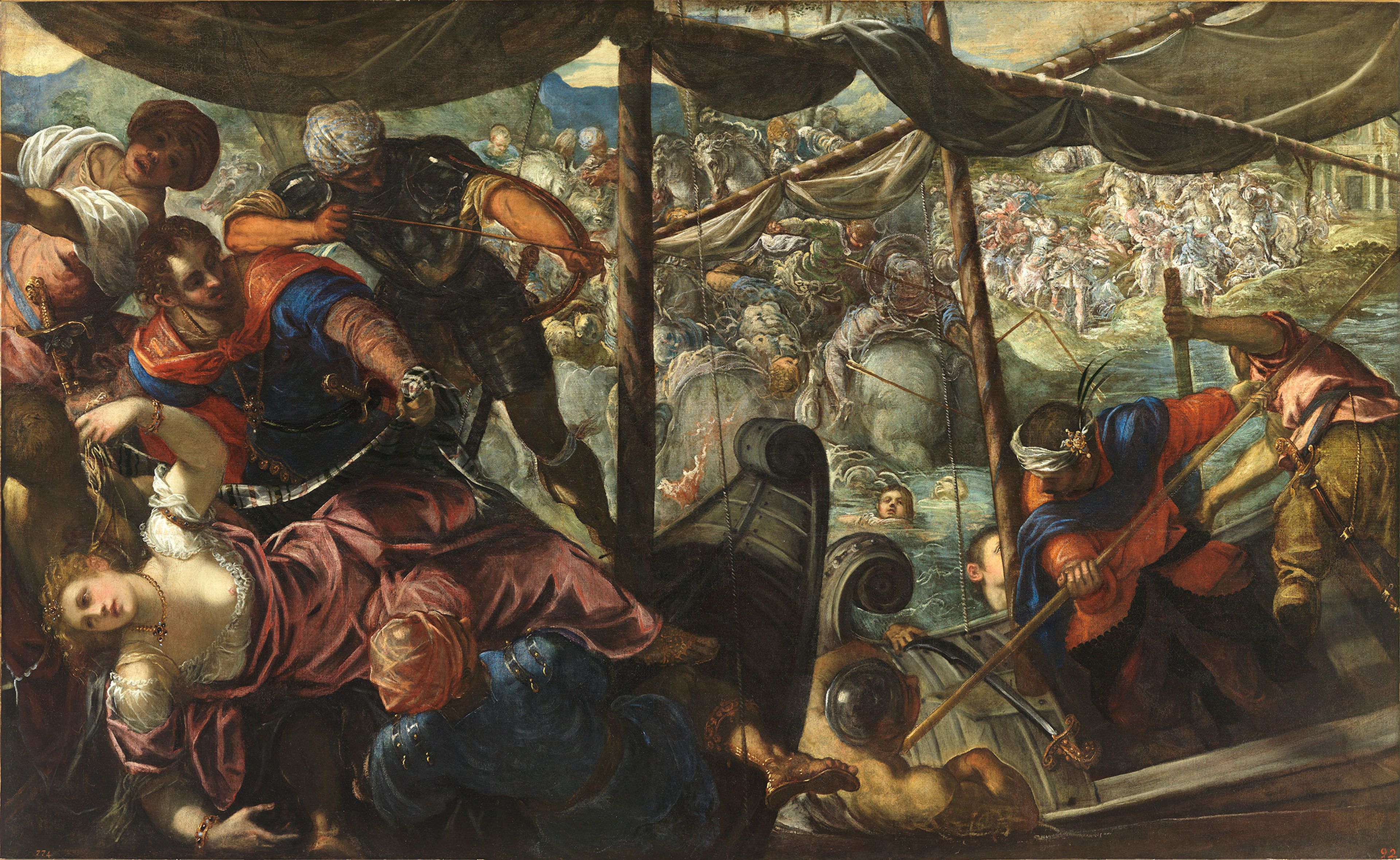
The picture has two registers. First is the foreground of big, convulsing figures. If “foreshortener” could be a painting specialist, then Tintoretto would be its master. Most of his paintings are on high places, tall walls or ceilings, and he loved the sense of figures spilling all over or, better still, looking as if they were blown up by an unseen force. His people are always coming at us, head-first, feet-first, or sliding sideways.
Then there’s the background. Tintoretto often conveys distances not only through shrinking figure sizes — they’re far away and therefore smaller — but by changing his palette to a sea of infinite grays with pastel-colored highlights. It’s partly a light trick, too. His foreground here, with the key players, among them Helen, hauled off like a fat, rolled-up carpet, has lots of deep, dark spaces. The back is in full sun. He’s giving us the chaos of battle, but his bright light and muted palette dissolves the melee. It doesn’t distract from the core crime.
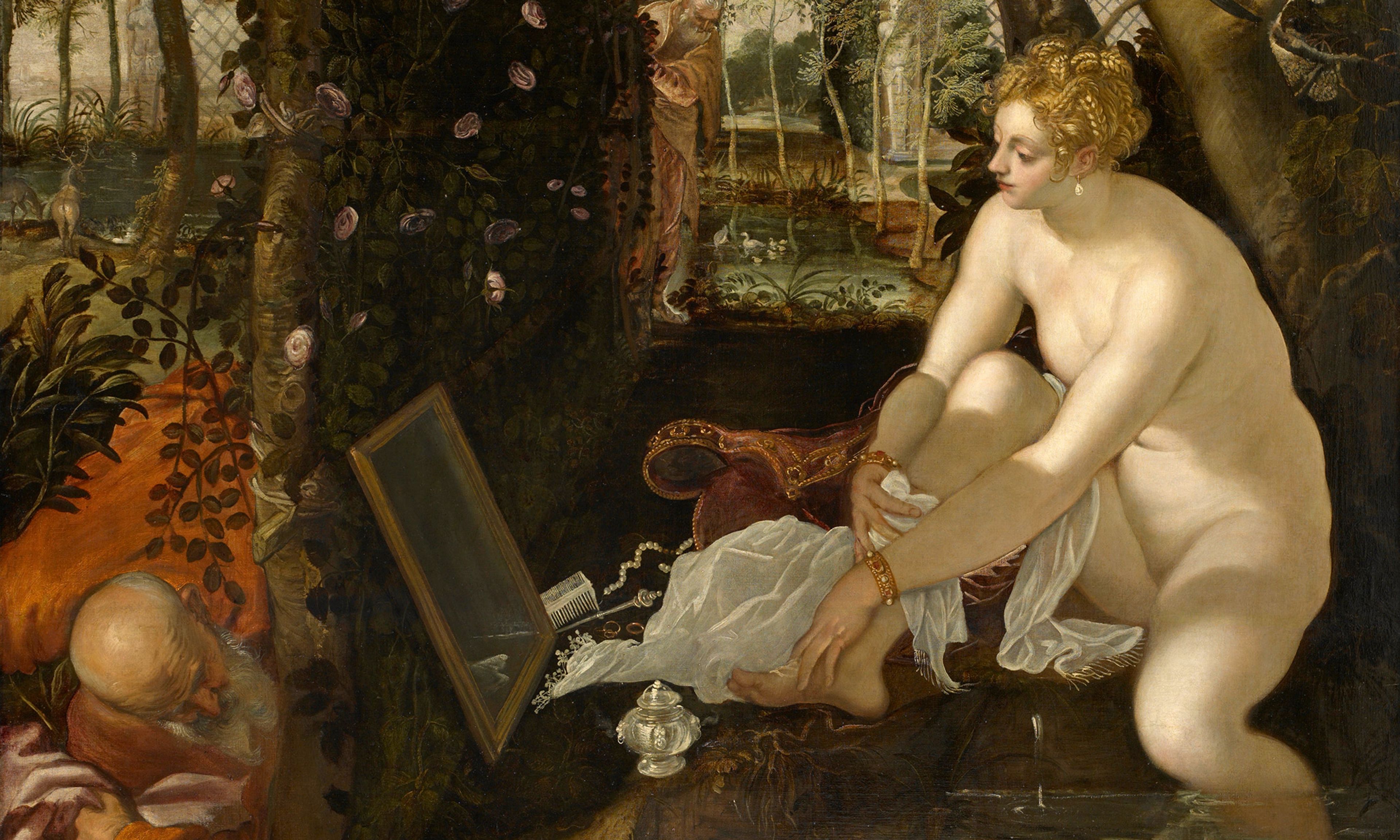
A second picture that makes the show worth seeing is Susanna and the Elders from the mid 1550s, coming from Kunsthistorisches Museum in Vienna. It’s a sheer beauty. It’s a twist on the old convention of the reclining nude, because Tintoretto is implying multiple vantage points, not only from the two voyeurs but from the big mirror. She’s luminous and opalescent, but instead of hot, she’s as cool as a string of pearls. Susanna was the virtuous one, not the geezers stalking her.
I wrote a bit last week about Tintoretto (1519–1594) the man. He was self-taught, which doesn’t mean he was without instructors. A self-taught person learns from watching others do their own everyday work, how they really work, not sitting in a classroom listening to teachers paid to talk to them. At the same time he was watching artists work, he learned from their patrons, suppliers, dealers, and assistants. He learned by doing. Since no academic infrastructure was there, no teachers with a mallet beating individuality out of him, his strong, inventive personality remained undiluted. He was a self-made man, inventive and opportunistic.
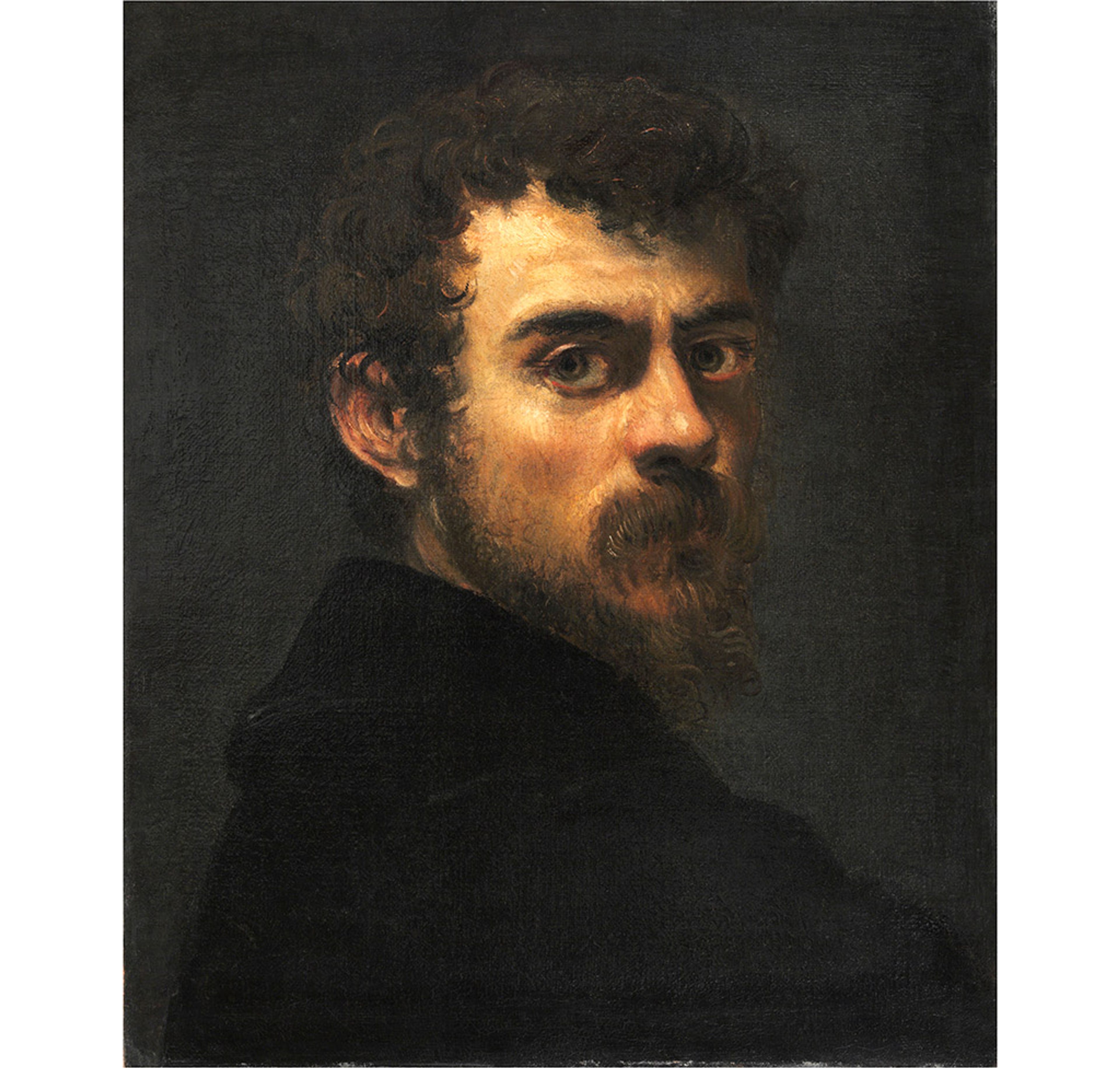
Everything the art world’s first great biographer, Giorgio Vasari, says about Tintoretto isn’t strictly accurate, but he knew the man and saw his work in Venice in the 1560s. What he wrote has the ring of closely observed truth. He called Tintoretto “swift, resolute, fantastic, and extravagant, with the most extraordinary brain that the art of painting has ever produced.” High praise, but now the dig: “This master at times has left as finished works sketches still so rough that the brushstrokes seem done more by chance and vehemence than with judgment and design.”
In his day, Tintoretto’s rough finish was a marketplace plus and a minus. I called Tintoretto a “slasher” last week because of the gestural vigor of his brushstrokes. This was his personal style and something new in Venetian art. He had the mood, the eye, and the hand to apply the new medium of oil paint in thick dollops on a textured canvas and create a coherent, buoyant line. It served Tintoretto well professionally. It was a style for billboard-size paintings, where figures were conveyed in broad outlines and general characteristics rather than in tiny details. The effect isn’t confused, incoherent clots of figures but restlessness. Tintoretto also worked fast, as slashers often do. If you needed something good in a hurry, Tintoretto was your man.
Tintoretto was entrepreneurial, too. He had almost no prestigious noble commissions in his career. Titian cornered that market and didn’t like Tintoretto. He found his elbows too sharp, but Tintoretto was self-made. If he didn’t promote himself, who would? Worse for Tintoretto, Titian lived until 1576, and by then his stylistic legacy had been assumed by Paolo Veronese (1528–1588), younger than Tintoretto and practicing a Venetian style driven by luscious color but also, in keeping with Titian’s and the nobility’s taste, figures moving with gracious, refined ease. Tintoretto’s style was a minus for the reasons offered by Vasari. He showed vehemence, not detachment and deliberation. Aristocrats don’t like that in upstarts.
Tintoretto was happy to paint for parish churches and social clubs in Venice, his bread-and-butter base. He was an evangelical Roman Catholic invested in work that inspired fervor, a good match for Venetians who took religion seriously rather than as so much social decoration. It’s easy to push the issue of class too much — Tintoretto was a big success and by the end of his life was doing much of the work in the Doge’s Palace — but of the three artists, he treats poverty and humility with an authentic, unembarrassed touch. His men look as if they work for a living. There’s not a languid, rich slug to be found.
Of the two shows, the Accademia show on the young Tintoretto is the most satisfying because it’s complete. The art’s there. In the Doge’s Palace show, there’s a big problem: It’s difficult to do a Tintoretto retrospective without a modern miracle: the conveyance of art to the galleries from the Madonna dell’Orto church, the Scuola San Rocco, and the rest of the Doge’s Palace. I visited all three after I saw the retrospective. I could easily do it. They’re all in Venice. I’m curious to see how the show will function at the National Gallery in Washington since not even the speediest gondolier will get you to the Grand Canal from the Potomac.




Comments