I write this column with some trepidation — because I am about to mention the office of the speaker of the House of Representatives. And, as I write, anything can happen. Is Pope Francis available? Can we make an Argentinian exception just this once if no one else wants the job?
No, no, no. Pope Francis has his own unenviable task before him, but one with eternal rewards. And despite the largely warm and moving welcome he received when he arrived at the joint session of Congress last month — his visit was a first for a pope — I’m not drafting him for the job. But in a somewhat epic, as the kids say, Sunday-night rant on Twitter, an up-and-comer on the other side of the Capitol had a brilliant idea. Freshman senator from Nebraska Ben Sasse tried to recruit Arthur C. Brooks for speaker.
Sasse said some quite true things that we seriously need to be reminded of: “Truly American leadership starts with politicians admitting that politics and D.C. are not the center of national life. A vibrant citizenry is.”
He said: “House Speaker should be Congress’s chief STORYTELLER — cast the big vision of American exceptionalism; remind nation who we are/what we’re about.”
“Next speaker needs to have the ideas of Jack Kemp, work ethic of Mike Rowe, resolve of Margaret Thatcher, & wit of Larry the Cable Guy,” Senator Sasse tweeted. “Therefore . . . I’m endorsing @ArthurBrooks for Speaker of the House.”
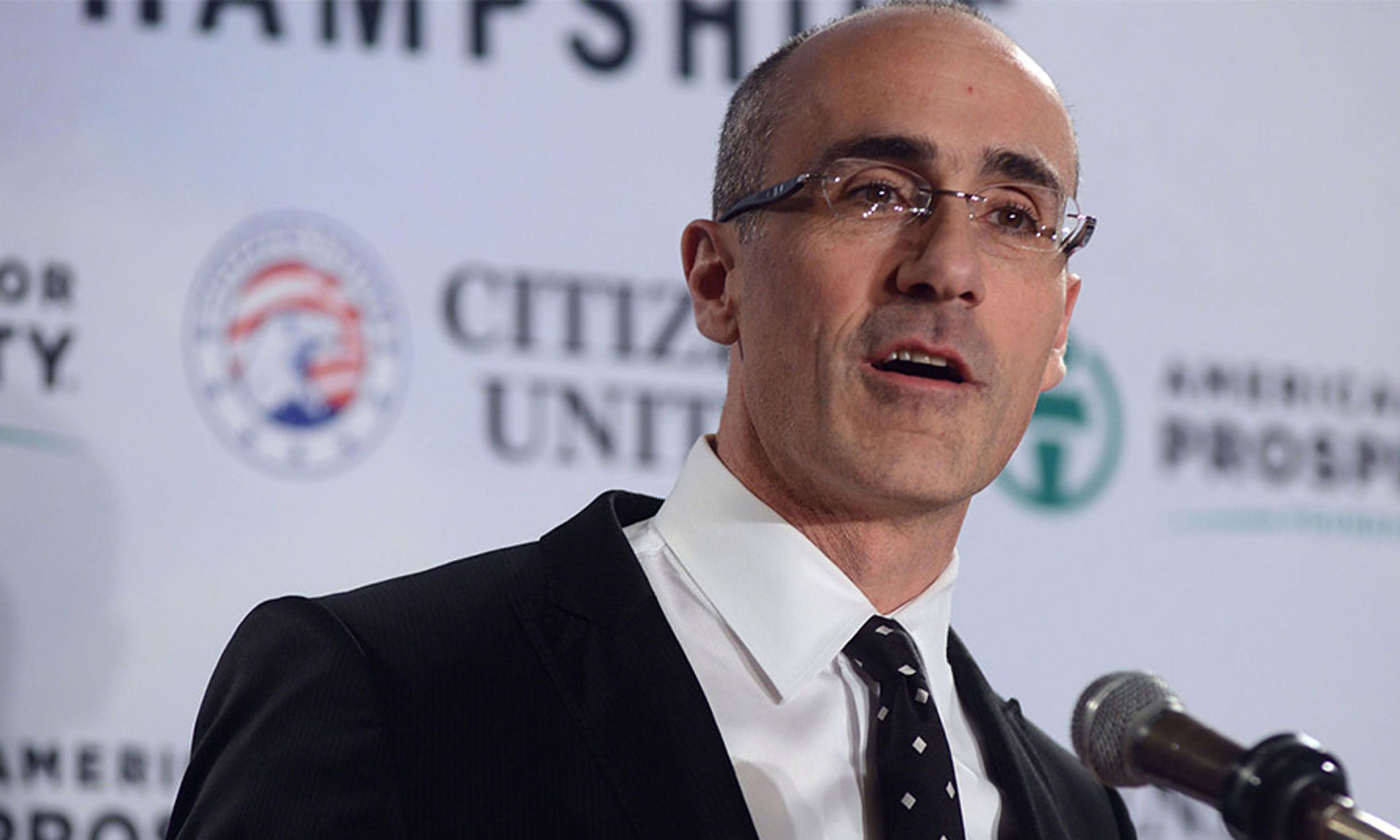
Brooks, in case you don’t know him, is the president of the American Enterprise Institute. And when he was selected for that job, he was a quite unusual choice.
As he tells the story in his new book, The Conservative Heart, “I didn’t start out as a conservative. First I was a musician, and a liberal bohemian one at that. My hometown of Seattle is one of the most progressive cities in America. And my early path made me exactly the sort of slacker that right-wingers love to make fun of. I dropped out of college at nineteen to pursue my dream of making my living in classical music. During what my parents referred to as my ‘gap decade,’ I traveled the world playing concerts, barely making my rent every month, and having a blast.”
He was pursuing, as he says, “happiness.”
He would move to Spain as a French-horn player. “I had defined happiness as the freedom to pursue my dreams to make music and travel the world, and I’d attained exactly that,” he writes.
He realized that it wasn’t making him happy, though; he wanted to learn more. He headed back to America — specifically, to Trenton, N.J., where he would take “inexpensive BA courses” “entirely by correspondence.” He would take “math, anthropology, and literature.” And, “to my utter shock,” he writes, “I fell in love with economics.”
‘Most of all, I learned that American-style democratic capitalism was changing the world and helping billions of poor people to better their lives.’
“But as I studied it at age twenty-eight, it blew my mind at every turn. I learned that market forces tend to win out even when we don’t want them to, and that good intentions are no guarantee of good results. I learned that we can’t change behavior just by passing a law against something we don’t like. I learned that people are complex and respond to different incentives, which is why so many social problems are not fixable through government programs. But most of all, I learned that American-style democratic capitalism was changing the world and helping billions of poor people to better their lives.”
This was not a knee-jerk response. It was one from the heart. Brooks sees the pain and wants to help heal the wounds.
He writes that “millions of Americans believe that the American Dream is no longer within their reach and that conservatives don’t care. Millions of Americans don’t see the benefits of democratic capitalism extending to them, their families, and the poor. Millions of Americans no longer believe that their children will be better off than they had been. And millions of Americans see conservatives as oblivious to these problems.”
How do people get out of the misery?
In his book, Brooks writes, “We live in an age in which tearing down the high and mighty has become a twisted type of public sport.” It doesn’t make for the best work environment, needless to say. What we need is someone who can get at the heart of the matter.
Brooks writes: “There are many characteristics of American conservatives — some better than others. But the one that is non-negotiable has to do with the inherent dignity of every individual and his or her right to equal opportunity. I know there are a lot of times that we don’t express this so well; occasionally maybe we even forget it a little.”
“Since I was a child,” he writes, “the percentage of the world’s population living at starvation levels has declined by 80 percent! At least 2 billion people have been pulled out of absolute poverty. It was not progressive para-state entities such as the United Nations that did this; it was American conservative ideas that spread around the world, such as globalization, free trade, property rights, rule of law, and entrepreneurship. We should be shouting this from the rooftops.”
If that is truly the message of conservatism, who wouldn’t want to sign up?
In the New York Times, Brooks commented on Pope Francis’s trip to the U.S. and Cuba. He wrote: “For Francis, happiness comes from unity, both with God and with one another. Unhappiness comes from division from either — which comes from the Dark One.”
At the end of the day, whoever is to be a successful speaker has to have a heart for uniting. Not dividing, but uplifting. And never losing sight of humanity in the midst of our politics.
I think that’s what Senator Sasse was getting at. And it’s for all our leaders — not just the speaker.
— Kathryn Jean Lopez is senior fellow at the National Review Institute and editor-at-large of National Review Online. She is co-author of the new revised and updated edition of How to Defend the Faith without Raising Your Voice (available from Our Sunday Visitor and Amazon.com). This column is based on one available exclusively through Andrews McMeel Universal’s Newspaper Enterprise Association.





Comments