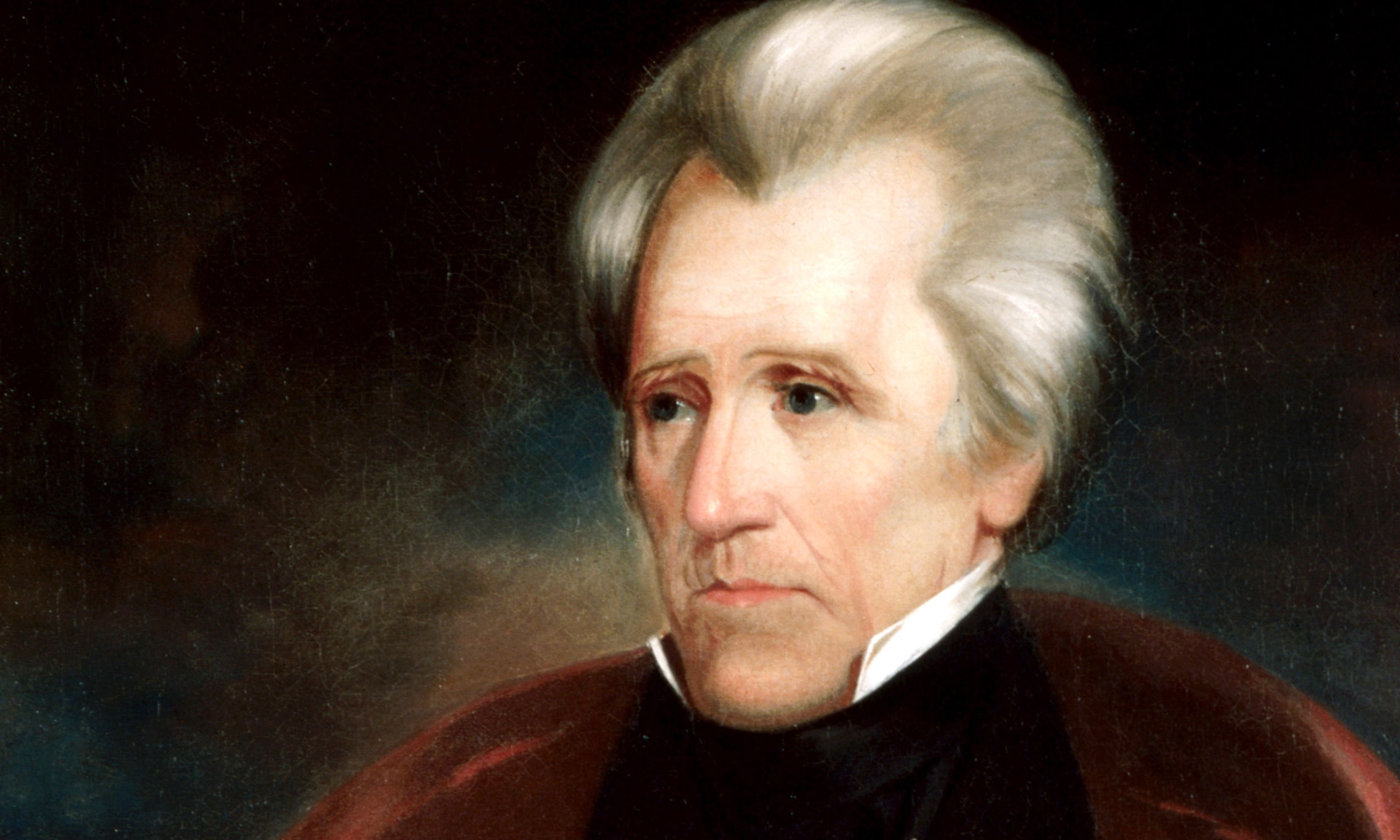
Andrew Jackson was the first president to come from beyond the mountains. He was also the first president of North British, Scotch-Irish stock. His predecessors in the presidential chair came from Virginia or Massachusetts: They were shaped by the blood and culture of the Tidewater Cavaliers or the New England Congregationalists, and their ancestors came mainly from the south of England. (Monroe’s antecedents were, indeed, Scottish, but they were thought to have been Cavaliers, and at all events the family had been long settled in Virginia.) Jackson was a departure from the tradition, and many resented him for it.
His language was not refined; he pronounced the word “end” as though it rhymed with “fiend.” John Quincy Adams thought him “a barbarian who could not write a sentence of grammar and hardly could spell his own name.” A woman who had known him in his youth was startled to learn that he was a candidate for the White House: “What! Jackson up for president? Jackson? Andrew Jackson? . . . Well, if Andrew Jackson can be president, anybody can!”
As the selection of Gov. Sarah Palin as the Republican vice-presidential candidate this year amply demonstrated, the fault-line between the culture of the backcountry and that of the cities and the coast persists. In his new study of Jackson, American Lion, Newsweek editor Jon Meacham describes the essential elements of the backcountry culture that framed “Jackson’s universe — clan, church, and country.” Revise the vocabulary slightly and the formula accurately describes the culture of the American heartland today, where family, God, and country remain the organizing principles of life.
The highbrows of the cities and the coast consider this heartland culture too primitive to be taken seriously. Meacham, however, shows that there is more to the backcountry than meets the eye. The foundation of Jackson’s “worldview,” Meacham writes,
most likely came from his childhood Sundays in South Carolina, where he spent hours soaking in 18th-century Presbyterianism. He attended services at the Waxhaw meetinghouse throughout his early years, and these childhood Sabbaths are worth considering in trying to solve the mystery of how a man with so little formal education and such a sporadic — if occasionally intense — interest in books developed his sense of history and humanity. . . . From his babyhood, then, Andrew Jackson probably spent between three and four hours nearly every Sunday for about 14 years hearing prayers, psalms, scripture, sermons, and hymns.
Meacham is persuasive in his contention that this immersion in Biblical poetry helped Jackson, later in life, to shape a compelling political narrative. The “rough-hewn Jackson,” Meacham writes, “understood the poetry of politics better than Calhoun, Clay, or Webster. His foes were speaking in prose, making technical arguments. Jackson was formulating a poetic narrative drama in which he was the hero defending the interests of the people against the powerful.”
The mandarins will raise their eyebrows at the assertion, but those who, like Jackson, have been thoroughly tasked and lessoned in the Bible are often on more intimate terms with the old poetic culture of the West than the typical Ivy Leaguer today, who, though he has been exposed to the classics in school, has been so in only the most superficial way. The theory that the mind benefits from close and scrupulous study of classic texts was long ago discarded by most educators. Matthew Arnold, for his part, could never understand why. “A schoolboy, who, as they did in the times of ignorance at Eton, read his Homer and Horace through, and then read them through again,” Arnold said, “and so went on until he knew them by heart, is not, in my opinion, so very much to be pitied.” Today this kind of apprenticeship in the poetry of Athens or Jerusalem is largely limited to those who, as John Ruskin said of his own upbringing, begin “with the first verse of Genesis” and go “straight through, to the last verse of the Apocalypse; hard names, numbers, Levitical law, and all.” Ruskin had no doubt of the value of this education: The “habitual music” of the Scriptures, he wrote in Præterita, “established my soul in life.”
Mothers were often, in the American backcountry, the dominant force in the transmission of higher culture. Though he was just nine when Nancy Hanks Lincoln died, Abraham Lincoln sensed in his mother a refinement that his boorish father lacked, and he traced the origin of all his loftier aspirations to her. The pattern was similar in Jackson’s case. His father died before he was born; it was his mother who encouraged him to raise his sights. “Elizabeth Jackson wanted her Andrew to be a minister,” Meacham notes, “an ambition for him that may have been among the reasons he was able to envision himself rising to a place of authority.”
Astute as he is in his analysis of the value of Jackson’s Bible poetry, Meacham is less careful in his assessment of the other sources of the backcountry, ultramontane culture that shaped the seventh president. In 1830 Jackson’s Kentucky ally, Francis Preston Blair, argued that the states’-rights doctrine of nullification appealed to those “men, who, like Caesar, would rather reign in a village, than be second in Rome.” Blair’s “more sophisticated readers,” Meacham writes, “may have heard an echo of John Milton’s description of Lucifer in Paradise Lost.” Blair, however, was alluding, not to Milton, but to Plutarch, who described Caesar’s reaction to the politics of an obscure barbarian hamlet in the Alps: “For my part,” Caesar said, “I had rather be the first man among these fellows than the second man in Rome.”
Those who lack formal education often have an almost mystical veneration for classical learning. Recalling the backcountry world in which he grew up, Lincoln said that if “a straggler supposed to understand Latin happened to sojourn in the neighborhood, he was looked upon as a wizard.” The backcountry leaders of Jackson’s day were versed in Plutarch and Tacitus. During a strenuous life Jackson himself found time to master the classical-republican vocabulary of virtue and corruption; as president he applied it in his analysis of the corrupting effects of the second Bank of the United States.
Highbrows will probably always underestimate the products of the heartland culture from which Jackson arose. Emerson thought Lincoln a “clown.” Reagan was deeply influenced by his Middle Western mother, whose traditions were those of Scotch-Irish Protestantism; the magnificos of Washington pronounced him an amiable dunce.
The condescension is unwarranted. The heartland presidents have been among the nation’s most inspired defenders of the citizenry’s liberty of action. Meacham identifies the Jeffersonian paradox at the heart of Jackson’s concept of a strong executive: “Jackson wanted the presidency to be central, but he was less interested in a centralized government, believing that such consolidation (as his contemporaries often called it) led to the rise of special interests.” Jackson rejected consolidationist government because he thought it vulnerable (in a way more limited forms of government are not) to corruption. He is perhaps best placed, not in the line of strong consolidationist presidents (such as Wilson and the Roosevelts), but in that of the strong anti-consolidationists (such as Jefferson and Reagan).
Jackson’s classical-republican dread of corruption illuminates his opposition to the second Bank. The Bank was a private institution, not a government entity, but (like Fannie Mae and Freddie Mac in our own time) it enjoyed a cozy relationship with official Washington. Such coziness was, Jackson believed, an invitation to corruption. He accused the Bank of maintaining its privileged position by converting itself into a “permanent electioneering machine,” one that did favors for lawmakers in exchange for support. A financial institution that profited from its association with the government but was not subject to its oversight could lead, Jackson said, to another “South Sea bubble.” It was for this reason that he vetoed a bill to renew the Bank’s charter and withdrew the government’s deposits from the institution.
Jackson vindicated, in his age, the ideal of limited government. According to Meacham, he “believed the less government interference with the market, the better.” He vetoed spending bills and opposed tax hikes for “irregular, improvident, and unequal appropriations of the public funds.” In 1835 he paid off the last penny of the national debt. At the same time he kept up the country’s reputation abroad; he pointed to Washington’s words as the beau ideal of American foreign policy: “There is a rank due to the United States among nations which will be withheld, if not absolutely lost, by the reputation of weakness. If we desire to avoid insult, we must be ready to repel it. If we desire to secure peace, one of the most powerful instruments of our rising prosperity, it must be known that we are, at all times, ready for war.”
With the important exception of his injustices to blacks and Indians, Jackson left an admirable record. Particular crises may require temporary enlargements of federal power, but Jackson was right to insist that as a rule the best government will limit itself “to a general superintending power to maintain peace at home and abroad, and to prescribe laws on a few subjects of general interest not calculated to restrict human liberty.”





Comments