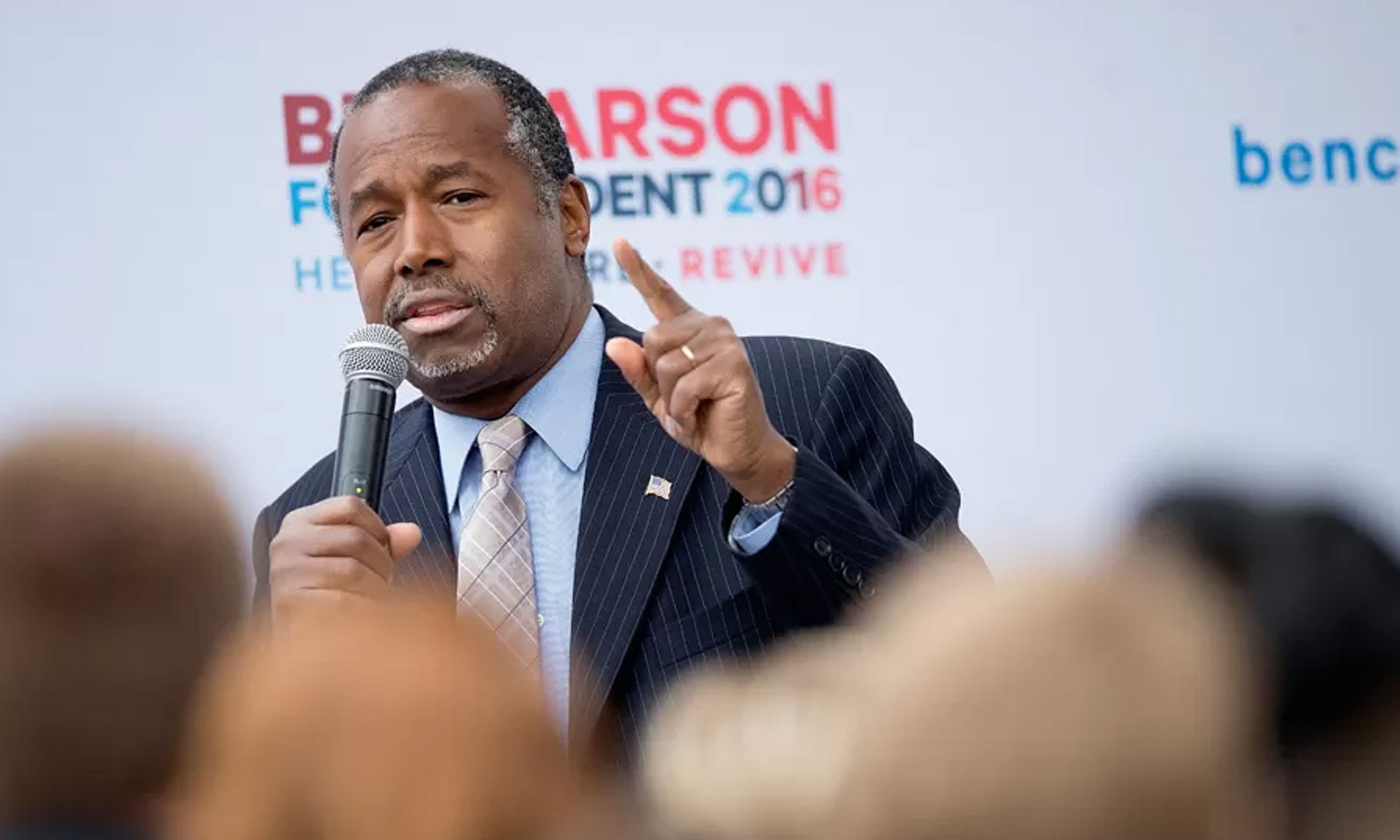
There are whispers in Iowa that volunteer supporters of Ted Cruz have been spreading malicious rumors about Dr. Ben Carson, claiming he is a supporter of mandatory vaccinations and conducted research using the tissue of aborted babies. Though they could hurt Carson with the Evangelical voters who have flocked to him in Iowa and across the country, none of these attacks have gotten much oxygen on the national stage — certainly not from Cruz himself.
Cruz has the ability and desire to appeal to the Christian conservatives who tend to dominate the Iowa caucuses, but Carson has emerged as the primary obstacle in his way. The retired pediatric neurosurgeon has risen to the top of the polls there over the past few weeks, and he is far and away the most popular Republican candidate in the race. But he has stumbled in recent days, as reporters unearthed inconsistencies in his memoir, and as he puzzled many with statements about the Biblical origins of the Egyptian pyramids. If these struggles take a toll on Carson’s poll numbers, it will benefit Cruz most of all.
Carson has presented a dilemma for Cruz. Attacking any candidate, but particularly a candidate as well liked as Carson, can backfire, as Jeb Bush has demonstrated colorfully. That explains why Cruz’s approach to Carson’s rise has been to hold him close and flatter him . . . and to count on his campaign’s imploding down the line. It’s beginning to look like a savvy strategy.
RELATED: When Cruz Makes His Move, Watch Out
If he has been a brutal critic of his Senate colleagues, Cruz has made a point of not attacking his Republican challengers on the campaign trail. When others were denouncing Donald Trump as a madman and a narcissist, Cruz was more sanguine, praising the real-estate mogul for “speaking out boldly and brashly on illegal immigration.”
It’s not only that in attacking Carson, Cruz would be reversing himself on a boldly stated principle of his campaign. Political strategists also say that it would be dangerous for him to attack Carson because the two share the same base. The Iowa talk-radio host Steve Deace, who has endorsed Cruz, says that attacking Carson is risky because his supporters are potential Cruz supporters. He likens it to “dropping [a] bomb on your neighbor.”
RELATED: Rubio and Cruz atop the GOP
Though he is a Detroit-bred neurosurgeon who spent most of his professional life in Baltimore, temperamentally Carson has a lot in common with Iowa’s Republican voters. He is gentle, soft-spoken, and devoutly Christian. “People who attack Carson do so at their own peril,” says Jamie Johnson, the longtime Republican national committeeman from Iowa who joined Rick Perry’s short-lived campaign earlier this year.
#share#There’s also a view gaining currency among Iowa politicos that Cruz doesn’t need to win the state, but just to perform well there. “You have to be one of the three tickets punched out of Iowa,” says Deace. He argues that a conservative, an outsider, and an establishment candidate will emerge from the caucus intact. “If Cruz finishes second to Carson,” he says, “that’s a win.” Johnson characterizes the caucus as a “three-camp race” among proven public servants, outsiders, and “everybody else the establishment is a little worried about,” which leaves room for Carson to emerge victorious among the outsiders and Cruz to win among those who give the establishment the willies.
Carson’s greatest weakness is in the realm of policy, where he is a self-proclaimed neophyte, and where Cruz can easily run circles around him. But when?
Right now, the media is doing Cruz a big favor as it steps up its scrutiny of Carson’s record. A Politico report Friday revealed that Carson embellished a story — relayed in his best-selling autobiography, Gifted Hands — about receiving a full scholarship to West Point. It came on the heels of a controversy over his account in the same book of attempting to stab a friend as an angry teenager. Carson clarified on Thursday that in fact he had attempted to stab a close relative.
But Carson’s greatest weakness is in the realm of policy, where he is a self-proclaimed neophyte, and where nobody — the media or another Republican challenger – has yet really to challenge him. On that matter, Cruz can easily run circles around him. But when? “I think right now it’s a very vulnerable place,” says Amy Walter, national editor of the Cook Political Report. “Do you wait to make that argument until January? Do you make it in December? Do you make it when 95 percent of Republicans think of him positive [as opposed to] just 85 percent?”
You could see Cruz dipping his toe in the waters after Carson took to CNN to explain why he was troubled by the prospect of a Muslim president. Cruz did not hesitate to weigh in on the matter, telling a local Iowa outlet, without naming Carson, that, “The Constitution specifies there shall be no religious test for public office and I am [a] constitutionalist.”
RELATED: Misunderestimating Carson
Carson’s deficiencies on matters of policy were on full display when he made the rounds on the Sunday shows trying to explain his proposal to reform Medicare. At one point, he proposed replacing the program with health-savings accounts, subsidized by the government, “starting from the time you are born until the time you die.” Then he reneged on the government subsidies, on doing away with Medicare, and on forcing anybody to adopt a savings account.
“I do not believe in imposing things upon people. I believe in presenting things that are so attractive that people will very quickly migrate to them,” Carson told Fox News’s Chris Wallace. Puzzled, Wallace asked, “So how does the health-savings account work if there’s no government subsidy? How do you get the money for your health-savings account. . . . I’m a little confused. If I’m just a regular person, I’m not indigent, and you’re gonna give me a health-savings account but you’re not going to give me any money, why wouldn’t I want Medicare?”
#related#Carson, who has never held political office, is beginning to wilt after weeks under the spotlight inevitably shined on the front-runner. If such problems with the truth leave Carson vulnerable to broader criticism on matters of policy, it will be good news for Cruz.
— Eliana Johnson is Washington editor of National Review.
EDITOR’S NOTE: This article has been updated since its original publication.





Comments