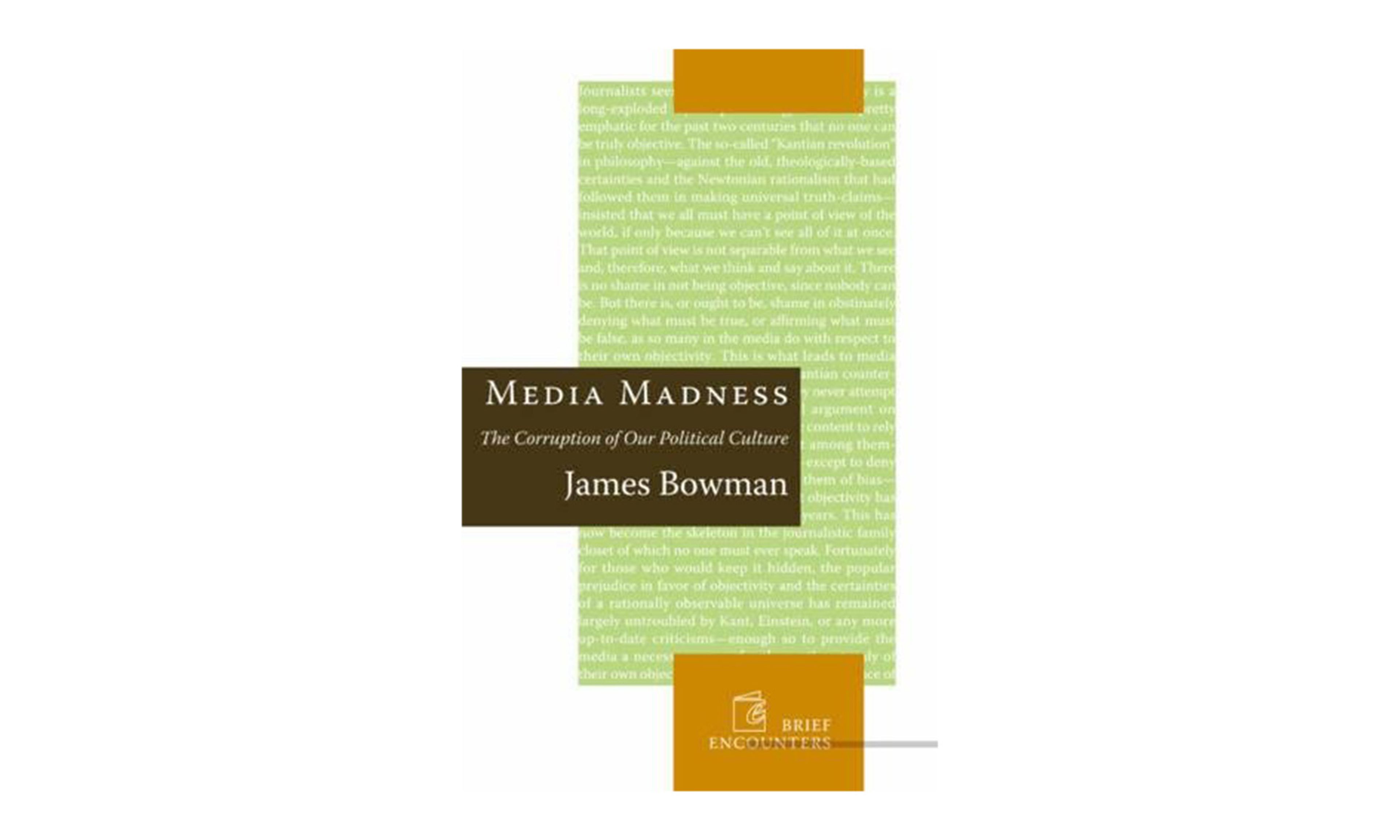
Even if he did not write media criticism, James Bowman would be a media critic by example: His original thinking and lucid prose are an implicit rebuke to the cliché-ridden, English-torturing, deep-as-a-bumpersticker discourse that issues from so much of the American media. In Media Madness, Bowman goes Sigmund Freud on press pundits and television blatherers, diagnosing in them a psychosis whose symptoms include paranoia, delusions of objectivity, and gradual withdrawal from reality.
Bowman is complaining not about the media’s lack of objectivity, but about their pretense to it. The myth of objectivity, Bowman argues, allows the media to relieve themselves of the more homely burden of being honest about their own prejudices and scrupulously fair to those who do not share them. He writes: “If you are truly objective, what need do you have to be fair? You speak, as it were, from no point of view — or all points of view at once, which comes to the same thing. In other words, you speak with the voice of God. To believe this is the very essence of media madness, and it is to eliminate the need for fairness.”
Bowman’s scoffing at objectivity takes him into rocky philosophical territory, which he navigates ably; it is a little jarring, pleasantly so, to find a conservative citing Jean Baudrillard, darling of the postmodernists, without total disdain. His skillful summary of the Kantian revolution — “we all must have a point of view of the world, if only because we can’t see all of it at once” — is worth committing to memory. He concludes that objectivity’s partisans are “Kantian counterrevolutionaries,” which, as Dave Barry would surely note, would make a great name for a band.
Bowman’s insights, however, are not distilled so much from the pristine snows of Olympus as from his connections with the sometimes grimy and never objective world of British journalism. A former correspondent for the Spectator of London and U.S. editor of the Times Literary Supplement, as well as a Cambridge graduate and former English schoolmaster, Bowman appreciates that there is an alternative model of journalism, one in which both individual journalists and the institutions they serve are open about their political allegiances. This openness has the pleasingly perverse effect of liberating British and European journalism from much of the dowdiness (and Dowd-iness) that afflicts the American press. A conservative reads Britain’s Guardian with certain caveats, but need not fear that its editorial pages will affect the Voice of God. Or even the Voice of Pinch Sulzberger, which is quite enough.
Political frankness, and the immediacy it enables, is part of what is attracting readers to the new media as they allow their subscriptions to Newsweek, the New York Times, and the Daily Local-Yokel to expire. But here Bowman also sounds a note of warning. Simply transferring Associated Press reportage from thin sheets of wood pulp to a computer screen does not guarantee that the pretenses, prejudices, and sloppy thinking that characterize the wire service will be stripped away. The medium is emphatically not the message, and Bowman’s media madness is perfectly capable of hopping from one format to another, a vinegary old rosé in a new cask. Perhaps this would be a good moment to reflect upon the unhappy trajectory of Andrew Sullivan, whose move from editor of the very old-media New Republic to his current incarnation as bonkers blogger is a case study in media madness, e.g., his barking-mad obsession with Sarah Palin’s gynecological records. Bowman’s book was written and printed before that particular media orgy got under way, but we can look forward to future dispatches from him on the subject.
The media love a scandal, of course, but not only for the obvious reason that prurience sells newspapers and epoxies eyeballs to TV screens. Bowman here makes an important and useful observation: The underlying narrative of the media isn’t just progressivism, but utopianism. Bowman concentrates on political journalism, of course, but he might as easily have taken a look at the business pages, where every time a firm goes bankrupt and shareholders lose money it is assumed that malfeasance is at the root of the losses. In business — as in war, as in politics or any complex undertaking — things go wrong. Bowman argues that the media’s implicit utopianism is what inspires them to treat every shortcoming, mistake, gaffe, or unforeseen development as a scandal. The greatest “scandal” of the Bush years, that no great trove of horrific weapons was uncovered in Iraq after the invasion, provides Bowman with his most salient case study. Laboring under the misconception that the only explanation for imperfection is malfeasance, the Democrats and their media instinctively argued that Bush was not simply wrong about Saddam Hussein’s arsenal, but that he lied. Bowman writes:
Simple folks might cling to a belief in the war as an attempt by an ordinary decent and patriotic president with his country’s best interests at heart to further those interests and avenge the grievous wound of 9/11 by making an example of one of America’s enemies who was also a sponsor of terrorism. Media sophisticates know that it cannot be that by definition.
Bowman finds much media misbehavior rooted in a Darwinian struggle for status. The media-Democratic alliance, he argues, cannot genuinely believe that George W. Bush is as much of a dunce as they pretend he is (when they are not pretending he is an evil genius who outwitted the world’s top intelligence services on Iraq). Demeaning the president’s intelligence is a covert way of elevating themselves by comparison — what better yardstick than the pontifex-potentate we have made of the government’s chief administrative officer? — and intelligence, rather than honor, goodness, courage, or the like, is the cardinal virtue in the mediaplex. In this chapter, Bowman is accidentally prophetic, writing: “Thus Joseph Biden, one of those candidates for the presidency whose chief disqualification for the office he seeks is the lack of political judgment demonstrated in thinking he could be elected to it, is also happy to join the media-mad by calling the Bush administration ‘brain-dead.’ He thus affirms that he is a member of the Bush-haters club by tacitly agreeing to treat a proposition he knows not to be true as if it were true.”
But condescending to the president is only one part of the liturgy; Bowman has great fun with the “Everything you know about X is wrong” genre of headlines and book titles, finding that, without the help of the media, the human race would be in uttermost ignorance about sex, love, grilling the perfect burger, the NBA, and the achievement of sexy, flat abs. Where would we poor know-nothing mooks be without the media to explain everything, and to sneer at us?
But sneering is not an activity limited to Democrats, or to those wide swathes of the media affiliated with them. And here Bowman does not quite deliver. There is some question about how much of the vapidity of American political discourse is a consequence of Democratic biases and how much is a consequence of a media culture that is distorted by things other than leftish politics. It is sometimes difficult to distinguish between the two, but there is one obvious way to begin that project, which is looking at the ways in which “media madness” infects conservative outlets and commentators. This is a Rubicon that Bowman is not quite ready to cross, and his analysis suffers for it. He faults Bush’s media critics for hyperbole, but describes Ann Coulter as “daringly outspoken.” It is difficult to believe that a critic for the uncompromisingly highbrow New Criterion — a journal that takes T. S. Eliot as its intellectual patron saint — believes that Coulter ought to be the type and model of political discourse. It’s been a long time since William F. Buckley Jr.’s Firing Line was setting the standard. If the conservative critique is to break out of the intellectual ghetto, the Konservative Korners of the mediaverse, the excesses are going to have to be dealt with, and dealt with convincingly.
It’s worth bearing in mind how much play conservative TV talkers gave to such trivia as the death of Anna Nicole Smith, because doing so reminds us that much of what Bowman finds objectionable in our media culture is simply our culture, with its democratic relish of spectacle and of seeing the high and mighty brought low and whiny. None of this diminishes Bowman’s insightful criticism. In fact, he goes a long way toward answering the question of why the media and liberalism go together like Donny Osmond and purple socks:
Hypothetical perfection shadows more and more of what the media “cover,” from the Iraq war to health insurance to campaign finance to gun control. More and more frequently media madness leads to the assumption that all these immensely complicated and difficult matters are moral rather than political. The choices they demand of us thus become simple and binary ones: either we are for or against the war, for or against universal health care, for or against limiting the amount of money in politics, for or against getting guns off the street. Putting the questions in this form is a way of pre-determining the answer that people give to them, but it doesn’t bring us any closer to real-world solutions to any of the underlying problems.
In short: You’re either with Al Gore or against life on earth.
For all his scholarship, Bowman properly identifies the germ of media madness, and its cure, in the low things rather than in the high things. He handles his poststructuralists and po-mo theorists with aplomb, but finds at the end that the problem isn’t one of philosophy but of common things: being careful with one’s words and one’s thoughts, and cultivating fairness, intellectual scruples, and a sense of proportion. That has long been the prescription the media need.






Comments